Less than half of South Africa’s working-age citizens have jobs


South Africa has the worst employment rate among all countries in the Organisation for Economic Co-operation and Development (OECD). It is among the worst places in the world to find a job.
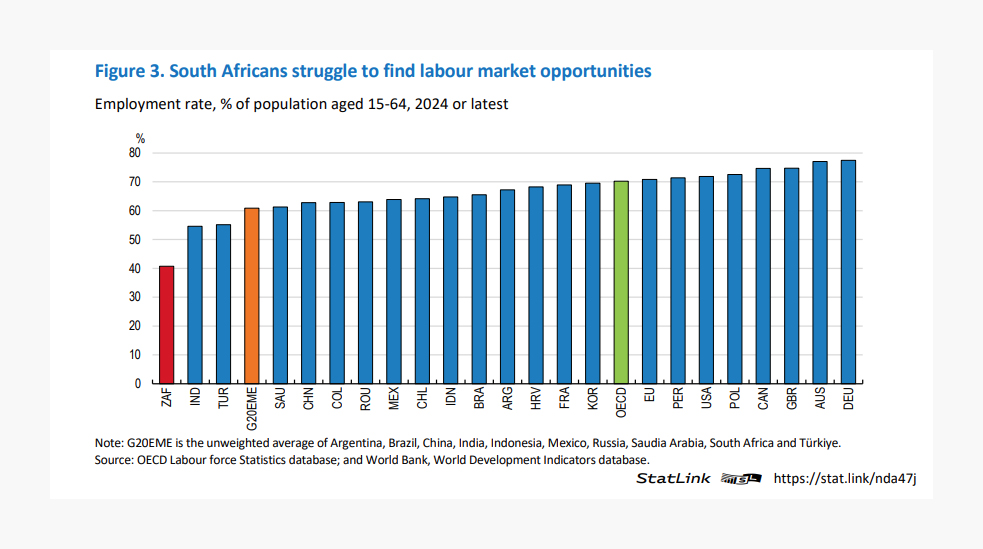
The country’s employment rate for its working-age population is just above 40%, compared to the OECD average of 70% and the emerging market average of 60%.
Of all the countries analysed by the OECD, South Africa has the lowest employment rate and is the only country with less than half of its working-age population employed.
The organisation revealed this in its latest survey of South Africa’s economy, released at the beginning of June.
The OECD bemoaned South Africa’s lacklustre economic growth, deteriorating financial health, and lack of urgency in implementing reforms.
It explained some of the economic challenges the country faces and outlined various paths for the government to revive its local economy.
One of the significant challenges the country faces is its inability to boost job creation and improve access to employment opportunities.
Many South Africans struggle to find work, with the country having the lowest employment rate and the highest unemployment rate among G20 economies.
Worryingly, many people excluded from formal jobs remain unemployed rather than working informally, as the country has a lower share of informal workers than peer countries, the OECD said.
It explained that this is largely due to the country’s poor economic performance over the past fifteen years.
The rise in corruption, political uncertainty, and the collapse of state-owned enterprises (SOEs) are the primary drivers of this stagnation, according to the OECD.
Without a dynamic and growing economy, the organisation said it is difficult to determine the impact of labour laws and regulations on employment.
The graph below, courtesy of the OECD, shows South Africa’s significantly lower employment rate compared to the OECD average and other G20 member states.
Solutions to the unemployment crisis
The OECD outlined some potential solutions to South Africa’s job creation problem, but said there is no silver bullet.
It explained that it will take immense investment and time to turn the situation around, requiring a multi-pronged approach.
To unlock job creation in the short term, it is key to prioritise reforms that ease barriers to business dynamism and improve workers’ abilities to reach employment opportunities, the OECD said.
As the previous Economic Survey recommended, South Africa should support upskilling by aligning vocational training systems with labour market needs.
The country should also expand public employment services, enforce minimum wage compliance, and strengthen active labour market policies, such as career guidance, training, and mobility support.
The transition from the coal sector is exacerbating labour market challenges in some regions, requiring enhanced labour market support, the OECD said.
Alongside these initiatives, the country needs to remove restrictive regulations on businesses that inhibit their ability to employ individuals and grow.
These regulations, the OECD said, prevent companies from competing effectively and expanding.
The burdensome licensing and permit regime, as well as complex public procurement policies, are priority areas for reform.
While steps have been taken to reduce red tape and streamline procurement, efforts must intensify to improve employment opportunities.
In particular, while there is a need to formalise the informal market, the government should ease zoning restrictions and registration burdens so that the sector can create jobs more effectively.
Reducing these burdens will also help the informal businesses formalise, as it will remove significant regulatory barriers. This, in turn, will improve tax collection from the sector.
Promoting densification and reducing transportation times and costs is vital to connecting South Africans with jobs and boosting disposable income.
Urban sprawl around many of South Africa’s cities isolates many from formal employment opportunities by creating a significant barrier to entry.
Lengthy and costly commutes burden workers, with low earners spending about 40% of their income on transport.
Aligning transport policies, urban planning, and housing policies is essential. This includes prioritising housing near public transport and development corridors, promoting rental housing near city centres and reforming restrictive building regulations.






Comments