1 million South Africans have left one province because of its economic collapse



890,715 people have moved out of the Eastern Cape to other South African provinces over the past 15 years.
The province’s economic decline is driving many of its residents away, particularly to areas such as Gauteng and the Western Cape, where employment is more readily available.
This means the Eastern Cape is also losing many of its skilled residents, experiencing a provincial ‘brain drain’ that could push the province further into decline.
The Eastern Cape’s migration problem is evident in Statistics South Africa’s Mid-Year Population Estimates over the past decade.
In 2016, the province’s population was estimated at 7.06 million people. By 2026, this had declined to 7.03 million.
The latest figures show that while the Eastern Cape is still South Africa’s fourth most populous province, its share of the total population has declined.
In 2016, 12.4% of the national population lived in the Eastern Cape. In 2026, this share had shrunk to 11.1%.
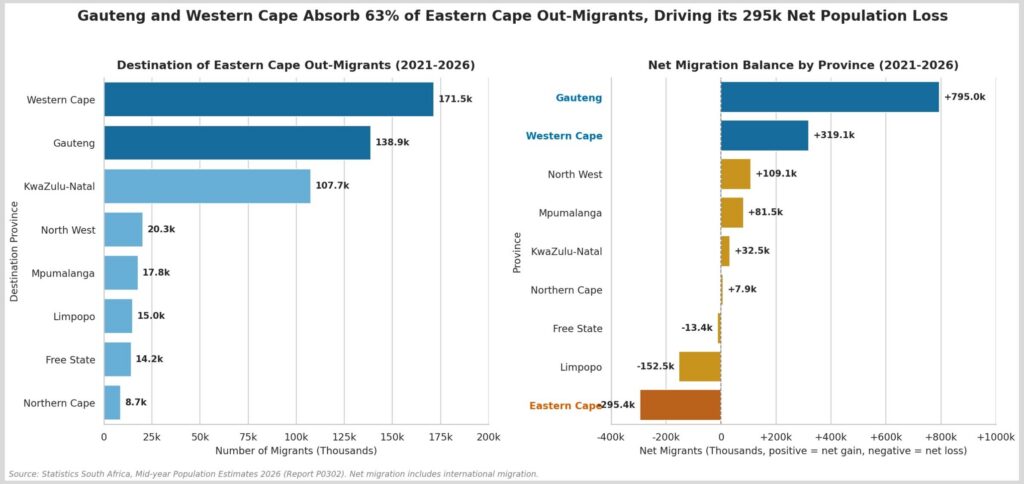
Over that 10-year period, the Eastern Cape experienced a net migration loss of 587,658 residents. Over 15 years, it lost 890,715 residents.
Looking at population estimates for other provinces, it is clear that Eastern Cape residents are most likely leaving for employment opportunities elsewhere.
The vast majority of Eastern Cape residents who migrate move to the Western Cape and Gauteng, with some also going to KwaZulu-Natal.
Between 2021 and 2026, 494,103 people migrated out of the Eastern Cape to other provinces.
The Western Cape received 171,525 migrants over that five-year period. Gauteng absorbed 138,869 migrants, and KwaZulu-Natal attracted 107,704.
Combined, the Western Cape, Gauteng, and KwaZulu-Natal received nearly 85% of all inter-provincial migrants, leaving the Eastern Cape.
This inter-provincial migration is driven largely by residents’ search for employment and economic opportunities.
The Eastern Cape is primarily a rural region and boasts the lowest proportion of young working-age adults, those aged between 25 and 34, in the country.
In contrast, very urbanised areas like Gauteng and the Western Cape act as ‘economic magnets’, attracting the majority of South Africa’s job-seeking youth.
The Eastern Cape’s decline
DA MP Andrew Whitfield, who is the party’s leader of the official opposition in the Eastern Cape Legislature, said the Eastern Cape is effectively exporting the people it needs to halt its decline.
“The scale of this outward migration reflects the depth of the Eastern Cape’s economic decline,” he said.
“People are leaving because the province is failing to provide the jobs, opportunities, and to get towns and cities working for all.”
The Eastern Cape has battled with high unemployment rates for well over a decade, with Stats SA’s Quarterly Labour Force Survey for the first quarter of 2026 showing no signs of improvement.
In the first quarter, the Eastern Cape had 1.33 million employed residents, a decline of 39,000 from the first three months of 2025.
This means the Eastern Cape unemployment rate is now standing at 44.6%, far higher than the national rate of 32.7%.
When looking at the broad definition of unemployment, which includes the potential labour force, the Eastern Cape’s rate is 54.4%.
In other words, more than half of the people in the Eastern Cape who are able to work are unemployed.
Whitfield said the result of this high unemployment rate, especially compared to provinces like the Western Cape, where unemployment is 19.6%, is a self-perpetuating cycle.
“Weak economic growth and unemployment push skilled and ambitious residents out of the province,” he said.
“Their departure reduces the pool of professionals, artisans, entrepreneurs, graduates, and experienced workers available to grow the economy.”
He said the loss of these people further contributes to the Eastern Cape’s economic stagnation, driving even more people to leave and thereby creating a vicious cycle.






Comments