South Africa’s growth challenge is also a youth opportunity challenge



By Harambee Youth Employment Accelerator and EY South Africa
Alex Beyers; Dr Michele Capazario; Leshern Devnarain; Sharmi Surianarain
South Africa faces a troubling jobs paradox. Economic growth remains fundamental to creating jobs at the scale South Africa needs.
Yet while the economy is larger today than it was fifteen years ago, and more people are employed overall, fewer young South Africans are working than in 2008.
Youth employment is not simply a social issue, but rather a leading indicator of the country’s economic health.
When young people struggle to access work, productivity declines, skills remain underdeveloped, consumer demand weakens, and long-term growth potential is constrained.
Faster GDP growth is essential. It expands the economic space for businesses to invest and hire, strengthens the fiscal position, and makes South Africa’s broader development goals more achievable.
Historically, economic growth and employment growth moved broadly in step.
As businesses expanded, more jobs were created, and more people entered the labour market. But that relationship is becoming increasingly uneven.
South Africa therefore faces two interconnected challenges: accelerating growth and ensuring that growth translates into employment, particularly for young people.
Independent analyses by EY and Harambee point to a concerning trend: economic growth is translating less effectively into opportunities for young people.
In 2008, approximately 6.4 million young people aged 18 to 34 were employed. Today, that figure stands at 5.6 million (800,000 fewer than in 2008).
Over the same period, South Africa’s economy grew by roughly 20% in real terms and total employment increased by about 2.3 million, or 16%.
Yet young people’s share of overall employment fell from approximately 44% to just 33%.
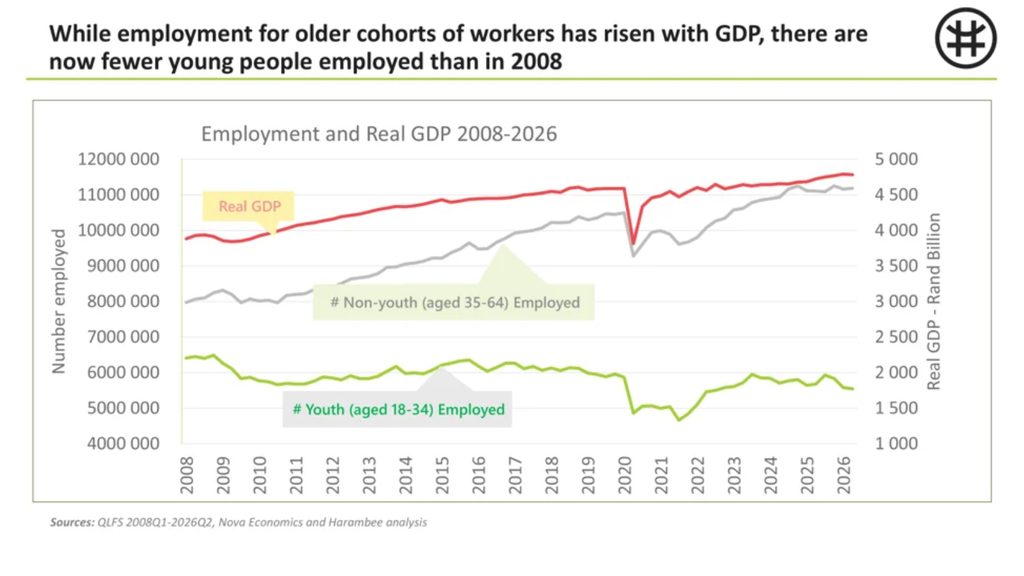
At the heart of South Africa’s youth employment crisis lies a simple reality: economic growth remains essential for job creation. But on its own, it is insufficient to tackle youth unemployment.
The relationship between growth and youth employment weakened further after COVID-19.
Before the pandemic, a 1% increase in GDP was associated with almost 0.9% growth in youth employment.
Today, the same growth is associated with only 0.2% growth in youth employment.
In other words, economic growth is increasingly benefiting those who already have a foothold in the labour market, while many young people struggle to gain and keep a first opportunity.
The longer young people remain outside the labour market, the harder it becomes to enter it.
Every year outside the labour market reduces future earning potential and makes long-term inclusion more difficult.
Further, education and training pathways often remain disconnected from labour market demand, leaving young people with credentials but no clear route into work, while employers struggle to find the skills they need.
Spatial barriers also constrain access, with many young work-seekers living far from centres of economic opportunity.
The result is a growing disconnect between learning, earning and employment. The problem is not a lack of ambition among young people, but the absence of clear and accessible pathways.
The good news is that South Africa is not starting from scratch. Across business, government and civil society, initiatives already exist that have demonstrated measurable impact. Three priorities stand out.
- First, widen access to first opportunities by hiring for potential, not only experience. Skills-first and potential-based hiring practices can significantly expand access to opportunity while helping businesses access a broader talent pool.
- Second, connect skills development much more directly to demand. Evidence shows that employment outcomes improve when training is linked directly to real vacancies, workplace exposure and sectors experiencing growth. The objective should not simply be to train more young people, but to connect learning to earning.
- Third, create and grow opportunities for youth. This includes strengthening labour-absorbing sectors, supporting growing small businesses, fostering entrepreneurship and improving the effectiveness of Public Employment Programmes as stepping-stones into sustainable employment.
Beyond these interventions, youth employment must become a more explicit objective of South Africa’s growth strategy.
Economic growth and youth employment cannot be treated as separate policy agendas.
Industrial policy, investment promotion, skills development and labour market programmes should be aligned around a common goal: ensuring that growth creates opportunities for first-time work seekers as well as experienced workers.
Large-scale platforms such as SA Youth, managed and operated by Harambee, show what becomes possible when technology, partnerships and opportunity are connected at scale.
Supporting nearly five million young people, enabling 2.4 million opportunities across formal, informal and public employment, and recording more than R56 billion in income earned, the platform demonstrates the potential of systematically reducing barriers to opportunity.
The next challenge is not to invent an entirely new set of solutions, but to connect, strengthen and scale what is already working.
That requires better coordination between business, government and civil society, and clearer pathways between learning, work experience, employment and self-employment.
Encouragingly, momentum is growing around a coordinated national effort aimed at reducing youth unemployment by 20% by 2030.
Many of the interventions, partnerships and platforms required to unlock youth employment already exist.
The task now is to connect them, strengthen what works and sustain collective action over the long term.
If growth and opportunity advance together, South Africa’s youth can become one of its greatest economic assets rather than its greatest untapped resource.