South Africa’s rand should be R16 against the United States dollar


Investec has pegged the fair value of the rand between R16 and R16.50 against the United States dollar.
South Africa’s currency is trading near the top end of this range, at R16.43 against the dollar on Monday, 19 October.
Investec’s fair value for the rand was revealed in the firm’s Global Investment View report for the fourth quarter of 2026.
The bank explained that one of the factors supporting South Africa’s rand is commodity prices.
It pointed out that the six-month average of South Africa’s commodity export basket is up 19% year-on-year in US dollars.
“Strong commodity prices provide support for the rand and also further boost tax revenue,” Investec said.
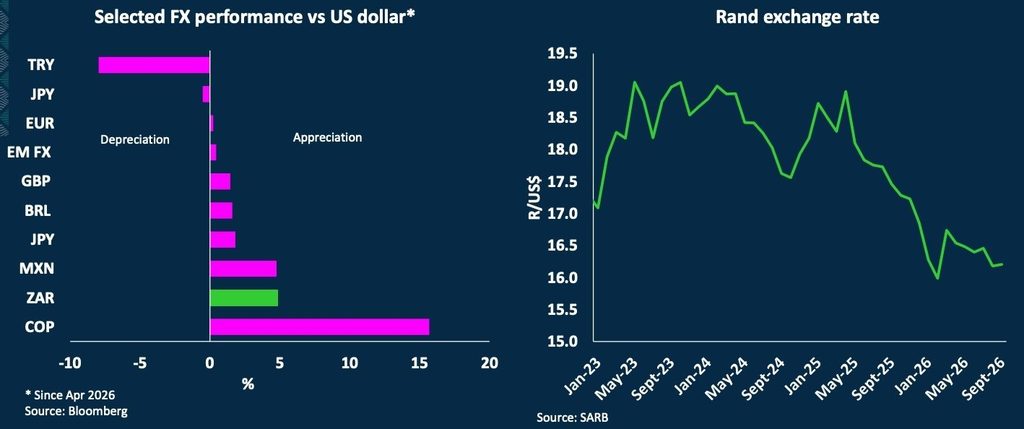
The Reserve Bank’s Quarterly Bulletin released in September 2026 explained that the rand strengthened in the second quarter of 2026.
The local currency’s nominal effective exchange rate increased by 3.9% in the second quarter, and the rand appreciated 4.2% against the United States dollar.
The central bank explained that the currency was buoyed by improved global risk sentiment following a ceasefire agreement between the United States and Iran.
The rand also benefited from an improved domestic outlook and the Reserve Bank’s decision to raise South Africa’s interest rates by 25 basis points in May.
However, many of these factors bolstering the rand have since changed. Most notably, the conflict in Iran has continued despite peace negotiations earlier this year.
The Reserve Bank said this led to a deterioration in risk sentiment towards emerging markets in the third quarter of the year.
This, along with renewed oil price hikes and a stronger US dollar, led to the rand weakening in the third quarter.
Despite this weakening, the rand’s resilience is evident in its remaining within Investec’s fair value range.
A strong rand protects South Africa
In its October 2026 Monetary Policy Review, the Reserve Bank explained why it is important to protect the rand’s value, particularly amid soaring fuel prices.
It said a relatively strong rand has helped to cushion the effects of higher crude oil prices on domestic fuel prices and other imported goods.
“A sharp strengthening of the United States dollar or rising policy rates in advanced economies could induce capital outflows from emerging markets, including South Africa,” it explained.
“That would weaken the rand and cause firms to raise prices – feeding into inflation.”
The central bank pointed out that South Africa is already struggling with inflationary pressures, stemming from the conflict in Iran.
It said core inflation rose from 3.2% in March this year to 4.1% in August, which can be attributed to the services component.
This component rose by a full percentage point to reach 5.2% in June. It stayed high at 5.1% in August.
“Core inflation would have been higher if not for subdued core goods inflation, which benefited from rand strength, moderate global goods inflation, and greater domestic competition,” the bank said.
A stronger rand was not an advantage South Africa had during previous periods of high inflationary pressure.
For example, the Reserve Bank pointed to the 2022 inflation shock, which most closely resembles the one seen in 2026.
“Both were triggered by sudden geopolitical conflicts that disrupted key global energy supply routes and pushed Brent crude above the $100 per barrel threshold,” it said.
“However, the 2022 shock was not a pure oil shock but a combination of an oil and food price shock.”
In 2022, the rand weakened from R15 to over R17 to the US dollar, which added inflation pressures.
By contrast, the rand has remained relatively stable so far in 2026, and food price increases have been muted.