State-owned telecoms company lost R831.3 million in five years and is technically insolvent


For more than a decade, Broadband Infraco (BBI) has operated without government recapitalisation or commercial bailouts.
However, years of recurring losses have pushed it into technical insolvency, leaving it dependent on a potential R14.4 billion cash injection from the National Treasury.
Initially, Broadband Infraco was established to introduce greater competition in South Africa’s telecommunications infrastructure market.
At the time, Telkom controlled 73% of South Africa’s national long-distance (NLD) market, raising concerns about the potential emergence of a monopoly.
In the absence of alternative NLD infrastructure, private operators and Internet Service Providers had to pay higher wholesale tariffs.
These costs were passed on to businesses and consumers in the form of higher end-user prices.
To counter the risk of a monopoly in South Africa’s telecommunications market and reduce end-user costs, Broadband Infraco was established.
Unlike other state-owned enterprises (SOEs), Broadband Infraco has relied solely on funds generated from its own operations since the 2011 financial year.
This dependence on internally generated cash has become increasingly difficult to sustain, as BBI’s financial position has deteriorated over time.
This deterioration can be traced back to FY13, when Neotel’s Right-of-Use (RoU) agreement expired.
At the time, Neotel was BBI’s primary client. As a result, the end of the RoU saw its revenue plummet by 40% to reach R237.4 million in FY13.
This marked the beginning of a prolonged period of financial deterioration as BBI entered a recurring cycle of losses, which culminated in a solvency crisis.
Although revenue grew cumulatively by 97.2% from FY11 to FY25, this growth failed to translate into improved financial health.
Over the same period, Broadband Infraco’s losses accumulated to R2.13 billion, representing a cumulative increase of 923.8%.
Moreover, deteriorating working capital posed further headwinds, shifting from a R498.9 million surplus in FY11 to a R442.6 million deficit by FY25.
This highlighted the strain on Broadband Infraco’s liquidity position and its ability to meet short-term financial obligations.
Signs of this are evident throughout the 2017 to 2020 financial period, during which BBI became technically insolvent.
FY18 compounded this crisis as short-term liquidity dried up, resulting in delayed supplier payments and strained relationships with key operational partners.
BBI acknowledged the severity of these losses in its 2022 and 2024 financial reports, describing it as a “major threat to the liquidity of the company”.
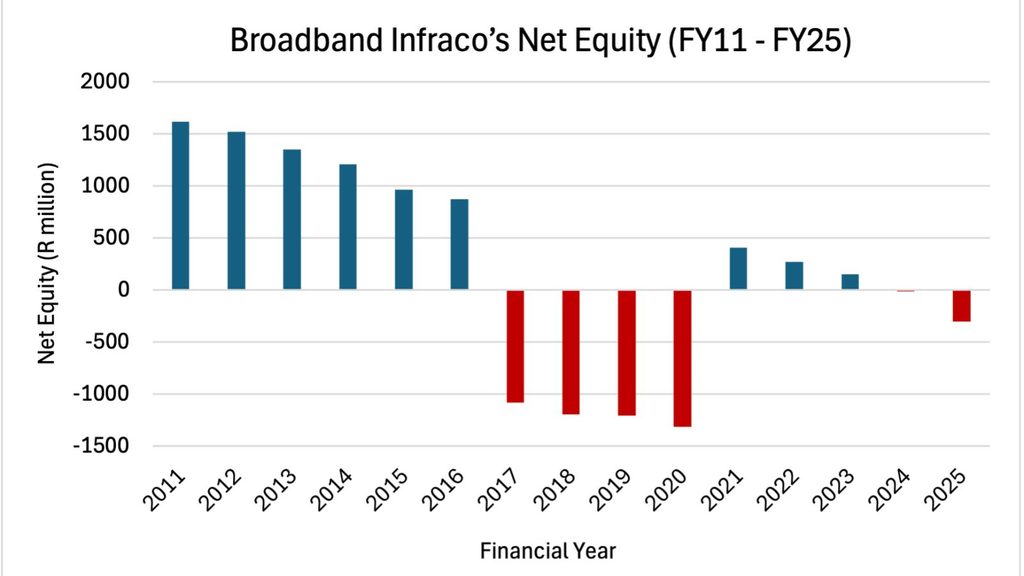
By FY24, years of accumulated losses had eroded BBI’s equity buffer, pushing net equity to -R11.8 million.
As shown in the graph below, the theme of technical insolvency persisted into FY25, with net equity deteriorating further to negative R301.3 million.
This marked a significant downturn in Broadband Infraco’s financial performance and underscored the mounting financial pressures facing the SOE.
The five-year slide into technical insolvency
Over the 2011 to 2025 financial period, Broadband Infraco’s financial resilience has deteriorated, culminating in technical insolvency.
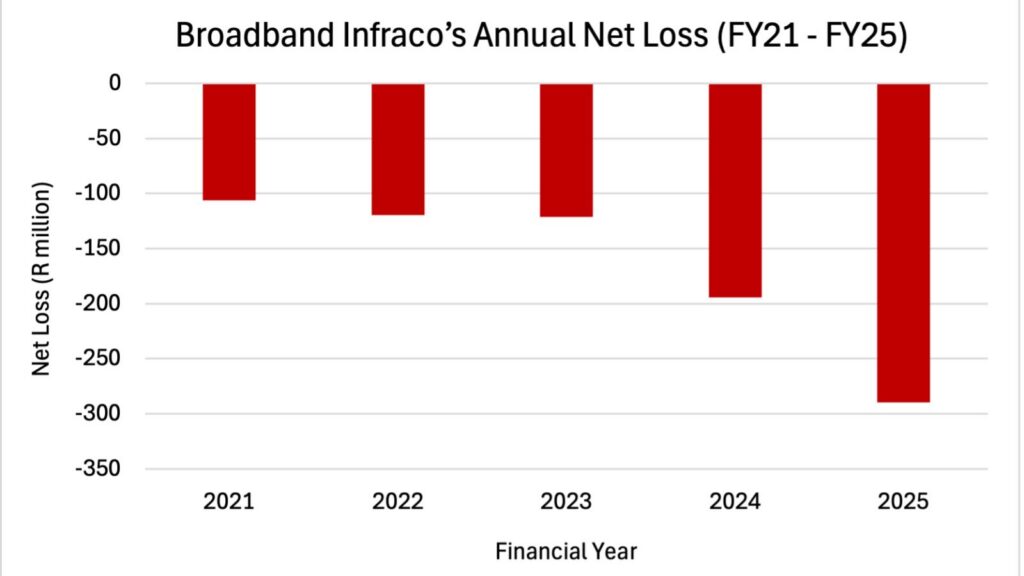
As illustrated in the graph below, FY21 to FY25 highlighted the severity of BBI’s financial deterioration, with losses increasingly concentrated in the latter years.
From FY21 to FY25, BBI’s annual net loss rose from R106.3 million to R289.5 million, equivalent to a 172.3% increase.
To put this into perspective, over the 2021 to 2025 financial period, Broadband Infraco incurred a loss of R831.3 million.
However, the pace of deterioration significantly accelerated in the final two financial years.
In FY24 and FY25, the combined net loss amounted to R484 million, accounting for 58.2% of the total loss incurred from FY21 to FY25.
Notably, the FY25 net loss represented the largest annual loss recorded in Broadband Infraco’s history.
However, this deterioration did not occur in isolation, as Broadband Infraco’s financial difficulties were compounded by longstanding operational headwinds.
By FY25, these pressures, encompassing vandalism and Eskom’s disconnection of BBI’s dark fibre links, further strained its weakened cash position.
Despite record revenue of R586.8 million, this came at a steep cost, as the cost of sales climbed by 33%, primarily driven by large-scale projects such as SA Connect.
This indicated that while BBI generated revenue, the costs associated with delivering its services increasingly offset these gains.
As the cost of sales outpaced revenue growth, BBI’s gross profit margin plummeted to a historic low of 24% in FY25.
Compounding this, operating expenses surged by 23% year-on-year, driven by higher employee and project-related costs.
These mounting cost pressures subsequently flowed through to Earnings before interest, taxes, depreciation, and amortisation (EBITDA).
Evidence of this is seen in FY25 when EBITDA fell into negative territory for the first time in over a decade, reaching negative R117 million.
This contributed to the erosion of its equity cushion and pushed net equity into negative territory to R301.3 million, leaving BBI technically insolvent.
Yet, the R14.4 billion broadband infrastructure proposal presented before the National Treasury in FY25 offered a potential pathway to financial recovery.
If approved, the project will not only provide an R14.4 billion capital injection but also generate additional revenue over the next decade.
In its 2025 audited annual report, the Auditor-General highlighted the significance of the R14.4 billion proposal.
Crucially, it noted that Broadband Infraco’s ability to remain operational in the future would be “dependent on the successful approval and funding of this proposal”.




Comments