South Africans will pay 10 times for electricity in 2027 than they did in 2008


Eskom’s rising energy prices have far outpaced inflation in recent years, with estimates that South Africans could be paying ten times as much for electricity in 2027 as they did in 2008.
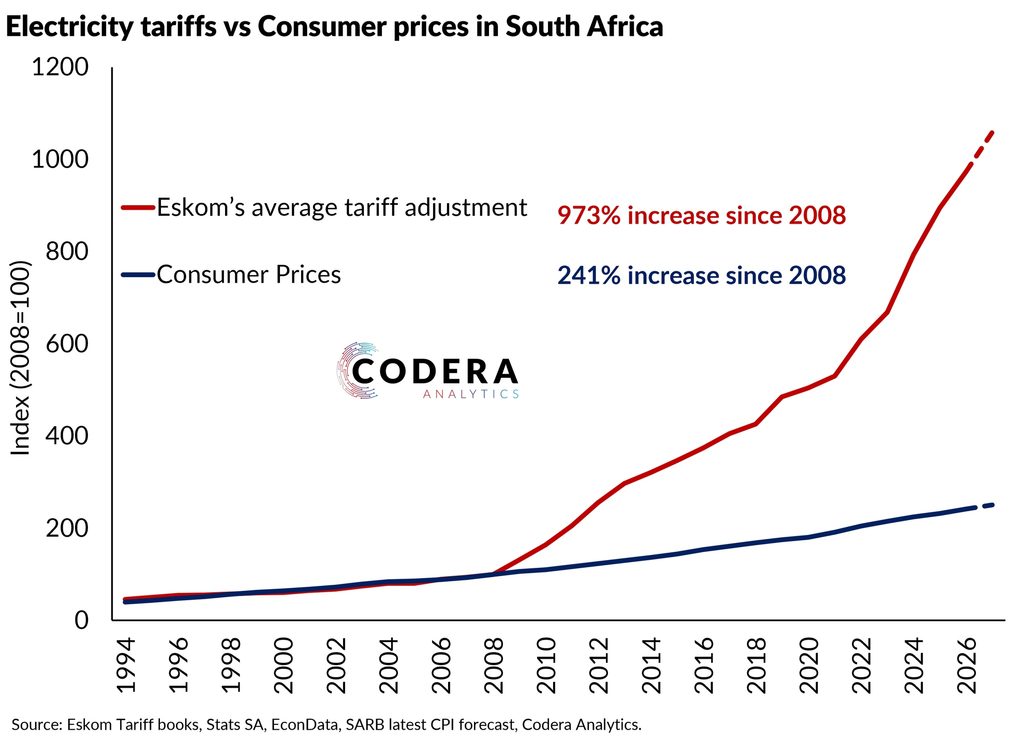
A recent blog post from Codera Analytics revealed that since 2008, Eskom’s aggregate standard tariffs have increased by 14.5% annually.
By comparison, average consumer price inflation (CPI) has risen at 5% per year over the same period.
This means that since 2008, Eskom’s tariffs have increased by 973%, while CPI has increased by just 241%.
Before this, Eskom’s electricity tariff adjustments had remained more or less in line with inflation from at least as far back as 1994.
While the average price of electricity charged by Eskom in 2008/09 was 24.7 c/kWh, this had reached 241.64 c/kWh by March 2026.
At its current pace, average electricity prices are expected to have increased more than ten times their 2008 levels by the end of the 2026/27 financial year, with CPI at 2.5 times its 2008 levels.
Eskom’s tariff adjustments are determined by the National Energy Regulator of South Africa (Nersa), based on a Multi-Year Price Determination (MYPD) submitted by Eskom.
Before 2008, Nersa’s tariff adjustments had remained within the low single-digit range, with the approved price increase for the 2007/08 financial year sitting at 5.9%.
The following year, however, Nersa approved an initial double-digit tariff increase of 14.2%. Eskom then applied for a 60% revision to address rising production costs and capital expansion.
As a result, Nersa approved an additional 13.3% tariff increase in June 2008, bringing the total approved adjustment for FY2009 to 27.5%.
The next few years would see additional double-digit tariff increases, with a 31.3% increase approved for FY2010 and mid-20s increases approved for FY2011 to FY2013.
Since then, Nersa’s approved tariff adjustments have fluctuated between single- and double-digit increases, with the latest increase of 8.76% taking effect on 1 April 2026.
Eskom explains price increases
Across its annual reports, Eskom has attributed the steep rise in electricity prices to several structural, operational, and regulatory factors.
These have ranged from rising input costs due to higher coal and diesel prices to escalating municipal debt and electricity theft to declining sales volumes.
The power utility has consistently pushed for a more cost-reflective tariff approach, arguing that historical tariff approvals from Nersa have lagged behind its actual cost of supply.
To this end, the power utility has frequently launched review applications in the South African court system to challenge Nersa’s tariff decisions.
“The price of electricity must migrate towards cost-reflectivity to ensure Eskom’s long-term financial sustainability,” Eskom said in 2020.
“Without a cost-reflective tariff path, we will remain reliant on government support, which implies that the taxpayer will have to foot the bill for the revenue shortfall.”
Eskom’s state-guaranteed debt totalled R328 billion at the end of its latest financial year, with much of this government funding going towards its Capital Expansion Programme.
The multi-hundred-billion-rand programme included the construction of the Medupi, Kusile, and Ingula power stations, as well as major transmission grid expansions.
The project kicked off in 2005 to meet growing energy demand in South Africa. That same year, Eskom said electricity revenue alone would not sufficiently fund the build.
“Present electricity prices are unsustainably low,” Eskom said at the time. “The cost of building a new fossil-fuel power station is six to seven times that of an existing power station.”
“The South African economy is continually growing. The reality of the cost of new capacity will therefore have to be reflected in the future pricing of electricity.”
While Eskom said at the time that future price increases would be inevitable, it said they would be implemented in a gradual and predictable manner to keep them as low as possible.
The power utility is currently preparing to submit its seventh Multi-Year Price Determination to Nersa, which will determine its allowable revenue from FY2029 onwards.
It said it will appeal to the energy regulator to restructure the current retail tariff to be both more cost-reflective for Eskom and more affordable for South African consumers and businesses.




Comments