SABC TV license disaster in South Africa


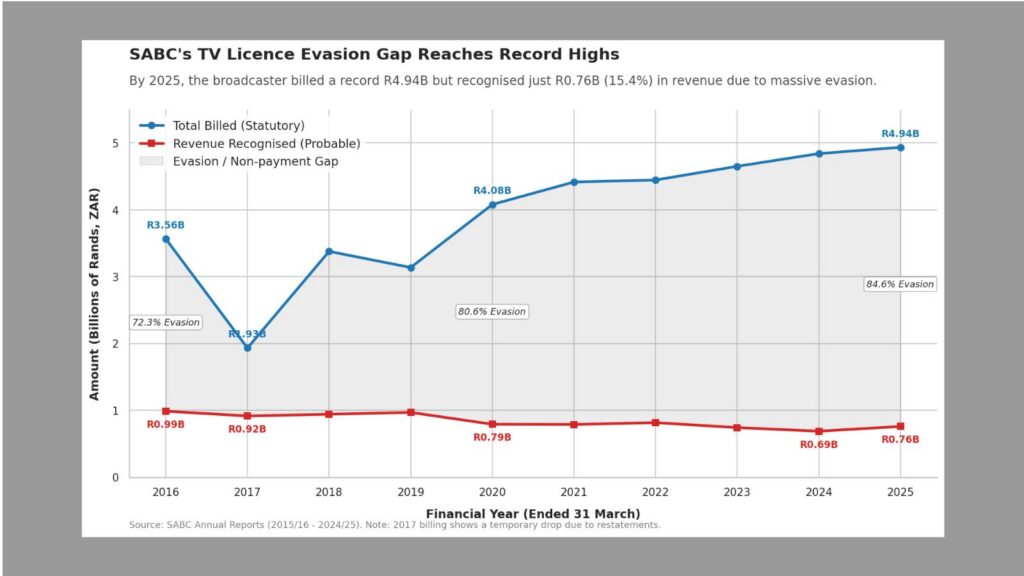
The South African Broadcasting Corporation’s (SABC) TV licence revenue has declined from R986.3 million in 2016 to R758 million in 2025, with its collection rate plunging to 15%.
This has been driven by rising evasion rates, which the SABC puts down to economic pressures and the rise of online streaming services such as Netflix and Amazon Prime.
The state-owned company has been unable to compete with the rise of pay-TV via DStv and the surge in online streaming’s popularity.
Coupled with financial mismanagement over the past decade, the SABC is now a shell of its former self and reported a net loss of R253.3 million in the previous financial year.
Its 1.3% revenue growth was offset by rising operational costs resulting from its public mandate to produce multilingual news and educational content across television and radio.
The SABC is meant to fund this public mandate through TV licence fees, which South Africans who own such a device have to pay.
South Africans are legally required to hold a valid TV licence, which costs R265 per household and R265 per TV for businesses.
However, the SABC has struggled to collect this revenue in South Africa as a rising number of South Africans avoid paying their TV licence fees.
There has also been a rise in the use of computer monitors to stream movies and series from online streaming platforms to evade paying for a TV licence.
The decline in TV licence fee revenue from R986.3 million in 2016 to R758 million in 2025 does not tell the full story of the SABC’s problem.
In 2016, the company billed R3.56 billion in TV licence fees and recognised R986.3 million in revenue. In 2025, R4.93 billion was billed, resulting in R758 million in revenue.
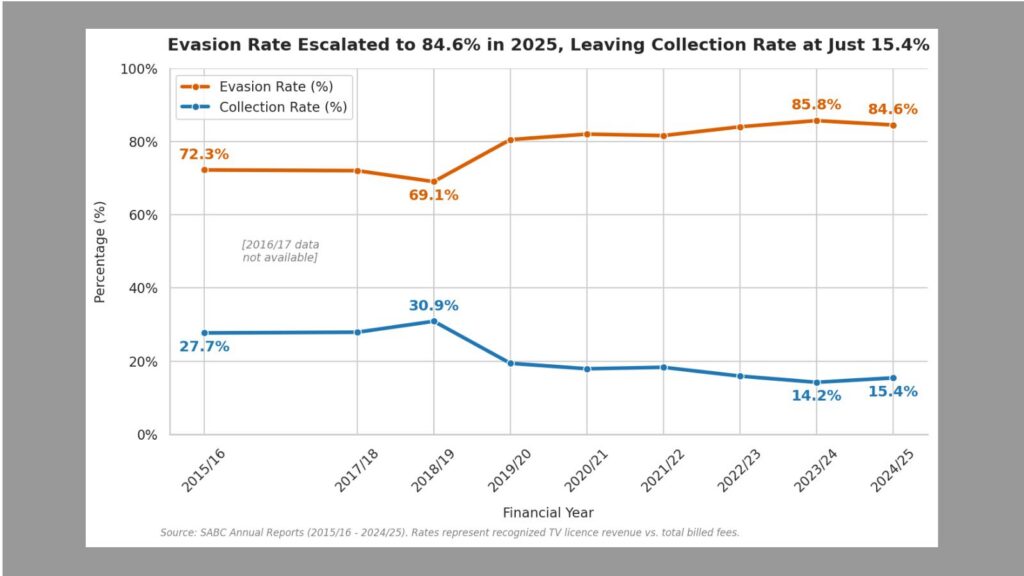
As such, the SABC’s TV licence collection rate plunged from 28% to 15.4% over the past decade as evasion rose.
This can be seen in the two graphs below: the first shows total billed vs revenue recognised, and the second compares the collection rate and evasion rate.
SABC explains the decline
The SABC has blamed the decline on South Africa’s poor economic performance over the past decade, which has hit household disposable income.
Throughout its annual reports from 2016 to 2025, the SABC has highlighted South Africa’s slow economic growth and high inflation as reasons for the fall in TV licence revenue.
Slow growth and high inflation have put consumers under pressure, and in the search for ways to cut costs, many have avoided paying their TV licence fees.
“Because households have less disposable income, paying TV licence fees has become a low priority for many citizens,” the broadcaster said.
“The distressed economy causes licence holders to default on their payments, often without facing any consequences.”
This points to another major issue for the SABC – its inability to enforce payment. This is largely due to the sheer scale of evasion.
The SABC said in its annual reports that legislation allows fines and imprisonment for non-payment, enabling it to enforce credit control.
However, it noted that evasion is so widespread that enforcing these measures would cost it too much and could bankrupt it.
“There is a widespread consensus that the current licence fee regime simply lacks validity and legitimacy in the eyes of the public,” the SABC said in its most recent annual report.
The rise of online streaming services has significantly changed how people consume content and undermined the SABC’s founding assumption that audiences would remain hooked on radio and television.
The broadcaster said that affluent customers have migrated to online streaming platforms and away from traditional broadcast television.
This has created the perception that licence fees do not need to be paid because people believe they are not watching the SABC.
While these external factors highlight the SABC’s outdated funding model, the company has only made its challenges worse through mismanagement.
The SABC admits in its annual reports that years of “compromised leadership, failed governance, and self-inflicted actions have severely damaged its revenue generation”.
It has also left the broadcaster’s reputation in tatters, with many South Africans unwilling to fund an organisation that requires bailouts to stay afloat.
A flicker of hope
The SABC is pegging its hopes on the creation of a new funding model that will be more sustainable in the modern era of television.
It has repeatedly been argued that its existing funding model is obsolete and unsustainable and that it cannot meet its public service mandate.
While TV licence revenue has declined, the government has been unwilling to step in with cash transfers. Over the past decade, state grants made up 3% of the SABC’s revenue.
The SABC has spent considerable time and resources over the past decade developing potential solutions to this problem.
One such solution is a technology-neutral public media levy that applies to households based on device access rather than on ownership of a TV.
This levy would include exemptions for lower-income and indigent households, similar to South Africa’s Free Basic Electricity policy.
To assist with collecting this, the SABC proposed that DStv collect the public media levy on its subscribers’ behalf.
Another proposed solution is for the government to fund the SABC’s public mandate, which costs it R2.1 billion annually.
This currently goes unfunded, with the SABC having to rely on commercial revenue to cover the expense of meeting its public mandate.
Potential government support would come from departments whose mandates align with public programming, such as health, basic education, and sports.
These departments would allocate specific budgets to directly fund public-interest content shown on the SABC.
Other changes include reforms to the must-carry regulations, which require the SABC to provide its three main terrestrial channels to pay-TV providers free of charge.
The SABC has proposed that these regulations should be removed to enable it to negotiate commercial deals for these channels.
Much of this is contained in the SABC Bill that was withdrawn from Parliament in 2024/25, with the broadcaster warning that legislative inertia is life-threatening.



Comments