Important South African state-owned company collapsed and needed bailouts to stay alive


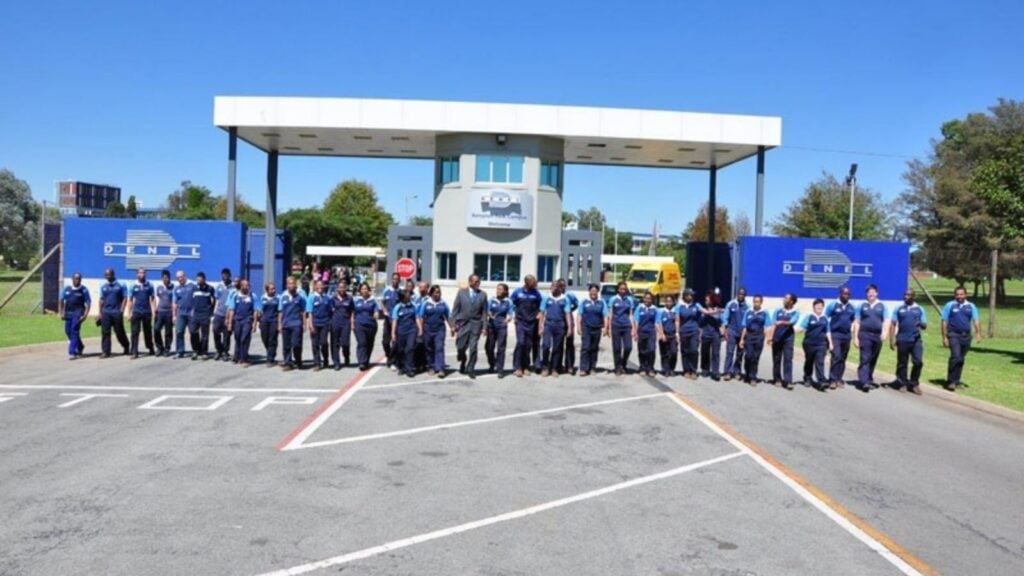
Denel has gone from one of South Africa’s strongest and most profitable state-owned enterprises (SOEs) to one in financial distress over the past decade.
While there have been some improvements at the SOE over the past two years and a return to profitability, Denel’s bottom line remains under pressure.
Denel is the South African National Defence Force’s primary supplier, designing, developing, manufacturing, and supporting defence material.
The SOE made a presentation to the Standing Committee on Appropriations (SCOA) on 5 August 2026, which provided insight into its financial performance in the 2025/26 fiscal year.
Denel’s presentation revealed that its revenue grew by 15% in 2025/26, reaching R1.4 billion.
This is the most revenue Denel has generated since the 2021/22 fiscal year, and was driven by its maintenance contracts at Aeronautics, Landward, and Pretoria Metal Pressings.
Despite this significant revenue increase, Denel’s net profit declined by 19.17%. The SOE was still in the black, with a net profit of R156 million.
However, this marks a slowing of the momentum it started to gain in 2023/24, when its revenue increased for the first time in over a decade.
The year after, 2024/25, Denel returned to profitability for the first time since 2016/17. It reported a net profit of R223 million, which has since been restated as R193 million.
This came after selling off many of its assets, laying off staff, exiting onerous contracts, and receiving a government injection.
Now, this momentum was broken in 2025/26, with Denel’s profit slipping again. In its presentation to SCOA, the company’s CFO attributed its lower profit to various factors.
“The net profit, unfortunately, went down due to various items mainly relating to cost control, guarantee fees and so on,” he said.
This state of affairs is a far cry from the Denel of old, which was once one of South Africa’s most respected, well-run, and profitable state-owned companies.
To understand Denel’s decline, it is important to go back to 2015, when the company was at its peak profitability and achieving phenomenal growth.
Denel’s collapse
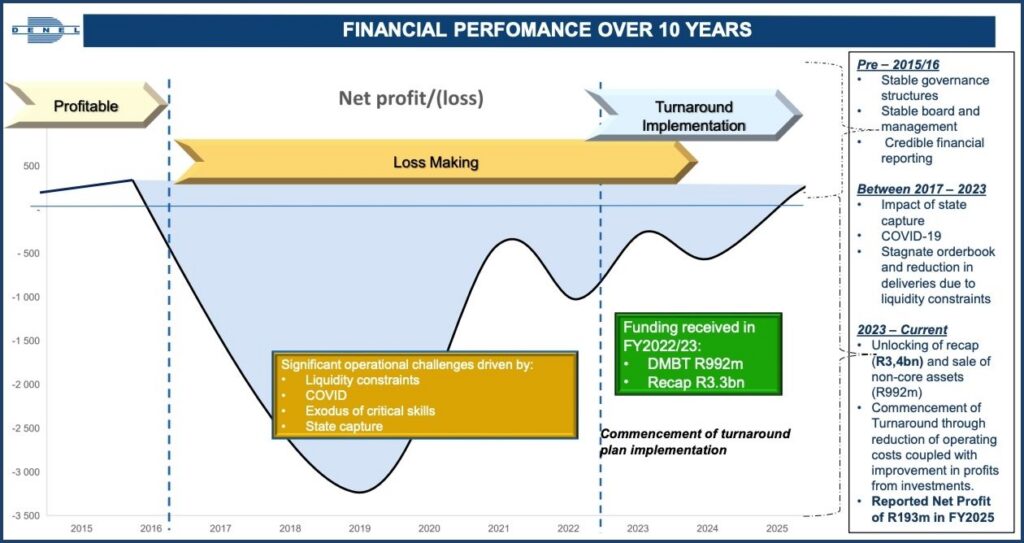
In the 2015/16 fiscal year, Denel was flying high. It was at peak revenue and profitability, and had doubled its revenue over a five-year period to reach a record R8.2 billion.
However, trouble started brewing at the company that same year, as Public Enterprises Minister Lynne Brown appointed a new board of directors at Denel.
This move saw Denel lose its highly competent board that had driven its record order books in that very year.
The impact of this move showed in Denel’s 2016/17 fiscal year, as its revenue and profitability started to slip. Its reported revenue is R8.06 billion, with a net profit of R282 million.
That year, it had also benefited from a solid order book and significant export sales to the Middle East and Africa.
It all came tumbling down in 2017, when Denel experienced a severe downturn triggered by a liquidity crisis, poor contract execution, and reputational damage linked to state capture.
In 2016, Denel had set up a joint venture, Denel Asia, with VR Laser, a company that was controlled by the now-infamous Gupta family’s associates.
The joint venture saw VR Laser be awarded lucrative single-source contracts at highly inflated and generous terms. A few years later, the Zondo Commission found that these deals cost Denel up to R3 billion in lost revenue.
However, at that point, all the public knew was that Denel’s revenue for the 2017/18 fiscal year plummeted to R5 billion and that it recorded a net loss of R1.76 billion.
It went from record-high revenue and a well-respected institution to loss-making and embroiled in controversy within two years.
Denel had also contended with under-recoveries, delayed projects, and high finance costs on its debt in 2017/18. This not only affected its bottom line but also led to the SOE losing client trust and contracts.
Commercial banks were also starting to refuse to extend Denel’s bridging loans and guarantee facilities due to governance concerns and the ethical risks involved.
This means the losses kept coming in the years that followed, with Denel recording its largest loss on record, R1.96 billion, in the 2019/20 fiscal year.
While this was the peak of its losses, Denel also hit an operational low point in May 2020, when it ran out of working capital and could not afford to pay employees their full salaries or pension contributions.
This put Denel in even deeper trouble, as it lost many of its most highly skilled and high-tech personnel. Between 2016 and 2024, headcount plummeted from 4,950 to 1,600.
It should be noted that this was also due to restructuring efforts at the company, which started in 2020 when Denel realised it was time for a change.
Denel’s turnaround plan
Having bottomed out in 2019/20, Denel embarked on an aggressive turnaround strategy in the 2020/21 fiscal year.
Between 2020/21 and 2023/24, Denel exited onerous contracts, rationalised its facilities, and reduced headcount.
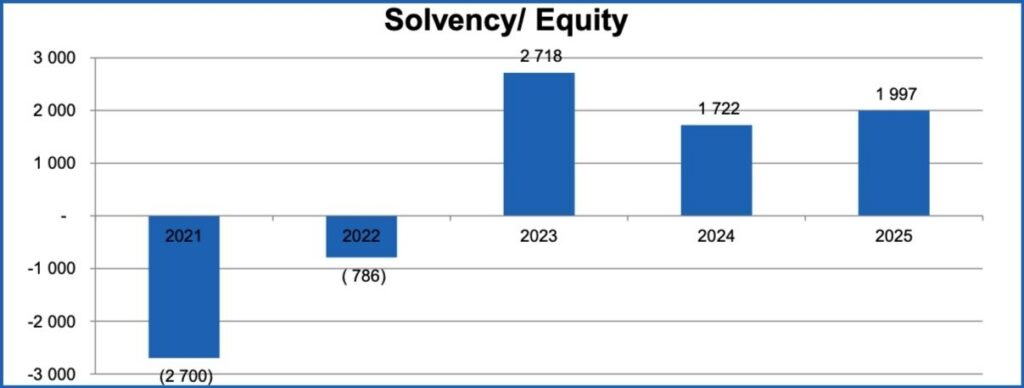
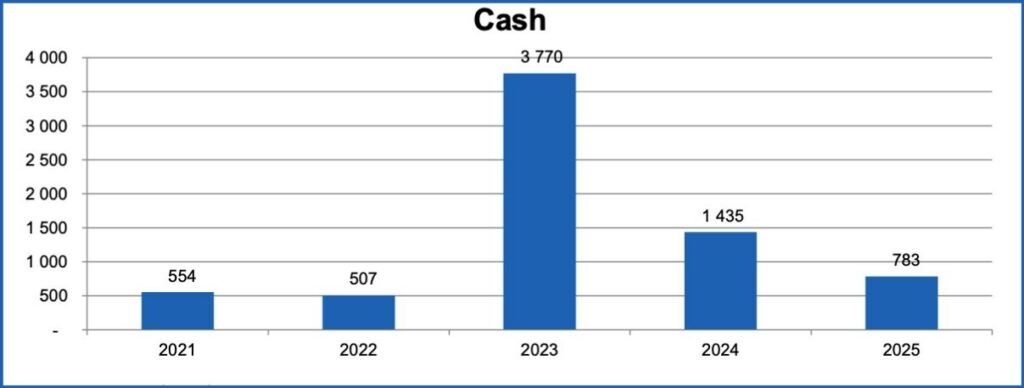
It also received some government assistance in the form of a R5.2 billion bailout package. This bailout consisted of a R3.4 billion guarantee from the state in 2023/24.
It was intended to settle the SOE’s remaining legacy debt and to fund the turnaround strategy.
The Auditor-General (AG) noted in her 2024/25 Consolidated General Report on National and Provincial Audit Outcomes that this did not go to plan.
The AG’s audit found that Denel could not provide supporting documentation for some of the payments, making it impossible to verify whether they were used in accordance with the approved conditions.
In addition, due to Denel’s ongoing liquidity challenges, a portion of the recapitalisation funds was used for operational costs and to pay damages and interest related to contract failures.
“Of the R3.4 billion in bailout funds received, only R277 million had not been used by March 2025, with minimal improvement observed in either financial or operational performance,” the AG said.
The remaining R1.8 billion of Denel’s bailout was supposed to be raised from the dissolution of the Denel Medical Benefit Trust and the sale of some of the SOE’s non-core assets.
However, the planned asset sales did not materialise, which resulted in a funding shortfall of R900 million.
Aside from direct cash injections, Denel has also been awarded R6.9 billion in state guarantee facilities.
“Overall, Denel’s turnaround plan has not achieved its intended objectives due to weak execution capacity, poor governance and misaligned financial priorities,” the AG said.
While it did not go according to plan, Denel’s turnaround efforts yielded some results in the form of an improved bottom line.
In 2024/25, Denel returned to profitability, recording a net profit of R223 million, which was later revised to R193 million. Its revenue also improved, reaching R1.32 billion in 2023/24 and R1.27 billion in 2024/25.
However, with the SOE’s profit slipping in its 2025/26 fiscal year, it remains to be seen whether Denel’s turnaround will set the company up for sustainable, profitable growth.
 Loading ...

Comments