How much the person responsible for social grants gets paid


The SASSA CEO receives an annual salary of R2.65 million a year, as well as an annual service bonus of R154,583.33.
Social Development Minister Nokuzola Tolashe revealed these figures in a recent response to a Parliamentary question from DA MP Thamsanqa Bhekokwakhe Mabhena.
Mabhena asked the minister for the full details of the annual remuneration packages paid to the leaders of the state-owned enterprises that report to the Department of Social Development.
In her response, Tolashe clarified that no state-owned enterprises report to the Department of Social Development.
Regardless, she could provide the details for the South African Social Security Agency (SASSA) and National Development Agency (NDA), which do report to her department.
The minister explained that SASSA appointed its CEO, Busisiwe Memela-Khambula, in 2019.
However, in December 2024, Memela Khambula was placed on precautionary suspension on full pay pending the outcome of an investigation into her appointment.
Regional executive manager for Gauteng, Themba Matlou, was appointed as acting CEO in her stead until the matter is resolved.
Tolashe revealed that the annual total remuneration package of the current SASSA CEO is R2.65 million per annum.
In addition, a CEO receives additional compensation payable to Heads of Department, a 10% non-pensionable allowance.
Therefore, she explained that the CEO’s monthly basic salary is R154,583.33, and is awarded an annual service bonus, also called a thirteenth cheque, of R154,583.33 in November each year.
The minister said the SASSA CEO does not receive a performance bonus because the payment of performance bonues to public servants was discontinued in the 2021/22 financial year.
Tolashe explained that the total annual remuneration package of R2.65 million is higher than the salary band applicable to salary level sixteen, which applies to the SASSA CEO.
However, the CEO’s salary package, which she accepted in 2019, was compared and matched with the salary package the CEO stated she was receiving from her previous employer.
Social grant spending

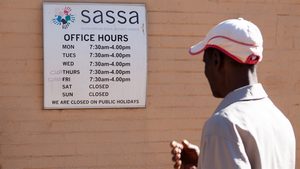
SASSA is the government agency responsible for the management and administration of social grants and assistance programs in South Africa.
South Africa has several different types of grants and spends billions on social development each year.
The country’s 2025 Budget, delivered by Finance Minister Enoch Godongwana on 21 May 2025, revealed that the social wage accounts for 61% of total non-interest spending over the medium term and is projected to reach R1.3 trillion in 2025/26.
The social relief of distress (SRD) grant constitutes R35.17 billion. This grant was introduced as a temporary measure to provide relief to struggling households during the Covid-19 pandemic.
Despite still being considered temporary, this monthly grant has been extended yearly since its introduction. In 2024, it was also increased from R350 to R370 a month.
In the 2025 Budget presented in May, Godongwana confirmed that the grant would be extended for another year, until March 2026.
He also said the government is actively exploring various options to better integrate this grant with employment opportunities.
“This includes considering a job-seeker allowance and other measures, as part of the review of Active Labour Market Programmes,” he said.
“Our goal is to not only provide immediate relief. It is also to create pathways to employment, empowering our citizens to build better futures for themselves and their families.”
In his 2025 State of the Nation Address, President Cyril Ramaphosa revealed that more than 28 million people receive monthly social grant payments in South Africa.
“Since the dawn of democracy, we have worked together to reduce poverty. Today, our country spends around 60% of our national budget on the social wage,” Ramaphosa said.
This includes social grants, healthcare, education, community development, and public employment programmes.
“More than 28 million unemployed and vulnerable people in our country receive social assistance. More than 10.5 million learners go to public schools where they do not have to pay fees,” the President said.
Furthermore, over 900,000 students pursuing tertiary education received funding.
“We are providing the means through which South Africans can rise above poverty that has been passed down from one generation to the next,” he added.


Comments