Warning to South African citrus farmers


South Africa’s citrus producers may need to absorb some of the impact of the new 30% tariffs on local goods exported to the United States or risk losing their competitive edge over other producers.
The latest Absa AgriBusiness report considered the impact of these tariffs on South African citrus exporters and found that the severity will depend on the health of United States consumers.
This comes after United States President Donald Trump announced a global 10% tariff on all imports and higher rates for what he deemed the ‘worst offenders’, including South Africa.
Therefore, South Africa was slapped with 30% tariffs on local goods exported to the United States.
Absa AgriBusiness senior economist Dr Marlene Louw explained that South Africa is a counter-seasonal citrus supplier to the United States.
In other words, South Africa supplies citrus products to the United States that are in demand during times when other suppliers are less active.
In 2024, citrus exports from South Africa to the United States amounted to approximately R1.8 billion.
This is 5.4% of South Africa’s total citrus exports. For the Western Cape citrus-producing area, the only area with access to US markets, the share of total exports to the United States amounted to around 20% for the same period.
South Africa’s primary exporting months to the US run from July to October, with oranges and mandarins being the main citrus products destined for export.
Louw explained that this is where Trump’s 30% tariffs become a problem, as other notable Southern Hemisphere exporters like Chile are already sending the bulk of their orange exports (75% or more) to the US during this period.
This means there is limited capacity from other Southern Hemisphere producers to substitute South African volumes, which become uncompetitive due to the 30% import levy Trump has implemented.
Therefore, South African citrus producers and other participants in the citrus export value chain may need to absorb a portion of these 30% tariffs if American consumers cannot stomach hefty price increases in the coming months.
“Given the limited capacity for alternative sourcing, we expect the biggest portion of the duty increases to be passed on to the US consumer,” she said.
“However, whether consumers have the capacity and willingness to absorb the full tariff increase remains uncertain.”
“It seems likely that exports from other geographies and competition from other fruit types will trigger changes in consumption patterns and that some portion of the duty impact would need to be absorbed by other participants in the citrus value chain.”

South Africa’s citrus market
Trump’s tariffs come as South Africa’s citrus market and prices are recovering from various production challenges faced in the 2024 citrus export season.
“This ranges from heat waves affecting fruit size in the North to floods in the Western Cape just as the export season from this region started to gain traction,” Absa’s AgriBusiness report for Spring 2024 explained.
“Frost during July in areas such as Weipe and Groblersdal also affected fruit quality and contributed to a downward adjustment in export volumes from this region.”
However, the report said the production declines caused by these events were largely offset by extremely favourable conditions in the processing and juice market.
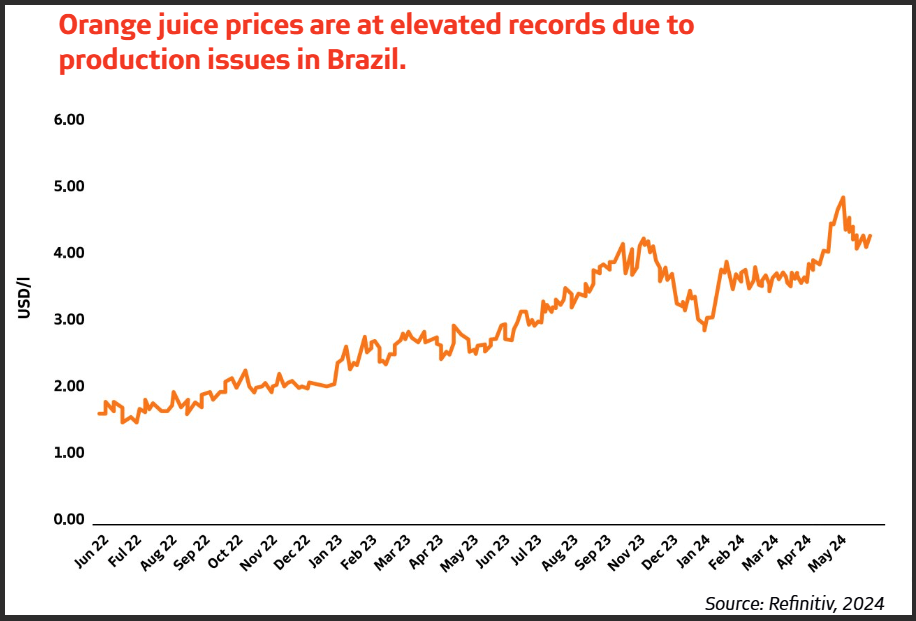
For example, El Niño conditions and the spread of citrus greening in Brazil, the world’s largest producer of orange juice, have kept global prices and, therefore, local prices of orange juice at record levels.
“This effectively creates a floor price for class-2 and class-3 fruit, for which supply was firm during the past few months due to the climatic issues listed above,” the report said.
It added that this supported positive on-farm margins in South Africa.
Prices for oranges also started the 2024 season at record highs in key export markets like the European Union but eased from April to June.
The report attributed this easing largely to high Egyptian volumes entering the market.
“Prices during July were expected to pick up as the Egyptian season concludes, which is likely to improve pricing for citrus exported from South Africa to the EU during the second half of this season,” it said.
“Given the large expansion of orange and soft citrus areas in countries such as Egypt, price pressures during the early South African export season are likely to remain an issue into the future.”
The graph below shows how the price of orange juice rose in the first half of 2024.






Comments