The R20.37 billion private company breaking Transnet’s 116-year monopoly


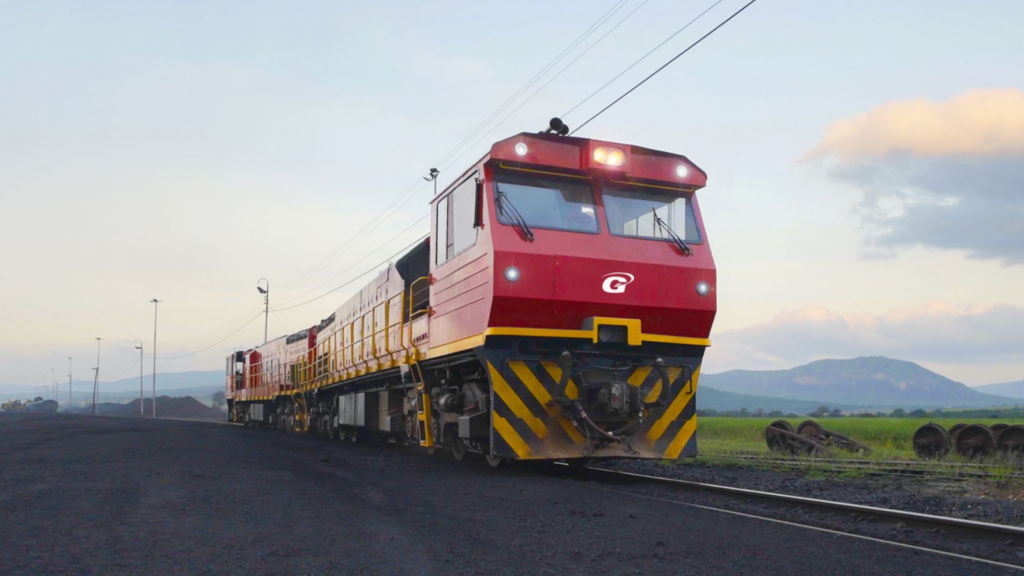
Grindrod has become the first private company to operate a train on South Africa’s national freight rail network under the country’s new open-access framework.
The logistics group and Transnet Rail Infrastructure Manager (TRIM) successfully completed a test train on the North-East Corridor in November 2026.
This marks a significant step in opening the state-owned rail network to private operators.
The operation began in Komatipoort, Mpumalanga, on 1 November. The train travelled empty before returning on 2 November with 2,991 tonnes of cargo.
It used Grindrod-owned locomotives and wagons, demonstrating that the company is ready to begin operating services on the corridor.
The milestone followed the signing of rail access agreements with 12 train operating companies, including Grindrod. These agreements allow private operators to use Transnet’s national freight rail network.
Grindrod plans to begin commercial operations in 2027 and will move 288,000 tonnes of cargo during its first year.
The company has been allocated two slots on the North-East Corridor. It will primarily transport coal from Mpumalanga to its Matola Terminal in Mozambique.
Future growth will depend on available corridor capacity, additional slot allocations and operational efficiencies.
The partnership gives Grindrod an opportunity to integrate rail operations more closely with its existing port and terminal infrastructure.
The company operates an integrated logistics business with infrastructure and services that connect customers to regional and international markets.
The North-East Corridor is particularly important because it links South Africa’s mining and industrial heartland with regional markets and export gateways.
Allowing Grindrod to use its own trains on the national network could improve the efficiency and reliability of its supply chain services.
Group CEO Kwazi Mabaso explained that the milestone demonstrated the practical benefits of rail reform.
“As an integrated logistics provider, the ability to combine rail operations with our terminal infrastructure and corridor footprint enables us to deliver greater efficiency, reliability and value to our customers.”
He added that the company was proud to partner with TRIM in helping restore rail as the backbone of bulk freight transport.
Transnet also views the test as evidence that its open-access policy is moving beyond planning and into operations.
TRIM chief executive Moshe Motlohi said the successful test train was a landmark achievement for South Africa’s rail reform programme.
“It demonstrates that open access is no longer a policy concept but an operational reality.”
He said the collaboration with private operators would help create a more competitive and efficient rail network.
The test train also demonstrates how private operators can help improve network utilisation and move more freight by rail.
Transnet is opening its network to private companies

Grindrod’s first test train forms part of a broader effort to bring private-sector investment and expertise into Transnet’s rail and port operations.
The state-owned logistics group has faced years of declining freight volumes, underinvestment, operational problems and financial pressure.
Its recovery strategy, introduced under CEO Michelle Phillips in October 2023, focuses on improving operations across its rail, port and pipeline businesses.
Transnet reported revenue of R88.56 billion for the 2025/26 financial year, up 7.1%. It also recorded a profit of R4.6 billion, its first full-year profit since 2022/23.
This compared with a R1.9 billion loss in 2024/25 and a R7.3 billion loss in 2023/24.
The improvement reflects higher rail and pipeline volumes, tariff adjustments and better operational performance.
However, the sale of Transnet’s interest in Durban Container Terminal Pier 2 also contributed to the result.
The company has also received substantial government support. National Treasury granted it a R47 billion financial guarantee in December 2023 and another R51 billion guarantee in May 2025.
Despite the recovery, Transnet is increasingly looking to private companies to help fund, operate and improve its infrastructure.
One example is the concession agreement with Philippines-based International Container Terminal Services Inc. (ICTSI) for Durban’s Container Terminal Pier 2.
Signed in December 2025, the agreement gives ICTSI the right to acquire almost half of the terminal for R10.5 billion and manage the facility for 25 years.
The terminal handles approximately 70% of the Port of Durban’s total throughput and 40% of South Africa’s container volumes.
Transnet is also seeking a private partner to help expand and operate the Ngqura manganese export corridor.
The project could cost up to R44 billion and will connect mines in the Northern Cape with ports in the Eastern Cape.
The proposed expansion forms part of Transnet’s private-sector participation programme, which aims to attract investment and use private-sector expertise to improve infrastructure performance.
Login or register for unlimited free access.


Conversation
1 commentsSo, Transnet made a R4.6 billion profit, and the Pier 2 sale brought in over R10 billion, meaning that Transnet would have shown a massive loss, if they did not sell part of their crown jewels. Go cadre deployment, viva amandla.