South Africa’s smallest province makes R2.4 trillion more for the economy than the biggest province



South Africa’s smallest province, Gauteng, is by far the largest contributor to the country’s economy.
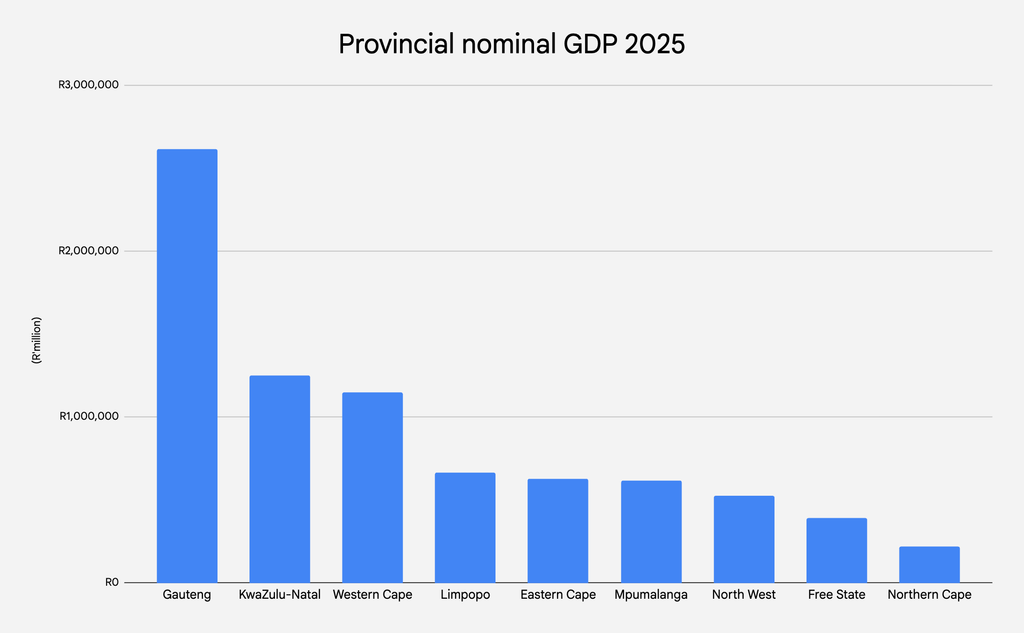
This small province accounted for 32.6% of the national GDP in 2025, at R2.62 trillion.
To put this into perspective, South Africa’s largest province by land area, the Northern Cape, contributed R219.95 billion, or 2.7%, to the national GDP in 2025.
This was revealed by Statistics South Africa (Stats SA) in its report on Provincial Gross Domestic Product for 2025, released in October 2026.
The report showed that Gauteng remained the growth engine of South Africa’s economy in 2025, contributing nearly a third of national GDP.
This makes Gauteng the country’s largest provincial economy, despite it being the smallest province by land area, at only 18,178 km².
At this size, Gauteng makes up just 1.5% of South Africa’s total land area. However, it is the country’s most populous province, home to 15 million people.
This large population is one of the reasons for Gauteng punching above its weight when it comes to its economic contributions.
Another reason is that Gauteng is home to 44% of all registered businesses in South Africa, and serves as the headquarters for 70% of the country’s major listed companies.
Some of these companies include powerhouses in their respective fields, such as Standard Bank, FirstRand, Discovery, and the JSE itself.
Stats SA’s Provincial GDP data revealed that Gauteng accounts for 43% of all national value added in the finance, real estate, and business services sector.
It also generates 41% of national government services value added, 40% of total national manufacturing, and 31% of national construction activity.
Stats SA explained that Gauteng’s provincial output is overwhelmingly service- and industry-driven, with tertiary industries making up 68.1% of the provincial economy.
Gauteng’s largest industry is finance, real estate, and business services, which account for 29% of its GDP.
The Northern Cape
The Northern Cape is, in many ways, Gauteng’s polar opposite, both in terms of its size and economic output.
The Northern Cape is by far South Africa’s largest province, spanning 372,889 km².
This means the province is 354,711 km² larger than the smallest province, Gauteng, accounting for 30.5% of South Africa’s land area.
Despite its size, the Northern Cape is the least populous province in the country, home to only 1.38 million people, or 2.2% of the national population.
In addition, it is the smallest contributor to the national GDP, accounting for 2.7% of South Africa’s economy in 2025.
In 2025, the Northern Cape contributed R219.95 billion to the national economy, R2.4 trillion less than Gauteng.
In contrast to Gauteng, this contribution is largely derived from primary industries such as mining and quarrying.
While it is the smallest economic contributor, the Northern Cape plays a critical role in South Africa’s mining industry.
The Northern Cape is the fourth-largest contributor to national mining output, accounting for 12% of South Africa’s mining value added in 2025.
It falls just below the North West at 26%, Limpopo at 25%, and Mpumalanga at 20%.
Mining and quarrying is the largest industry in the Northern Cape, generating 29.9% of the province’s GDP.
This is followed by personal services, which contributed 12.5% to the Northern Cape’s economy in 2025.
There is also a stark difference between the economic growth rates of Gauteng and the Northern Cape.
In 2025, Gauteng’s economy grew by 1.1% in real terms, an improvement from 0.6% in 2024. Gauteng was the second fastest-growing province after the Western Cape (1.4%).
The Northern Cape’s economy expanded by 0.9% in 2025, matching the national average of 0.9%. It also improved from 0.2% in 2024.
Login or register for unlimited free access.