South Africans without matric find jobs faster than those with university degrees



South Africans with lower qualification levels are generally finding new jobs faster than those with university degrees.
This is according to the September 2026 Pnet Job Market Trends Report, which analysed more than 2.8 million employment records for people who started new jobs between 2022 and 2025.
Only roles lasting at least one year were included. The data showed that job-search times vary considerably depending on a person’s qualifications, experience, sector and the type of work they are looking for.
Pnet found that there was a clear link between qualification requirements and the time it takes to find work.
People associated with roles requiring some schooling or training below NQF4 (a matric certificate) took an average of 11.9 months to find a new job.
Those with N4 and N5 qualifications took around 12 months, while matric-level roles took 13 months. The average increased to 13.3 months for roles requiring an N6 or diploma.
For positions requiring a bachelor’s degree, master’s degree or doctorate, the average job search increased to 15.8 months.
Pnet said this does not mean higher qualifications make it harder to find work. Instead, the roles requiring those qualifications are often more specialised and have fewer vacancies.
The recruitment process can also take longer, with more interviews, assessments and decision-makers involved.
The same pattern is evident in professional experience. People with one to two years of experience took 11.5 months to find a new role on average.
This increased to 14.8 months for those with three to five years of experience and to 16.5 months for those with six to 10 years of experience. For people with more than 10 years of experience, the average was 16 months.
| Highest qualification | Average job-search period |
|---|---|
| Some schooling/training below NQF4 | 11.9 months |
| N4, N5 | 12.0 months |
| Matric | 13.0 months |
| N6, Diploma | 13.3 months |
| Bachelor’s degree, Master’s degree, Doctorate | 15.8 months |
Which job roles take the most time to fill
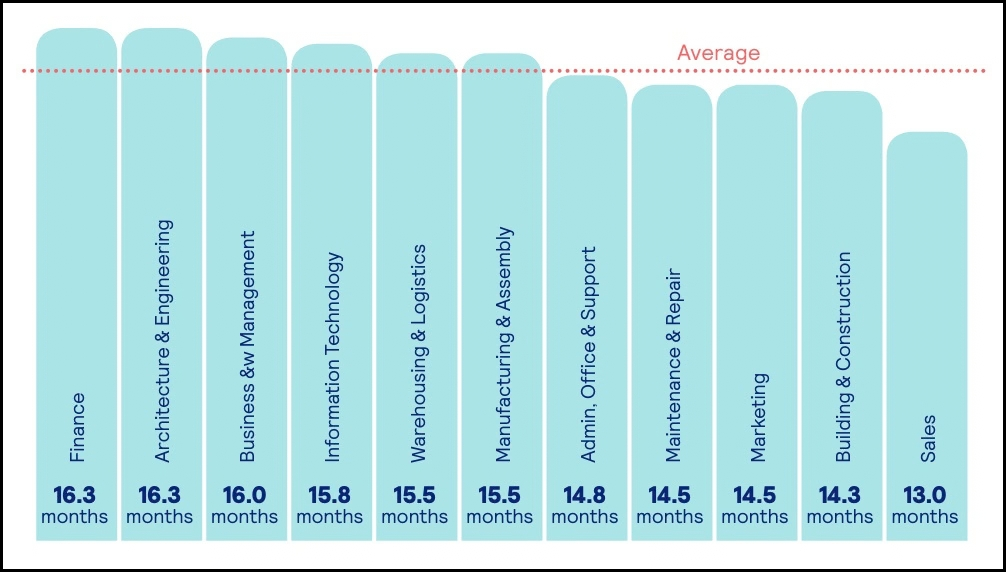
The sector and occupation also affect how long people spend looking for work. Sales had the shortest average job-search period among the sectors analysed.
This sector had an average job search period of 13 months over the four years. In 2025, the average fell to just nine months.
Building and construction followed at 14.3 months, while marketing and maintenance and repair were both at 14.5 months. Admin, office and support roles averaged 14.8 months.
Some sectors reported a much longer job search period. Finance had an average search period of 16.3 months.
Architecture and engineering was also at 16.3 months, followed by business and management at 16 months.
Information technology averaged 15.8 months, while warehousing and logistics and manufacturing and assembly were both at 15.5 months.
Pnet said these differences reflect how specialised the roles are and the number of suitable opportunities available.
Some specific occupations also had job-search periods well above the national average.
Financial portfolio managers, risk managers, and business and solution architects took an average of 20 months to secure a new role.
Other specialist positions in finance, information technology, business and engineering also took between two and five months longer than the overall 15-month average.
These roles often require specific technical or professional skills, narrowing the pool of suitable vacancies. They can also involve longer recruitment processes, particularly for senior positions.
By contrast, some occupations move much faster. Drivers took an average of 8.3 months to find a new role, followed by construction workers at 8.7 months.
Home appliance installation and repair roles averaged 9.3 months, while cleaning and housekeeping roles took around 10 months. Electricians had an average search period of 10.5 months.
Pnet said these roles generally require less professional experience. Strong demand for certain skills can also shorten the hiring process.
What employees and employers need to know
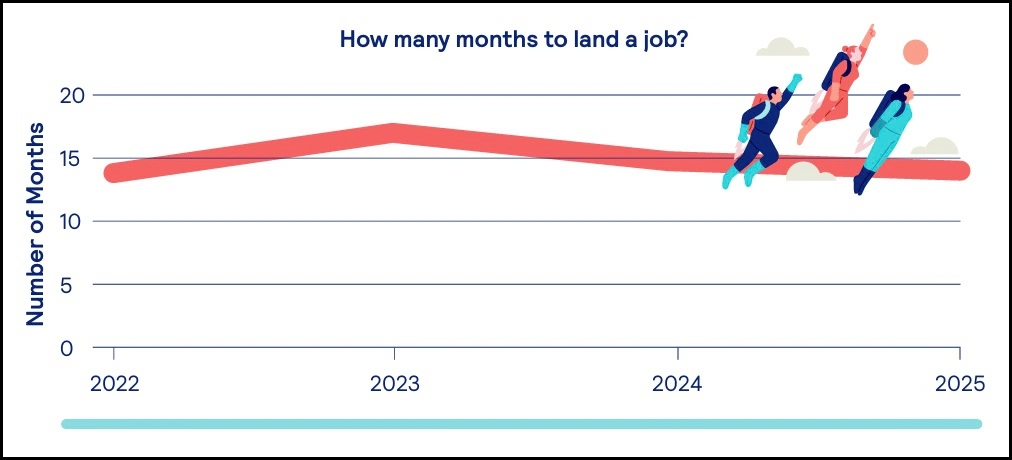
Over the period analysed, the average time between the start of an active job search and the start of a new role was about 15 months. The average reached 17 months in 2023, then fell to 14 months in 2025.
Pnet said the overall trend has remained consistent despite changes in the labour market. The data also suggests that job seekers should not assume that a long search means there are no opportunities.
“Pnet’s data shows that finding the right role is often a long-term process driven by patience and persistence, rather than a quick transition,” the company said.
“For highly specialised and senior professionals, longer searches are particularly common because suitable opportunities are fewer and recruitment processes tend to be more complex.”
Pnet said job seekers should plan career moves with realistic expectations, remain active in the market and keep their professional profiles up to date.
At the same time, employers need to move quickly when suitable candidates are identified, particularly in areas where skills are scarce.
“Efficient recruitment processes, clear decision-making and competitive offers therefore remain important when employers identify the right talent,” Pnet said.