National shutdown: South Africa’s biggest private security company doing the police’s job for a day


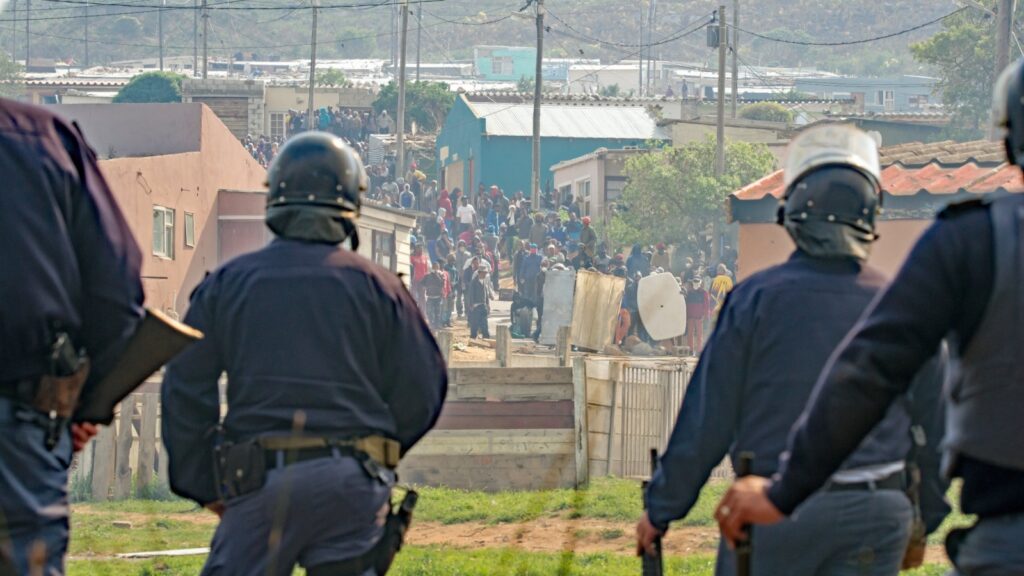
South Africa’s police force needs the help of Fidelity Security Group to handle the unrest expected to stem from the national shutdown on 30 June.
This is an indictment of South Africa’s current state and the result of decades of policy failures and institutional decline.
This is feedback from North-West University lecturer and researcher Cobus Steenkamp, who said that the South African Police Service (SAPS) cannot stand alone.
Steenkamp’s comments come as South Africa prepares for a national shutdown on 30 June, organised by citizen-led anti-immigrant movement March and March.
March and March issued an ultimatum for illegal immigrants to leave South Africa by 30 June, threatening to shut the country down should this not happen.
While it is unclear how this shutdown will play out, many South Africans fear it could lead to a repeat of the July 2021 riots.
The government, local companies, and other organisations have issued calls for peace and adherence to the law.
To prepare for whatever may happen, President Cyril Ramaphosa said South Africa’s security forces were on high alert.
At the same time, South Africa’s largest private security firm, the Fidelity Security Group, has been preparing for the worst.
The group is expected to deploy 35,000 operational personnel, seven helicopters and an undisclosed fleet of surveillance drones to assist SAPS in managing the anticipated unrest.
Fidelity has also maintained its own crime-risk assessment capability and operational intelligence infrastructure.
According to Steenkamp, SAPS will not and cannot stand alone amid this threat, and this raises an uncomfortable question about South Africa’s constitutional health.
“What does it say about the constitutional health of the state when the chief executive of a private security company effectively becomes the operational right hand of the National Commissioner of Police?” he asked.
Police commissioner for a day

Steenkamp said South Africa now finds itself in a situation where Fidelity CEO Wahl Bartman will serve as the in-situ national police commissioner for the day.
“A constitutional responsibility vested exclusively in SAPS under Section 205 of the Constitution will be exercised, in part, by a company whose primary legal obligation is to its shareholders rather than to the South African public,” he said.
“This is not an indictment of Fidelity. It is an indictment of a state that has become dependent upon it.”
This comes as South Africa is experiencing a growing reliance on private security, where those citizens who can afford to pay the associated fees choose this option instead of relying on state resources for protection and security.
Steenkamp said this is not the consequence of a single policy failure, but the culmination of three decades of institutional decline.
Over the past 30 years, private security has evolved from a supplementary service into an industry providing what the Constitution requires the state to provide: public safety.
“The result is a profound inequality. Safety has become a commodity. Those who can afford it buy it; those who cannot simply wait and hope,” he said.
Steenkamp pointed out that, for many South Africans, the national police force is simply no longer a trusted source for protection and public safety – and often for good reason.
A recent survey undertaken by the Democratic Alliance of 1,025 police stations found that 56% were not operationally available at the time of the audit.
“Not understaffed. Not slow to respond. Unavailable. For millions of South Africans who cannot afford armed response services, this is not merely a statistic. It is a daily reality,” Steenkamp said.
He further pointed out that South Africa’s police-to-population ratio is approximately 1 officer per 427 citizens.
In contrast, there is one private security officer for every 142 civilians, but only in communities able to pay for protection.
“This is no longer simply a resource imbalance. It is the emergence of a parallel system of public safety in which protection increasingly depends on purchasing power rather than citizenship,” Steenkamp said.
Declining public trust

Steenkamp emphasised that the declining trust in the national police force is not only due to numbers, but also the quality of service SAPS provides.
“The reasons are familiar: slow response times, inadequate police visibility, corruption and declining professional standards,” he said.
This aspect has recently received a lot of attention due to the Madlanga Commission, which has been investigating claims of corruption and mismanagement at the highest levels of South Africa’s law enforcement agencies.
The commission has exposed widespread instability in South Africa’s police force, adding to concerns about the force’s ability to handle a crisis similar to the July 2021 Riots.
“That loss of confidence has created fertile ground for private security companies,” Steenkamp explained.
“Their growth has mirrored the erosion of public trust, with households and businesses increasingly purchasing security that they no longer believe the state can provide.”
Ultimately, Steenkamp believes the 30 June national shutdown will be the culmination of a process that has unfolded over three decades.
“The police service exists to prevent, combat and investigate crime, maintain public order, protect the inhabitants of the Republic and their property, and uphold the law,” he said.
“On 30 June, those obligations will be fulfilled, in part, by a private company accountable to its board rather than to Parliament or the public.”
“That is the significance of this moment. It is the gradual transfer of a core state function made visible.”
He said South Africa has not lost policing capacity overnight. Rather, the country has surrendered it incrementally.
This, he said, happened through leadership instability, the loss of experienced officers, a weakening of organisational culture, poor resource management, and the steady expansion of an industry that has filled the vacuum left by the state.
“Whether one agrees that SAPS has partially abdicated its constitutional responsibility is ultimately a matter of interpretation,” he said.
“What is beyond dispute, however, is that South Africa now depends on private security to perform functions that were once regarded as the exclusive responsibility of the state.”
“The real question is no longer whether that shift has occurred. It is whether South Africans are prepared to accept it – or to demand that the constitutional promise of equal public safety be restored.”



Comments