Government makes R17.2 billion by punishing South Africans for saving and investing


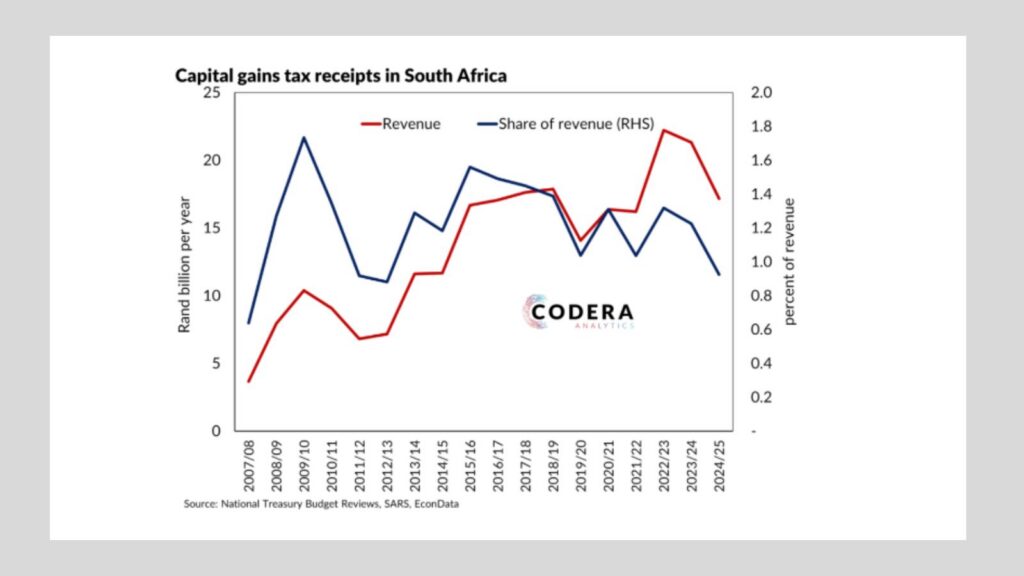
The government collected R17.2 billion in revenue from Capital Gains Tax (CGT) in the 2025 financial year, which makes up 1.5% of total tax collection.
This shows that the tax does not generate significant revenue for the government, yet it negatively affects economic growth by discouraging saving and investment.
The data collected by Codera Analytics shows that CGT tax receipts have grown strongly in South Africa since 2007/08.
However, CGT’s contribution to the state’s overall revenue has remained flat as other revenue sources have grown more quickly.
CGT was implemented in South Africa in 2001. Prior to that, profits from the sale of assets such as property, stocks, or companies were completely tax-free.
The vast majority of the government’s revenue at the time came from income tax, with no tax on asset sales intended to encourage domestic savings and investment.
The Katz Commission in the 1990s recommended implementing CGT to the post-1994 government to crack down on tax avoidance and make South Africa’s tax system more progressive.
Its main argument was that high-net-worth individuals own the majority of assets, and exempting CGT meant they bore a lower tax burden relative to lower- and middle-income South Africans.
Wealthy South Africans contributed more tax in absolute terms, but the commission argued that in relative terms, this was below its share of the economy.
CGT was thus designed to ensure that wealthy asset holders contributed a fairer share and reduce the burden on the middle and working classes.
The commission also explained that wealthy individuals were reducing their tax burden by structuring their compensation as share options rather than a standard salary.
This effectively converted their taxable income into tax-free capital gains, reducing their tax burden. A CGT would close this loophole.
Minor reasons for a CGT in South Africa included a desire to discourage stock market speculation and to extend the tax base.
The data from Codera Analytics undermines many of the Katz Commission’s arguments, showing that CGT is a tiny proportion of state revenue.
South Africa’s government post-CGT is still heavily reliant on a narrow income tax base and VAT. Furthermore, the country still suffers from high inequality.
Damaging consequences
Despite its relative insignificance in the R1.8 trillion collected by SARS in the 2024/25 financial year, it has damaging consequences for the economy.
By discouraging saving and investment, the tax does not help raise South Africa’s already low savings rate of -1.2% of GDP.
This limits the pool of capital available within the country to finance infrastructure development, business startups, or plug the government’s deficit.
The savings rate of faster-growing emerging market economies, such as India, Indonesia, and China, ranges from 18% to 36% of GDP.
This gives governments and companies in those countries easy access to domestic capital to fund economic growth and development.
These countries also have CGT, but it is levied differently and, in the case of India, actively encourages long-term investment.
The sub-continent economy hits short-term traders and investors with a 20% CGT, while long-term gains across all assets are subject to a 12.5% flat tax.
Indonesia’s CGT system incentivises investment in locally listed equities and property, which are subject to a 0% tax rate. Non-listed assets are taxed as income.
In China, trading in domestic listed A-shares on local exchanges is exempt from CGT for individuals, encouraging investment in equities. There is a flat 20% CGT on property or unlisted equities.
These countries’ CGT systems incentivise investment in equities, encouraging individuals to grow their wealth by investing in local companies.
Vestact Asset Management’s Michael Treherne said that South Africa’s CGT system punishes people for being savers and investors instead.
“We all dislike paying taxes, but the tax I hate the most is CGT. You are basically being penalised for being a good saver and investor,” Trehern said in the company’s newsletter.
Treherne explained that South Africa’s system is uniquely punitive as investors do not receive an inflation adjustment to their base price.
“In South Africa, where inflation causes prices to double every 7 to 10 years, you get nailed just for keeping up with inflation. In real terms, you are going backwards,” Treherne said.
“The part that really kills me is that we already pay large amounts of tax through PAYE, VAT, and municipal rates.”
“In return, you have to pay for your own education, medical expenses, security, backup batteries and water tanks, and even tar to fill the potholes.”
Treherne said that South Africans who use their after-tax money to invest and it grows shouldn’t be taxed on that money again.





Comments