Collapsed South African state-owned company coming back to life


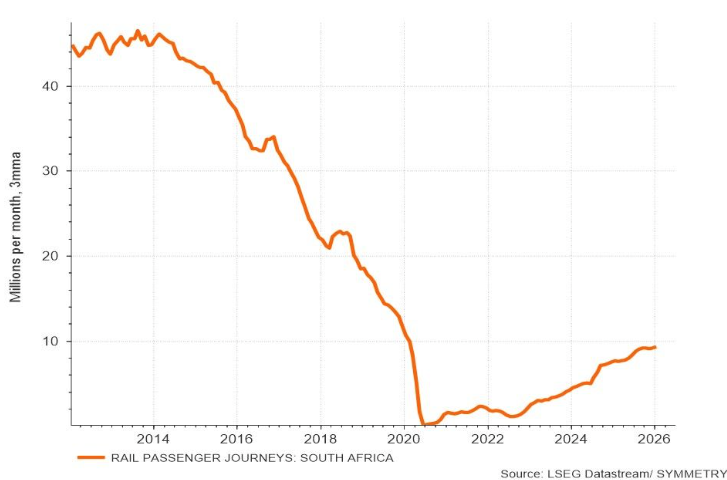
The turnaround of the Passenger Rail Agency of South Africa (PRASA) is gathering momentum, with the number of trips per month rising to 10 million from zero five years ago.
While noteworthy, PRASA is still a shadow of its former self, with the company regularly conducting over 45 million trips just a decade ago.
This collapse has come with significant implications for South Africa, with billions in extra spending on transport and increased sensitivity to oil shocks.
Symmetry chief investment strategist Izak Odendaal said the turnaround of PRASA cannot happen soon enough to save ordinary South Africans meaningful sums of money.
Odendaal estimated that in areas where trains are running regularly, commuters can now save between 60% and 70% on their daily commutes versus using a bus, car, or taxi.
The lack of a functioning public transport network exaggerates the impact of an oil price shock on the South African economy and on households.
Due to South Africa’s abundance of coal and renewable energy potential, the country’s passenger rail network is largely uninfluenced by global oil prices.
Odendaal said that, in this regard, a functioning PRASA could cushion the blow of a surge in fuel prices that South Africa is now experiencing.
“Needless to say, South Africa does not have a functioning public transport network. The destruction of commuter rail over the past decade is a shame and tragedy,” Odendaal said.
“For low-income workers, it is a massive blow, forcing them to use buses and taxis that are often three or four times more expensive.”
Odendaal has previously said that this shock to disposable income has not been widely discussed by economists, with it slowing economic growth and putting households under financial pressure.
The mismanagement of PRASA has resulted in the effective privatisation of public transport, as it forced individuals to use private transport rather than cheaper public options.
PRASA’s collapse was made worse by the government’s desperate attempts to save SAA, which received billions in bailouts from the state.
Passenger rail, on the other hand, was left to collapse and its deterioration happened largely under the radar compared to other public companies.
In under a decade, the company went from completing over 500 million railway journeys a year to less than 20 million.
PRASA’s fare revenue collection stood at R228 million in 2010 compared to a horrific R2.8 million just over a decade later. This makes it a significant fiscal risk.
The public company’s collapse can be seen in the graph below, courtesy of Odendaal.
The comeback
PRASA is beginning to make a comeback, with the number of rail passenger journeys per month nearing ten million for the first time in over five years.
The recovery is likely to take years and potentially even over a decade, as PRASA’s infrastructure cannot be rebuilt at the flick of a switch.
This is even if the utility manages to get its finances in order, which were left in a mess after the era of state capture.
After 2010, PRASA spent heavily on increasing the salaries of its employees and neglected to deploy capital into its infrastructure network.
Its infrastructure was rated a C- in 2011 by the South African Institute for Civil Engineering (SAICE), meaning that it was satisfactory.
This meant that the infrastructure was still operational and fit for purpose, but increasing attention needed to be paid to maintenance and upgrades. Theft and vandalism of PRASA’s infrastructure were a particular concern for SAICE.
PRASA’s C- rating turned out to be the peak of the company’s infrastructure quality, with it deteriorating significantly since 2011.
Just over a decade later, in 2022, SAICE rated PRASA’s infrastructure an E. This means it is unfit for purpose and poses a significant risk to users.
“Safety and security on the rail network have deteriorated, and fewer and fewer trains are dispatched each year due to infrastructure, process, and systems challenges,” it said.
“Operational issues include outdated equipment, theft, arson, and vandalism. Many mainline passenger services have collapsed and are now almost non-existent.”
PRASA is slowly beginning to invest in its stations, some of which have been rehabilitated, and new trainsets have been introduced in recent years.
It is crucial that this process is accelerated, as it will result in the public company generating significantly more revenue.
Running trains on their tracks also results in less vandalism and theft, with thieves simply not having the time to take tracks or overhead cables.
Odendaal said that if PRASA can be turned around, it will have significnat benefits for South Africa’s broader economy –
- Freeing up disposable income for commuters (though there will be a concomitant loss of income for minibus taxis and the potential for violence).
- Less pressure on urban roads, less time in traffic jams, and greater economic efficiency.
- More housing and related development near rail corridors, increased urban density and a reduction in spatial inequality.
Achieving these benefits will be costly, as billions of rands will need to be spent repairing and upgrading PRASA’s infrastructure.
In some cases, entire stations and railway lines will need to be rebuilt, and new locomotives will need to be acquired.





Comments