From 45 million trips a month to zero and back


Commuter rail has effectively collapsed in South Africa, with an industry that once conducted over 45 million trips a month falling to zero and now clawing its way back to a fraction of its ridership.
This collapse was the result of years of mismanagement, corruption, and inadequate maintenance of infrastructure.
Once the backbone of South Africa’s transport network, commuter rail has become synonymous with unreliability, a lack of safety, and inefficiency.
However, in recent years, hard work has been done to try to revive commuter rail through an overhaul of the Passenger Rail Agency of South Africa (PRASA), the state-owned enterprise (SOE) that effectively runs the sector.
Chief investment strategist at Old Mutual’s Symmetry Izak Odendaal outlined the impact of PRASA’s collapse on South Africa’s economy and individuals.
“The complete collapse of commuter rail is one of the saddest tales of corruption and mismanagement in South Africa,” Odendaal said in a recent social media post.
“It has had a devastating impact on hundreds of thousands of working-class people who have been forced to use more expensive alternatives. This is a shock to disposable income that is not widely discussed by economists.”
He explained that the mismanagement of PRASA could be viewed as an effective privatisation of public transport, as it forced individuals to use private means of transport rather than cheaper public options.
This collapse occurred simultaneously with the government’s desperate efforts to save South African Airways (SAA).
At the time, SAA consumed much of the media attention and the government’s financial resources, with billions in bailouts and successive management changes.
PRASA, on the other hand, was neglected, and its collapse happened largely under the radar compared to other SOEs.
In under a decade, the company went from completing over 500 million railway journeys a year to less than 20 million.
PRASA’s fare revenue collection stood at R228 million in 2010 compared to a horrific R2.8 million just over a decade later. This makes the SOE a significant fiscal risk.
The collapse of its rail journeys can be seen in the graph below, courtesy of Odendaal.
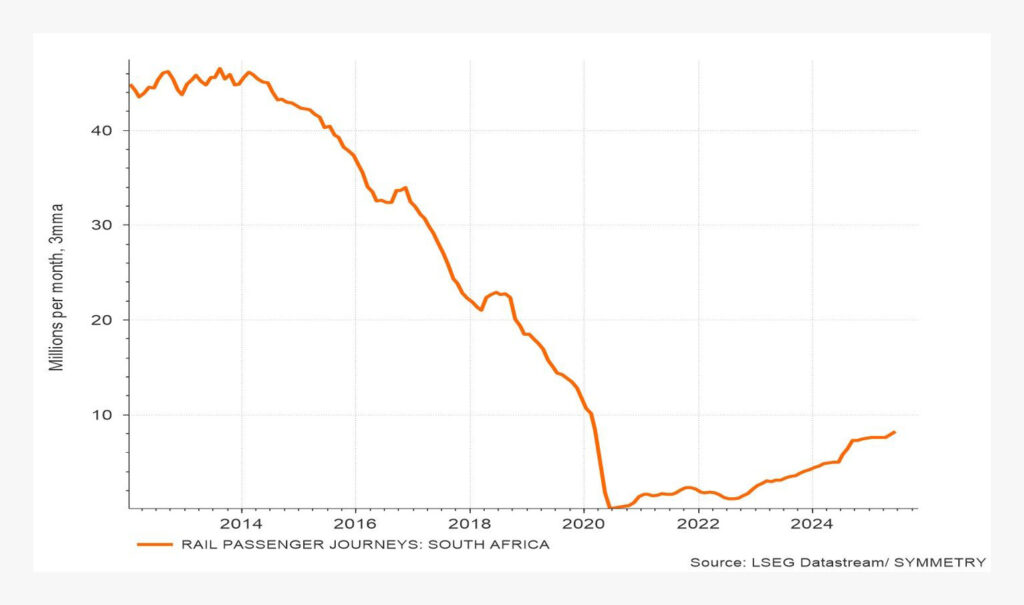
PRASA’s collapse and slow recovery
PRASA’s declining operational performance is a direct result of the collapse of its infrastructure and financial mismanagement.
Rather than invest in maintaining and upgrading infrastructure, the SOE spent heavily on consumption, particularly salary increases.
While the collapse of its infrastructure has only been felt more recently, it has been deteriorating for well over a decade.
Its infrastructure was rated a C- in 2011 by the South African Institute for Civil Engineering (SAICE), meaning that it was satisfactory.
This meant that the infrastructure was still operational and fit for purpose, but increasing attention needed to be paid to maintenance and upgrades. Theft and vandalism of PRASA’s infrastructure was a particular concern for SAICE.
PRASA’s C- rating turned out to be the peak of the SOEs infrastructure quality, with it deteriorating significantly since 2011.
Just over a decade later, in 2022, SAICE rated PRASA’s infrastructure an E. This means it is unfit for purpose and poses a significant risk to users.
SAICE said the general condition of the commuter rail network is very poor. “Safety and security on the rail network have deteriorated, and fewer and fewer trains are dispatched each year due to infrastructure, process, and systems challenges,” it said.
“Operational issues include outdated equipment, theft, arson, and vandalism. Many mainline passenger services have collapsed and are now almost non-existent.”
Odendaal said that PRASA’s performance has improved more recently, and a very gradual recovery is taking hold at the SOE.
Network repairs are underway, stations are being rehabilitated, and new trainsets are being introduced.
If this process can be accelerated, including by devolving responsibility for commuter rail to metro governments, as is the case in most countries, it will have three important economic benefits –
- Freeing up disposable income for commuters (though there will be a concomitant loss of income for minibus taxis and the potential for violence).
- Less pressure on urban roads, less time in traffic jams, and greater economic efficiency.
- More housing and related development near rail corridors, increased urban density and a reduction in spatial inequality.
Achieving these benefits will be costly, as billions of rands will need to be spent repairing and upgrading PRASA’s infrastructure.
In some cases, entire stations and railway lines will need to be rebuilt, and new locomotives will need to be acquired.
 Loading ...




Comments