End of an era for Nedbank



Nedbank CFO Mike Davis told Daily Investor that investors should now start thinking of the bank as a Southern African-East African play.
This is opposed to the traditional view of Nedbank as a South Africa-heavy lender with negligible exposure to the rest of the continent.
Davis explained that the acquisition of a 66% stake in East African lender NCBA will transform Nedbank’s presence on the continent.
The giant with 60 million customers will give Nedbank access to Kenya, Uganda, Rwanda, and Tanzania – all of which are faster-growing economies than South Africa.
This will reduce the bank’s reliance on South Africa’s economic and fiscal health to drive financial performance. A slow-growing local economy has seen Nedbank flatline relative to its peers.
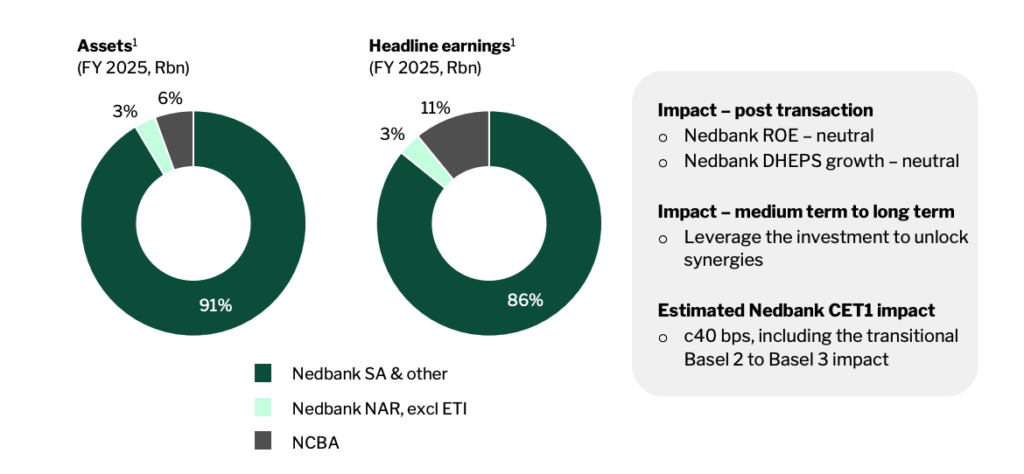
In its analyst presentation, Nedbank showed the impact of the NCBA acquisition on earnings across its business.
If NCBA were a fully-integrated subsidiary, as it will become before the end of 2026, it would have contributed 11% of Nedbank’s headline earnings.
This is a significant chunk for a bank that has 91% of its assets in South Africa. Coupled with Nedbank’s existing African businesses, 14% of the bank’s headline earnings would come from outside of South Africa.
“We would like that to be 20% of our earnings. Some part of the acquisition into East Africa was to diversify earnings,” Davis explained.
“We have made it clear, though, that we have no interest in being a Pan-African organisation. The focus is on Southern and East Africa. Our first step will be to build that to an 80-20 split.”
This will change Nedbank’s earnings potential and how investors view the bank, as it is finally set to gain exposure to fast-growing economies across the rest of Africa.
Its peers have been steadily expanding their presence across the rest of Africa and have built Pan-African franchises that meaningfully diversify their earnings.
The financial performance of banks is closely tied to the broader economic growth of the countries in which they operate, as this drives lending growth and client activity.
As Nedbank increases its exposure to faster-growing regions, its earnings should reflect that, and investors may change their view of the traditional South African bellwether.
Why NCBA is different

Investors may be cautious about changing their perception of Nedbank too quickly, given its history of investing in Africa without achieving the desired results.
Its investment in Ecobank Transnational Incorporated (ETI) in West Africa did not go to plan over the past decade.
Davis explained that Nedbank took a 21% stake in ETI with the understanding that Nigeria’s strong growth was expected to continue.
However, a falling oil price crushed the Nigerian economy and exposed businesses. This forced many banks to require recapitalisation from shareholders.
“If you look at where that was going, we were concerned that it would require further recapitalisation and that would mean we would either need to invest more capital into ETI or be diluted,” Davis said.
“As a result, we decided to exit ETI, and that decision was taken on its own because of the concern regarding future capital injections.”
Learning from this, Nedbank decided to acquire a majority stake in NCBA, thereby gaining control of the bank.
It also carefully analysed the jurisdictions in which it operates, with Davis saying Nedbank is much more comfortable doing business in East Africa than in West Africa.
“We really like East Africa. You have to look at the jurisdiction in which you think you can do business. We spent a lot of time with the management team and on the ground,” Davis said.
“You look at where they operate in Kenya, Tanzania, Uganda, and Rwanda. Those are areas we are very comfortable doing business in and areas whose growth will far exceed South Africa’s.”
Davis also noted that the expansion into East Africa puts the bank in a position to capture value from growing trade between Africa, the Middle East and Asia.
“So, it will be different for two reasons: the jurisdictions as well as the fact that we will have control of NCBA,” he explained.
Davis said the bank will leave NCBA’s management team unchanged and ensure the bank continues operating under its own brand.
Nedbank’s initial focus will be on integrating the business into the group, and then it will go after the low-hanging fruit.
In particular, Davis said there are big wins on the table for Nedbank’s Corporate and Investment Banking (CIB) unit. Traditionally Nedbank’s crown jewel, CIB is expected to play an active role in dealmaking in the region.
The CIB unit will lead the expansion and look to finance infrastructure development, bank South African corporates, and win investment banking deals.
This will be followed by Nedbank’s other units, which may have a harder time generating immediate value in East Africa.
“If you think of where Nedbank is strong, it is in commercial property, infrastructure, renewable energy, and mining,” Davis said.
“Looking at the countries in which NCBA operates, we will leverage that expertise. We think we can leverage synergies quite quickly in our CIB unit.”
Nedbank Financial Overview






Comments