Top economist warns people are not safe in South Africa


Efficient Group chief economist Dawie Roodt said the government’s most important job is to keep citizens and their belongings safe, and the state is currently failing miserably at this task.
The government has identified crime, particularly organised crime, as the most immediate threat facing South Africa, with President Cyril Ramaphosa saying that tackling this problem is the government’s primary focus this year.
However, the state’s spending priorities in the 2026/27 national Budget tell a different story.
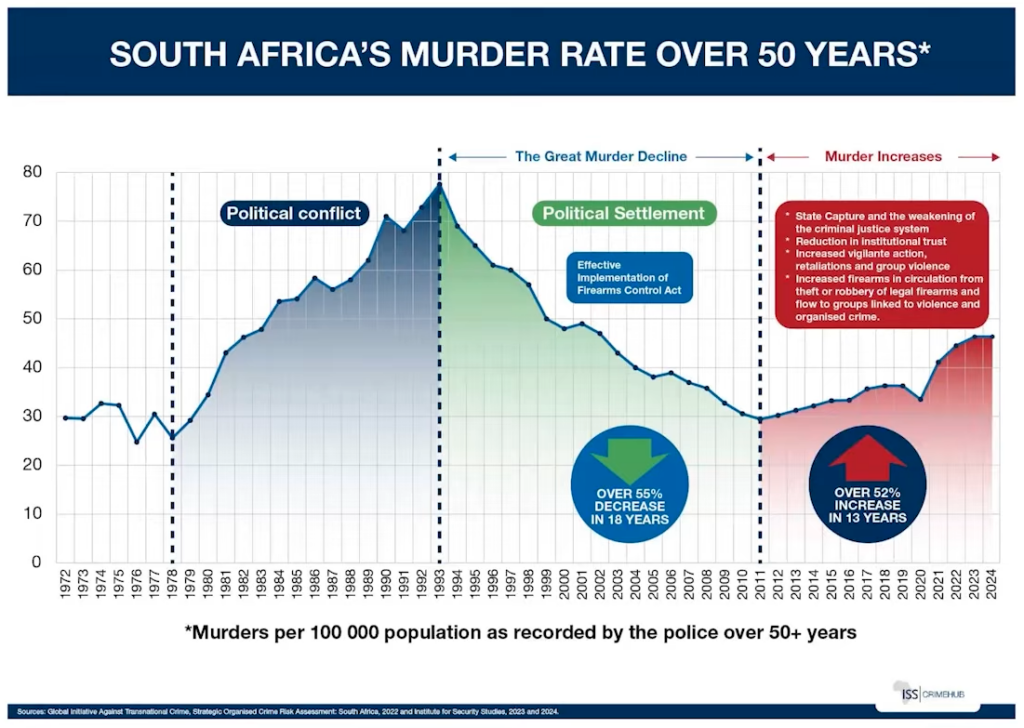
Roodt made these comments following the tabling of the national Budget on 25 February 2026. He explained that in the past 50 years, South Africa has seen significant rises and falls in its murder rate.
Between 1978 and 1993, the national murder rate shot up, which Roodt attributed largely to increased political conflict in pre-democracy South Africa.
From 1994 to around 2010, during the period of political settlement, the murder rate showed a clear downward trend, achieving an over 55% decrease over this period.
However, from about 2011 onwards, South Africa’s murder rate has continued to grow, increasing by over 52%.
Today, South Africa has a homicide rate of 45 murders per 100,000 people, over ten times the global average.
“Clearly, South Africa is a very violent place. This is totally unacceptable,” Roodt said. “The primary function of the state is to protect me and my stuff, and it doesn’t seem to me as if the state is doing a very good job of that.”
“Clearly, the state is not looking after me. I’m not safe in this country – they kill me, they steal my stuff.”
Previously, Roodt warned that South Africa’s government is losing control of crime in the country. He said the government’s plan to deploy the military to support police efforts in certain provinces is an admission of this.
The graph below shows the trends in South Africa’s murder rate over the past 50 years, including the notable rise in the past decade.
The government’s plans
The government has, to some extent, acknowledged the heavy toll South Africa’s high crime levels take on citizens.
Ramaphosa made this a key topic in his 2026 State of the Nation Address, calling organised crime, in particular, “the most immediate threat to our democracy, our society, and our economic development”.
“Our primary focus this year is on stepping up the fight against organised crime and criminal syndicates, using technology, intelligence and integrated law enforcement.”
The President also outlined his plan to address this problem, saying it must be tackled at a national level.
“We will tackle organised crime by consolidating intelligence at the national level, identifying priority syndicates and deploying hand-picked, multidisciplinary intervention teams focused on dismantling criminal networks,” he said.
In particular, he announced plans to strengthen South Africa’s fight against gang violence by deploying the South African National Defence Force (SANDF) to support the police.
“I have directed the Minister of Police and the SANDF to develop a tactical plan on where our security forces should be deployed within the next few days in the Western Cape and Gauteng to deal with gang violence and illegal mining,” he said.
Other government plans to enhance the fight against crime include –
- Tackling gun crime by streamlining legislation and regulations on licencing, possessing and trading in firearms and ammunition, as well as increasing enforcement of existing laws
- Recruiting 5,500 additional police officers in 2026
- Establishing a national illicit economy disruption programme to address the threat posed by the infiltration of illegal and counterfeit goods
“The cost of crime is measured in lives lost and futures cut short. It is felt also in the sense of fear that permeates our society and in the reluctance of businesses to invest,” the President said. “This must and will change.”
While Ramaphosa described this fight against crime as the government’s top priority, Roodt said the state’s priorities are more clearly evident in the breakdown of its spending in the 2026/27 national Budget.
Police services are the eighth largest spending item in the Budget, while law courts and prisons are in eleventh place.
In addition, the state’s allocations for these two line items are only a fraction of what the government spends on higher-priority items.
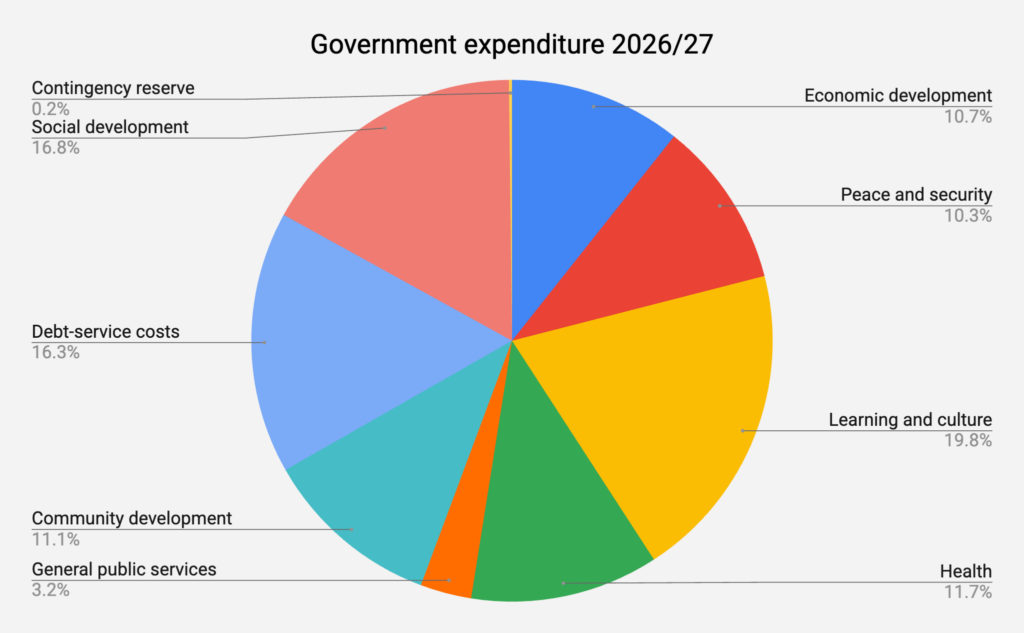
In fact, the government spends more on debt-service costs than on the entire budget for peace and security.
Police services account for 51.3% of spending on peace and security, and their budget is growing at 3.8%. Notably, this is a smaller increase than the 4.4% civil servant employees are set to receive over the next three years.
“If you look, for example, at how much we spend on police, you can see very clearly that the police are well down on the list of items on which my money is spent,” Roodt said.
“Maybe what we need to do is spend less money on certain of the other things and spend more money on protecting me, because that is the primary function of the state – to make sure that we live in a safe environment, which certainly is not the case.”
The breakdown of the state’s spending in the 2026/27 fiscal year is shown in the chart below, with peace and security accounting for 10.3% of total expenditure.



Comments