How much money the University of Cape Town makes


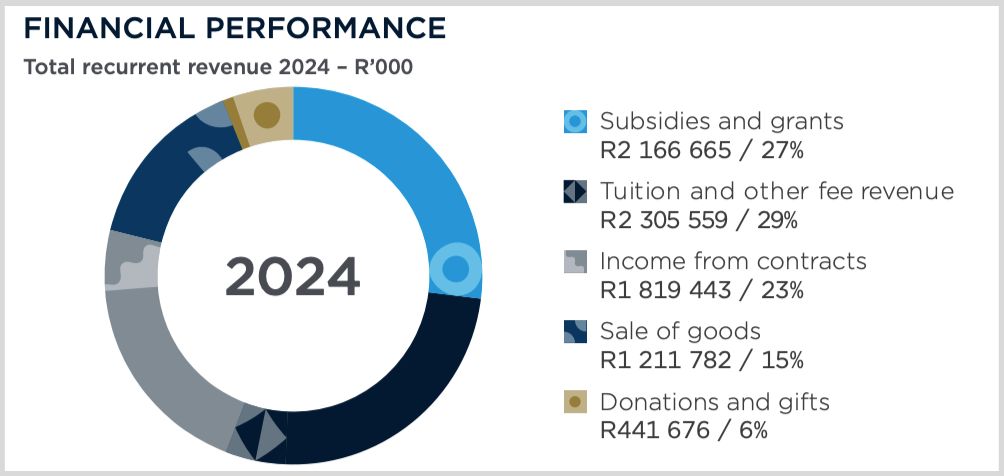
The University of Cape Town (UCT) recorded revenue of R8.68 billion in its 2024 financial year, R2.17 billion of which came from government subsidies and grants.
Tuition and other fee income constituted the largest revenue stream for UCT, at R2.31 billion, with income from contracts, the sale of goods and services, and donations and gifts contributing the rest.
UCT’s 2024 revenue reflected a 0.6% increase from 2023, driven by higher income from contracts like research contracts and tuition and other fee income.
In contrast, the university said its income from state appropriations experienced a 0.1% decline in 2024, attributed to a sector-wide clawback from the Department of Higher Education.
This, combined with a rise in personnel costs, saw UCT record a significantly smaller surplus of R851.98 million for 2024, down 18.06% from 2023.
This surplus includes a deficit of R434.66 million from council-controlled activities at the university, compared to a deficit of R349.29 million in 2023.
In terms of spending, the bulk of UCT’s expenditure goes towards personnel costs, which consumed R4.99 billion of the university’s total R8.53 billion expenditure in 2024.
This reflects an increase from the prior year, which the university attributed to the cost-of-living increment agreement it reached with unions as well as an overspend on staff performance awards.
Like most other public universities in South Africa, UCT is particularly dependent on state grants and subsidies for its financial sustainability, which have been declining in recent years.
In its 2024 Annual Report, UCT explained that there are certain concerns regarding its financial sustainability that warrants the university’s attention.
This includes mounting pressure on the state to fulfill its funding commitments, which are severely constrained by South Africa’s low economic growth.
The university explained that the state’s funding struggled including its ability to fund the National Student Financial Aid Scheme, which has been under severe pressure in recent years.
The graph below, courtesy of UCT, shows the university’s different revenue sources in 2024.
NSFAS headache
NSFAS is the largest funder of undergraduate student financial aid across the higher education sector and at UCT.
However, the scheme faces significant operational and systemic challenges, including delays in disbursements, limited administrative and ICT capacity, high loan non-repayment, oversubscription, and issues of corruption, mismanagement, and underfunding.
UCT explained how some of these issues placed significant pressure on the university in its 2024 financial year.
In 2023, NSFAS changed its full-fee-free funding model to apply an accommodation cap of R50,000, resulting in a funding shortfall for students whose accommodation costs exceeded this cap.
While UCT was able to assist students in 2023, the institution said it could not meet the R150 million shortfall faced in 2024, resulting in increased student debt.
The university said increasing levels of student fee debt is also a significant concern, further compounded by the NSFAS-imposed fee cap on student accommodation.
UCT’s gross student fee outstanding for the 2024 financial year was R836 million, a 41% increase from 2023.
This led the university to increase its provision for credit losses regarding student debt by 44.5% to R349 million.
The institution further warned that these ongoing issues create the risk of student protests, as they threaten students’ financial stability, accommodation and food security.
“The university remains deeply concerned about the impact on students, particularly regarding accommodation and food security, and on the financial sustainability of the higher education sector,” it said.
“Where possible, the university has assisted students with food parcels and other humanitarian support.”
The institution pointed out that close to 40% of South African undergraduate students received financial assistance in previous years, with higher figures when including corporate funding.
“NSFAS remains central to institutional stability – its success is UCT’s success, and its failure affects UCT,” the university said.
“It is imperative that NSFAS engages the sector constructively and accepts help to resolve ongoing challenges.”






Comments