Plan to replace 30,000 government workers in South Africa


The National Treasury is in the process of implementing its Early Retirement Programme, which aims to impact around 30,000 jobs within the state.
These jobs are not expected to be cut or lost, but rather the individuals that currently occupy them are being encouraged to take early retirement through various incentives.
They will then be replaced by younger workers, who require a lower salary to employ, to ensure the state can maintain service delivery at a lower cost and replace staff who are lost to natural attrition.
The tricky balancing act comes with the government’s need to retain skilled employees to maintain service delivery and enable the implementation of state policy.
This is part of the National Treasury’s efforts, collectively referred to as fiscal consolidation, to keep a tight lid on government spending in a stagnant economy.
The public sector wage bill is one of the major threats to this strategy, with salaries consuming over 30% of the government’s budget.
More importantly, these salaries have been growing at a rate above inflation and faster than economic growth, making the trajectory unsustainable.
Apart from driving a hard bargain in salary negotiations, the National Treasury aims to rebalance the state’s workforce by addressing its top-heavy nature.
The introduction of the Early Retirement Programme is a key intervention to manage compensation spending and maintain long-term fiscal sustainability, the National Treasury said in the full Medium-Term Budget Policy Statement (MTBPS).
These programmes are designed to alleviate pressure on departmental compensation budgets by incentivising early retirement and voluntary exit programmes.
An amount of R5.5 billion was provisionally allocated to support these initiatives, which provide a voluntary exit path for long-serving public sector workers.
Through this, the National Treasury aims to create opportunities for savings and a strategic realignment of the public service to reduce the wage bill as a share of total expenditure.
Up to 30,000 state employees are expected to apply for early retirement under the programme, resulting in savings of up to R7.1 billion per year. The programme has been in effect since 15 October 2025.
The National Treasury provided additional details as to how the scheme will work in practice in the full MTBPS.
The Early Retirement Programme has been in effect since 15 October and is open to employees aged between 55 and 59 with at least ten years of pensionable service.
Taking early retirement will be penalty-free, and applicants will receive a financial incentive of two weeks’ basic salary for each of the first 20 years of service and one week’s salary for each subsequent year.
The Voluntary Exit Programme, on the other hand, is available to employees aged 60 to 64 and offers a financial incentive of two weeks’ basic salary for each of the first ten years of service, plus one week’s salary for each year thereafter.
South Africa’s public wage bill
The National Treasury has placed increasing importance on tackling the rise in South Africa’s public sector wage bill over the past few years.
In the MTBPS, it explained that this has proved to be tricky as it requires balancing the need to attract and retain skilled employees with the need to ensure long-term fiscal sustainability.
While this is a constant balancing act, it has been exacerbated over the past decade by a stagnant economy and a skyrocketing debt-to-GDP ratio.
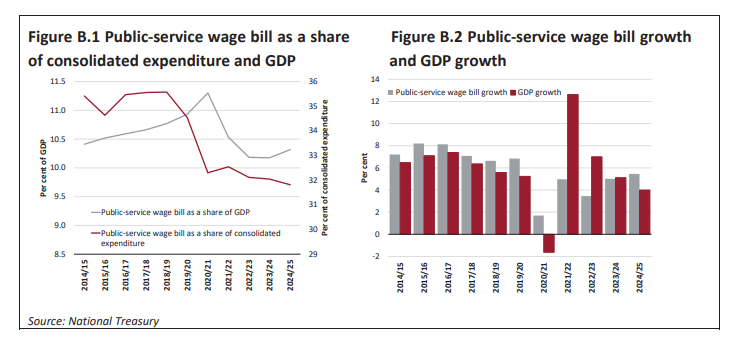
The Treasury’s efforts have proven to be successful in reducing the public sector wage bill as a share of spending and GDP.
Consolidated compensation costs accounted for 31.8% of total government spending in 2024/25, down from 35.4% in 2014/15.
Crucially, in recent years, the Treasury has managed to limit increases in the public sector wage bill to below GDP growth, making the longer-term trend more sustainable.
The Treasury was at pains to explain that the public sector wage bill has not risen in recent years due to an expansion in the number of employees.
Rather, it has risen as a result of skyrocketing cost-of-living adjustments, which have pushed average remuneration higher.
In the past, public-service wage agreements negotiated between the government and public sector unions often resulted in salary increases that exceeded inflation and economic growth.
These agreements historically included across-the-board percentage increases for all public-service employees, above the adjustments to various allowances such as housing and medical subsidies.
Even though these wage increases may seem small percentage-wise, they cover 1.3 million employees, resulting in billions of rands in additional spending.
Furthermore, these salary increases have been coupled with steady pay progression, which refers to the automatic annual salary increases that public servants receive based on their years of service.
This is designed to reward good performance, but has resulted in a substantial and continuous expansion of the overall wage bill, despite declining service delivery.
The result is that the cost to the state of employing an individual automatically increases each year, irrespective of negotiated salary increases.






Comments