Bad news for Mr Price, Foschini, and Truworths: Shein and Temu are here to stay


Affordable foreign e-commerce players continue to pose a threat to South Africa’s listed apparel retailers, despite recent tax changes.
Players like Shein and Temu offer pricing and direct-to-consumer models that give them a cost advantage that local players struggle to compete with.
This is feedback from PSG Financial Services wealth manager Schalk Louw, who told Daily Investor that these players remain a structural threat.
This means local listed apparel retailers, including Mr Price, The Foschini Group, Truworths, and Pepkor, will remain under pressure from these foreign players.
When Shein and Temu first launched in South Africa, they took the local market by storm.
South Africa’s price-sensitive consumers were attracted to the low prices these platforms offered, particularly compared with local retailers’ offerings.
Alongside their low prices, these companies also spent millions on South African advertising campaigns, further supporting local demand.
The threat these retailers posed to local retailers led some industry stakeholders to appeal to the South African Revenue Service (SARS) for stricter controls.
The stakeholders argued that players such as Shein and Temu were exploiting local tax loopholes to keep their prices low.
Specifically, they accused the retailers of breaking up large orders into multiple smaller parcels to stay under the R500 ‘de minimis’ threshold.
Under SARS’ de minimis rule, parcels with a value of less than R500 can pass through customs with no value-added tax (VAT) and a flat 20% import duty.
Local stakeholders argued that this gave foreign players an unfair cost advantage over domestic retailers.
For local players, their imports were taxed at 45% plus an additional 15% VAT.
SARS agreed that this was unfair, and in November 2024, announced the removal of tax exemptions on small-value imports under R500.
From then on, SARS has applied a flat 20% customs duty and 15% VAT on all clothing imports valued below R500.
This better levelled the playing field between local and foreign clothing importers, narrowing the pricing gap between them.
However, according to Louw, this and other changes to import duties have not closed the gap.
South African clothing retailers under pressure

Louw told Daily Investor that e-commerce players’ pricing and direct-to-consumer models give them a cost advantage that is difficult for local retailers to replicate.
“Changes to import duties have narrowed the price gap, but have not closed it,” he said.
While the playing field is now level in terms of import duties, there remains a substantial price gap between local and foreign players.
Trade service group and sourcing agent Sellers Union China has explained that players such as Shein and Temu’s low prices can be attributed to various factors, including their business models.
Shein, for example, runs on an on-demand production model through which it manufactures products in small batches.
This means it does not need to store or manage unsold inventory, saving costs. At the same time, this allows Shein to respond to trends almost in real-time.
In contrast, Temu operates as an “online megastore”, offering a far wider range of products than Shein.
It serves as a platform hosting independent third-party sellers, meaning Temu itself does not control the inventory.
While both of these models can result in quality control concerns, it means Shein and Temu can sell items at far lower prices than established local retailers.
Louw said the pressure this puts on local players is evident in the continued promotional activity by domestic retailers.
He described this as the clearest evidence that affordability still drives purchasing decisions, which has direct implications for both sales growth and margins.
“We view this as a lasting competitive factor rather than a temporary disruption,” Louw said.
This threat from foreign e-commerce players comes at a time when local apparel retailers’ margins are already under pressure.
South Africa’s lacklustre consumer environment means discretionary spending is constrained, especially given current record-high petrol prices.
When households look to cut back on spending, non-essential items such as clothing tend to be first on the chopping block.
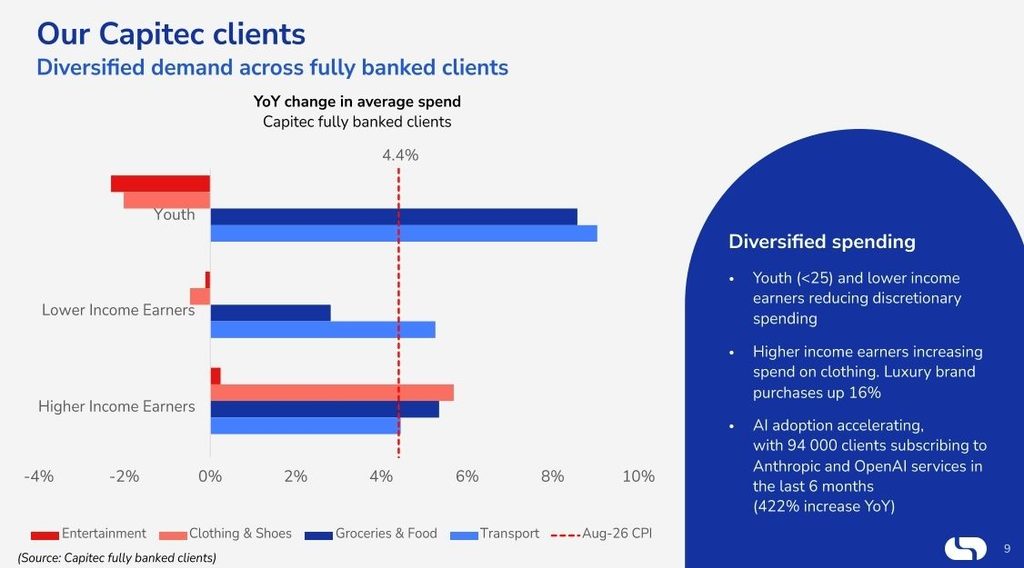
Capitec revealed in its latest interim results presentation that, in particular, youth and lower-income earners have reduced their discretionary spending over the past year.
These consumer segments are spending more on groceries, food, and transport, while reducing spending on entertainment and clothing.