Warning to people with domestic workers in South Africa



Many domestic workers in South Africa earn less than the national minimum wage, leaving their employers exposed to potential legal issues and fees of R100,000.
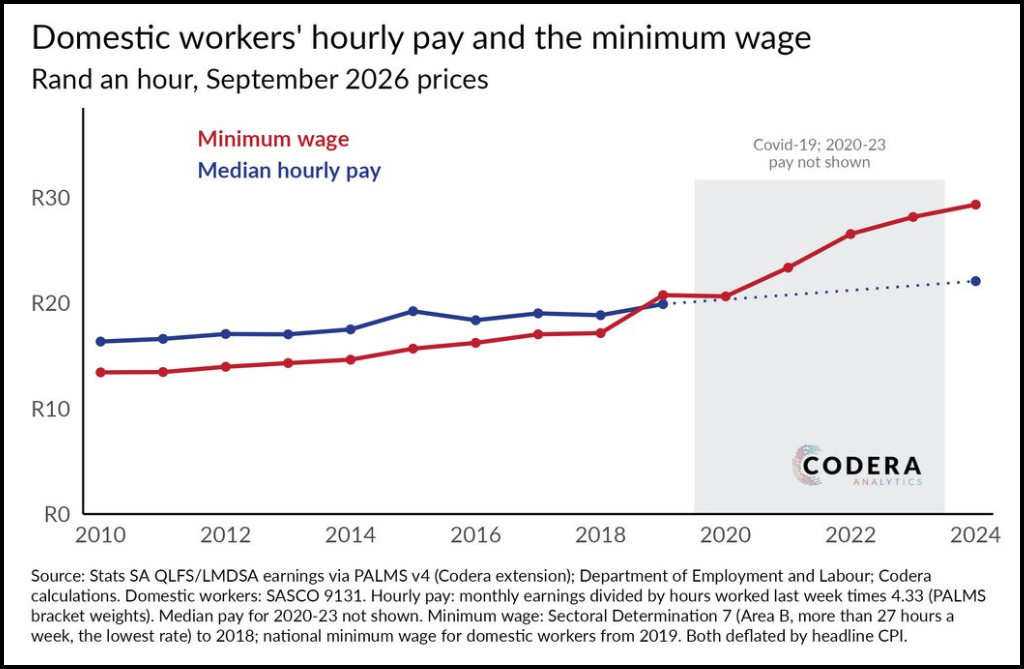
Labour survey data analysed by Codera Analytics showed that the proportion of domestic workers earning below the applicable hourly minimum wage increased sharply between 2018 and 2024.
The share rose from between 44% and 50% in 2018 to around 70% in 2024. The gap has widened because domestic workers’ pay has not kept pace with increases in the minimum wage.
Codera’s analysis found that domestic workers’ median real hourly pay increased by 17% between 2018 and 2024.
Over the same period, the real minimum wage for full-time workers increased by between 56% and 71%, depending on the applicable area rate.
The analysis also found that 79% of domestic workers who worked 40 hours or more per week earned less than the equivalent of a full-time month’s minimum wage.
The number of domestic workers in South Africa has also declined, from just over one million before the Covid-19 pandemic to slightly fewer than 850,000 in the latest data.
South Africa’s national minimum wage for 2026 is R30.23 per ordinary hour worked. For someone working a standard 45-hour week, this translates to R1,265 per week or R5,894 per month.
However, data from domestic worker platform SweepSouth suggested that many workers earn considerably less.
Its 2025 survey of 5,039 domestic workers found that the average worker using its platform earned R5,545 per month. Workers who were not classified as SweepStars earned an average of R3,932 per month.
Employers could face legal consequences
Employing a domestic worker in South Africa comes with several legal responsibilities, including paying at least the national minimum wage and complying with labour legislation.
Households that underpay domestic workers may face disputes and claims for unpaid wages.
Employers must also consider other obligations, including employment contracts, working hours, leave and registration for relevant employee benefits.
The issue becomes more complicated when households employ foreign nationals who are not authorised to work in South Africa.
The Employment Services Amendment Bill, gazetted in May 2026, proposes significantly higher penalties for employers who hire illegal foreign workers. The proposed penalties include:
- R100,000 for a first offence.
- R200,000 for a second offence.
- Up to R1 million or 10% of a company’s gross income for a third offence.
These penalties are proposed under the Bill and are not yet in force. The Bill is intended to strengthen enforcement of employment and immigration laws.
It would also expand the powers of labour inspectors and enable closer cooperation between the Departments of Employment and Labour and Home Affairs.
Although the proposed penalties are primarily discussed in the context of businesses, the legislation could also affect households employing domestic workers.
The proposed legislation comes as the Department of Home Affairs increases inspections of workplaces and private residences.
Home Affairs officials, working with the South African Police Service, have been inspecting businesses suspected of employing undocumented foreign nationals.
Officials reportedly require employers and workers to provide relevant documentation. Where documentation is not in order, foreign nationals may be arrested and face immigration enforcement proceedings.
Home Affairs Minister Leon Schreiber said the department was working with other law enforcement agencies to strengthen enforcement of immigration laws.
“The Department is working in coordination with other law enforcement agencies to restore the rule of law in South Africa’s immigration system,” he said.
Schreiber added that officials were verifying visas and permits and enforcing legal sanctions where violations were found.
“Where the law is violated, the relevant legal sanctions are enforced without fear or favour.”
These inspections are not limited to commercial workplaces. Private residences and residential estates have also been subject to inspections.
For example, High Riding Country Estate in Sir Lowry’s Pass reported that Home Affairs officials and police visited the estate in July 2026 and inspected several homes.
Log in or register for free access to all articles.





Conversation
1 commentsRule 1 : Do not employ any South African !! You will be sorry if you do.