No-name brands taking over 30% of sales at Woolworths, Checkers, and Pick n Pay


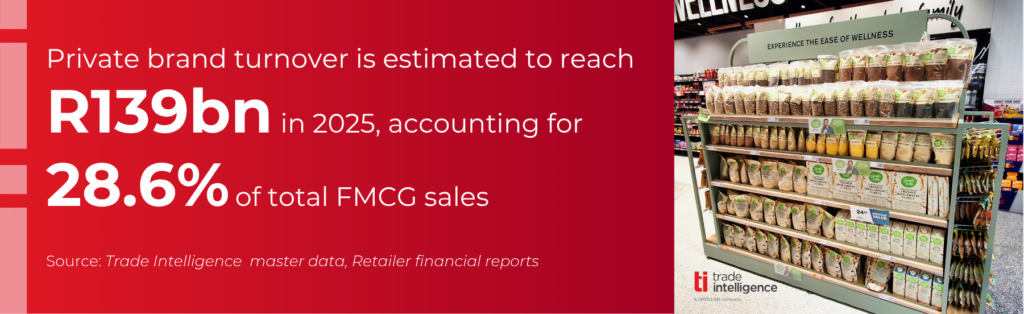
Private label brands are taking up a growing share of sales at retailers, accounting for R139 billion of turnover and nearly 30% of sales.
South African retailers are increasingly turning to private-label brands, sometimes referred to as ‘no-name’ brands, to drive sales growth through promotional activity and greater price control.
Private labels are products typically manufactured by a third party but are sold exclusively under a retailer’s own brand name.
This includes brands such as Checkers’ Forage & Feast, Pick n Pay’s PnP and No Name brands, or Woolworths Food-branded products.
Long considered a sideshow in South African retail, limited to higher-end segments, private labels have grown into a major money-spinner for retailers.
Trade Intelligence’s latest data show that private-label turnover reached R139 billion in 2025, accounting for 28.6% of total fast-moving consumer goods sales.
The firm said this has shifted private labels from tactical tools to a dominant force in the industry.
Private labels were typically used in South Africa to compete on price, with retailers using their own brands to offer products at lower price points, driving sales growth and revenue.
They are now core drivers of retailers’ long-term business strategy, brand identities, and profitability, Trade Intelligence said.
This creates some challenges for food processors and manufacturers, such as Tiger Brands, Premier Foods, and others who supply branded products to retailers.
Tiger Brands CEO Tjaart Kruger recently acknowledged that this is a challenge for his company, but does not believe it is a major threat thanks to the strength of its brands.
Ultimately, manufacturers can also win by supplying retailers with private-label products, which tends to create a lucrative income stream down the line.
Trade Intelligence said manufacturers and processors have to decide how they engage with South African retailers.
This includes partnerships to create private-label products or direct competition, or a hybrid approach, where private-branded products compete with their own offerings in the same store.
The future of retail
The rapid growth of private labels has led some to question whether this growth can be sustained or whether they will become dominant in retail stores.
This is unlikely as South Africans still have a strong affinity for particular brands, whether it be All Gold Tomato Sauce, Bakers biscuits, or Cadbury chocolate.
There are some key exceptions to the growth of private labels, where branded products still dominate market segments.
Carbonated drinks are one example, with this segment still dominated by brands such as Coca-Cola and Pepsi.
Private brands only hold 3% of this market, according to Trade Intelligence data. The firm attributes this to a strong emotional connection and habitual consumption.
However, private-label products still have some significant advantages over their branded competitors.
“The foundation of growth in private brands lies in the more functional, price-sensitive, and essential categories like flour, maize meal, rice, and sugar,” Trade Intelligence’s Caroline Short explained.
“This is because staples are anchors of trust, so if they deliver consistently on quality and price, this builds shopper confidence.”
Short also pointed out that building brand equity in these categories enables retailers to expand private brands into more complex or emotionally-driven segments.
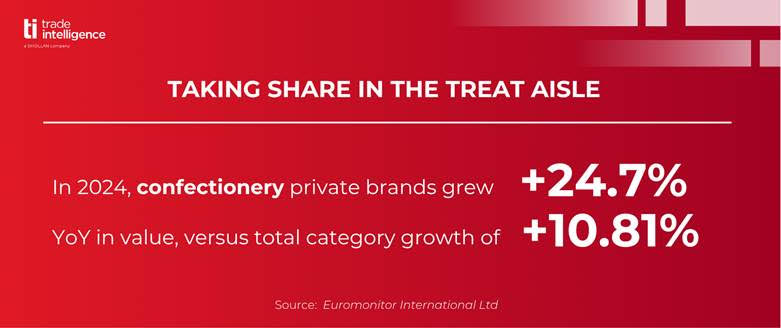
Another area where private brands are growing strongly is the confectionery aisle, with data showing 24.7% year-on-year growth.
The growth of this can be seen in the rise of Woolworths’ Chuckles brand, which now dominates chocolate and sweet sales at the retailer.
Short said this shows that the value perception of these brands is now strong enough to compete even where emotional purchase drivers are high.
A notable area of competition is products for animals, with retailers investing heavily in expanding their presence in the pet segment as it becomes highly lucrative.
There is a growing adoption of private brands in this category, with consumers shifting towards Checkers Petshop Science-branded products or Woolworths’ Absolute Pets alternatives.
This is primarily driven by trust in these brands, Short explained. It also indicates that traditional barriers to private brand adoption are eroding.
“Private brands are no longer a binary choice between ‘cheap’ versus ‘premium’,” Short said.
“They form part of a sophisticated, multi-tiered strategy that is reshaping shopper behaviour, how retailers differentiate themselves, and the decisions manufacturers make.”






Comments