The government helps criminal syndicates steal R23.5 billion a year from South Africa


South Africa’s mining legislation inadvertently fuels illegal mining in the country, which robbed the country of R23.5 billion in tax in 2025.
This illegal activity also results in the country losing billions of rands worth of foreign exchange earnings, thousands of jobs, and endangers the lives of citizens.
It has grown significantly over the past decade as formal mining companies reduce their exposure to South Africa due to policy uncertainty and strained labour relations.
The fleeing of mining businesses has left South Africa with 6,000 abandoned mine shafts, which are now home to illegal operators.
These operators are becoming increasingly brazen and operate as part of the shadow state, Frans Cronje Private Clients explained in its The Shadow State Rising report.
The report showed that illicit activity costs the state R84.6 billion in lost tax revenue every year, robbing South Africa of vital financial resources.
This lost revenue comes from three sectors in particular – the illicit trade in cigarettes, illicit alcohol sales, and illegal mining.
These sectors are no longer dominated by individual criminals and syndicates, but are rather a highly organised parallel state.
Termed the “shadow state”, these syndicates operate their own supply chains, distribution networks, and enforce their own kinds of law.
Frans Cronje Private Clients explained that the lost tax revenue comes in the form of uncollected taxes on the sale or production of goods.
This is what makes them illicit, and they are often unregulated, posing significant danger to customers who purchase these products.
All of this falls under what SARS describes as the tax gap, which is the difference between the amount of tax that is assessed and what is paid to it.
SARS estimates this gap to be R800 billion, with the largest share of it being made up of uncollected VAT in the illicit and informal economies.
Frans Cronje Private Clients explained that the shadow state’s drain on South Africa has a meaningful impact on the local economy.
The amount of money it ‘robs’ from individuals, businesses and the state is equivalent to 1% of South Africa’s entire economic output in a year.
Furthermore, it is equivalent to 4% of the government’s total tax revenue of R2.1 trillion and 23% of its annual budget deficit.
Illegal mining’s impact on the economy
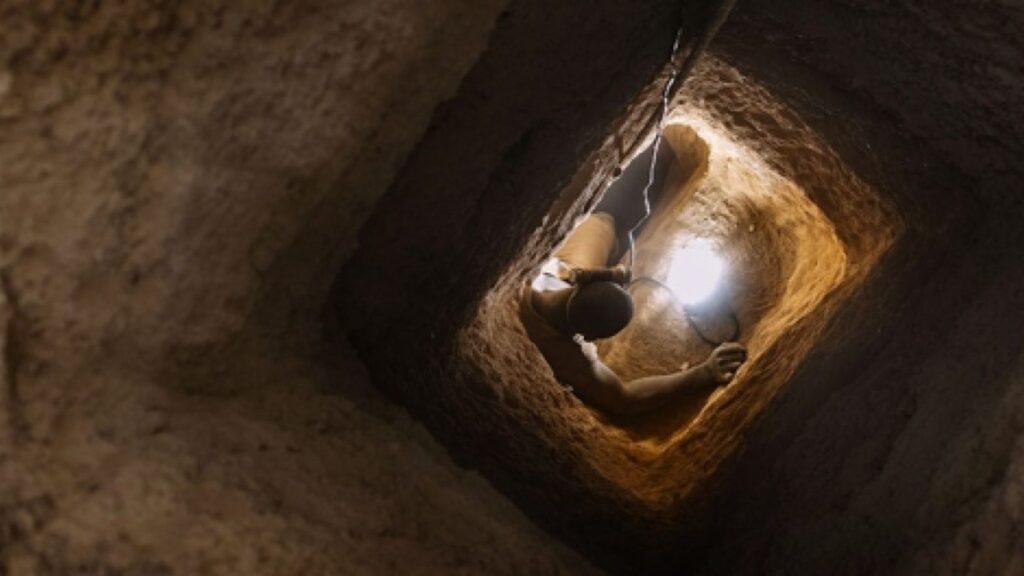
Illegal mining has surged in recent years as criminals look to make a quick buck exploiting abandoned mineshafts and weak law enforcement.
These groups are often highly organised and dangerous, creating mini-states where they enforce their own rules and facilitate the export of minerals and metals.
Frans Cronje Private Clients explained that this activity has been created and fuelled by the government’s own legislative agenda.
In particular, the Minerals and Petroleum Resources Act fuels the crisis by setting up regulatory barriers that lock out legitimate, small-scale miners.
The firm said the act treats all operators the same, failing to distinguish between small-scale or artisanal mining and large-scale industrial mining.
By applying a single, rigid regulatory framework to operations of all sizes, it holds local, resource-constrained miners to the same complex standards as multi-billion-rand corporations.
More importantly, the legislation makes it difficult for legitimate miners to obtain licenses to operate and compete legally.
This effectively locks these small-scale miners out of the legal economy, creating a large pool of excluded miners and labourers.
These individuals are captive labour for illicit operations who use their skills and inability to legally participate to operate illegal mines.
Over the long run, the only way to sustainably end illegal mining is to make it easier for small-scale miners to be legitimate operators.
This is something the legislation does not allow for, with South Africa’s mining sector being dominated by large corporates and illicit zama zamas who pick up the crumbs.
While Frans Cronje Private Clients puts the lost tax revenue at R23.5 billion a year, PwC estimates the total economic cost to be R60 billion.
This includes lost mineral export revenue, company earnings, and salaries for employees of legal mining operations.





Comments