The companies set to benefit from South Africa’s big retirement changes


Once the two-pot retirement system is implemented on 1 September this year, South African retailers and banks will benefit from increased consumer spending.
The new retirement system will allow South Africans to access a portion of their retirement savings before maturity to cover emergency payments.
However, many asset managers and economists expect individuals to withdraw money from their savings pot to spend on discretionary items, particularly clothing.
“While some surveys suggest that up to 50% of the money withdrawn will go to paying down debt, we argue that a large portion will simply be used for general consumption,” Stanlib senior economist Ndivhuho Netshitenzhe said.
She explained that the increased cost of living in South Africa has resulted in basic necessities taking up more of disposable income, resulting in minimal spending on discretionary such as clothes and appliances.
Thus, there is a massive pent-up demand for these products.
Amid this pressure on consumers, the government is giving South Africans access to long-term savings – effectively implementing a form of stimulus.
Therefore, consumers will likely use these additional funds for discretionary spending rather than reducing debt or building buffers against higher costs.
Positively, this means that the additional disposable income will boost consumption towards the end of this year and in 2025.
However, it is important to note that the increase in household consumption expenditure will likely be import-intensive, limiting the upside benefit to overall GDP.
Stanlib expects GDP to increase by an additional 0.2 percentage points in 2024 and 0.2 percentage points in 2025.
Netshitenzhe said this boost will likely be short-term, with increased spending in the next year offset by declining savings and a smaller pool of capital to fund investments in South Africa.

Head of investment research at FNB Wealth and Investments, Chantal Marx, echoed this sentiment.
Marx said the two-pot system, combined with interest rate cuts and lower inflation, will boost consumer confidence and drive increased spending in the months ahead.
This is expected to be positive for domestic retailers, particularly those focused on discretionary items such as clothing and furniture.
Some benefits could also accrue to the banks, as savers may utilise their withdrawals to pay down debt, improving asset quality and driving higher transaction activity.
When the two-pot system comes into effect, it is estimated that about R40 billion will be withdrawn from pension assets.
While this is a large number, it is less than what is typically lost in early access every year, with around 700,000 withdrawals occurring per annum under the old system.
“Of course, from a personal finance perspective, we would advocate for keeping “your fingers out of the pot”, but as an investor, there are ways to benefit from others choosing not to do so,” Marx said.
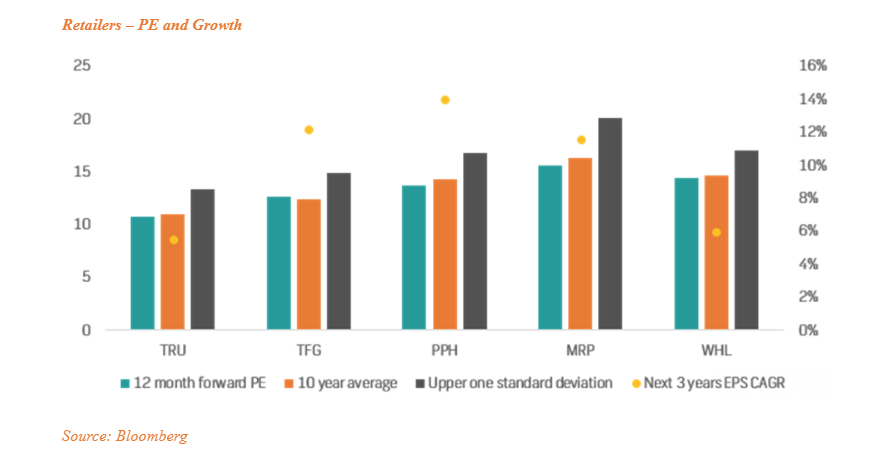
Most of the larger discretionary retailers listed on the JSE are trading above their two- and five-year average price-to-earnings (PE) ratios.
However, delving into history and looking at growth rates changes the picture somewhat.
All these retailers, bar The Foschini Group (TFG), are trading below their ten-year average forward PEs, and all these names are trading well off the upper end of their fair value range.
TFG, Pepkor, and Mr Price’s growth looks very solid over the next three years. With the above tailwinds, including the two-pot windfall, there is still opportunity in these names.
There is a flipside as well – the money must come from somewhere. It is expected that it will flow out of domestic bonds and cash – but given the size of these holdings in absolute terms, the flow impact is expected to be quite small.
The introduction of the two-pot system may result in slight short-term pressure for asset managers, money managers, and insurers – but the long-term flow impact is still expected to be net positive.
The graph below shows the PE ratios of South Africa’s largest retailers, with a significant focus on discretionary items, particularly clothing and furniture.






Comments