Absa revolving CEO door – six in six years


Absa has had six interim and permanent CEOs over the past six years, which has contributed to instability in the company, reflected in the bank’s performance against its competitors.
On Monday, 19 August, Absa announced that its CEO, Arrie Rautenbach, will leave the bank on 15 October 2024.
The bank revealed that Rautenbach will take early retirement following engagements between the board and its CEO.
Prior to the announcement, the Sunday Times reported in July that Rautenbach’s job was on the line as the bank was challenged with the “slow pace of transformation, governance lapses and human resource blunders”.
He reportedly met with the bank’s top leadership to garner support, but the meeting did not go as planned.
Some leaders told him they “had lost all confidence in him and wanted a new CEO, while others said they wanted a black African CEO”.
“The general view was that he is weak commercially, and the company has performed poorly under his stewardship,” the Sunday Times reported.
Rautenbach will be succeeded by Charles Russon, who will assume the role of interim CEO from October 2024 until a replacement is found.
This will make Russon Absa’s sixth CEO since 2019, an indication of instability within the bank’s leadership.
One of Absa’s longest-serving CEOs, Maria Ramos, was at the helm for 10 years.
However, after her departure in 2019, the top position at Absa became a revolving door – the CEOs that followed her all served terms of less than three years.
Financial Times writer and financial journalist Rob Rose said Absa could not afford another crisis at the top.
However, that is exactly what has happened. “It sheds the light on how unstable Absa has been for the last few years,” Rose told SABC News.
A similar situation has been noted at embattled institutions like Eskom, which has had 14 CEOs, interim CEOs and acting CEOs in just 16 years.
Commenting on Eskom’s revolving door, Efficient Group chief economist Dawie Roodt previously said frequent CEO turnover could be “hugely disruptive” to an organisation.
“You cannot run a company – any company – if you have a new CEO all the time,” he said.
A CEO does more in a company than give direction. A CEO is also a team leader who is supposed to take his team with him.
Without a CEO, a company will lose direction, and everyone on the team will become rudderless.
Roodt said the instability within Eskom’s top leadership can be seen in the company’s performance over this time period.
The same can be said about Absa, which is the worst-performing South African bank stock this year, according to Bloomberg.
“We believe the frequent board and CEO changes, with multiple interim designations, have limited Absa’s ability to develop and implement a consistent strategy,” Adrienne Damant, an analyst at Avior Capital Markets, told Bloomberg.
“Until Absa’s executive team stabilises, we believe Absa will trade at a discount.”
While the bank’s share price reacted positively to Russon’s appointment, scepticism remains about whether he can close the gap and claw back market share from Absa’s competitors.
Old Mutual Wealth research analyst Tasneem Samodien told Bloomberg that Absa’s credit loss ratio has exceeded the board-approved target range, whereas peers have managed credit stress more effectively.
“Competitors like Standard Bank and Nedbank have successfully communicated and achieved their goals to increase return on equity, whereas Absa’s performance has declined,” said Samodien.
“Overall, the bank has many challenges that contribute to its lower valuation relative to peers, and we remain cautious about its outlook.”

Compared to its peers, Absa’s struggles become clear, as all of the other major banks in South Africa have had relatively stable leadership for the past decade.
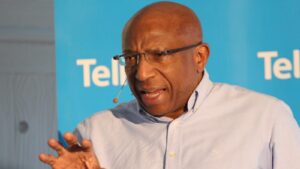
Standard Bank CEO Sim Tshabalala has been at the helm since 2013. Before that, he served as deputy CEO for four years.
FirstRand has also enjoyed orderly success among its leaders. Before handing the reigns to Mary Vilakazi earlier this year, Alan Pullinger served as chief executive since 2018.
Nedbank CEO Mike Brown was South Africa’s longest-serving banking CEO, holding the position for 14 years before stepping down earlier this year.
Brown handed the reigns to Jason Quinn this year. He was the financial director of Absa before joining Nedbank.
Capitec – the youngest bank among South Africa’s largest – has only had two CEOs since it was founded in 2000.
In 2000, Michiel le Roux approached Gerrie Fourie to start Capitec Bank. Fourie served as chief operating officer until he took the reins as CEO on 1 January 2014.
These banks stand in stark contrast to Absa, which has had six CEOs in six years – and is now looking for a seventh. Below is an overview of Absa’s CEOs between 2019 and 2024.





Comments