DStv price increases in South Africa and the pain that followed



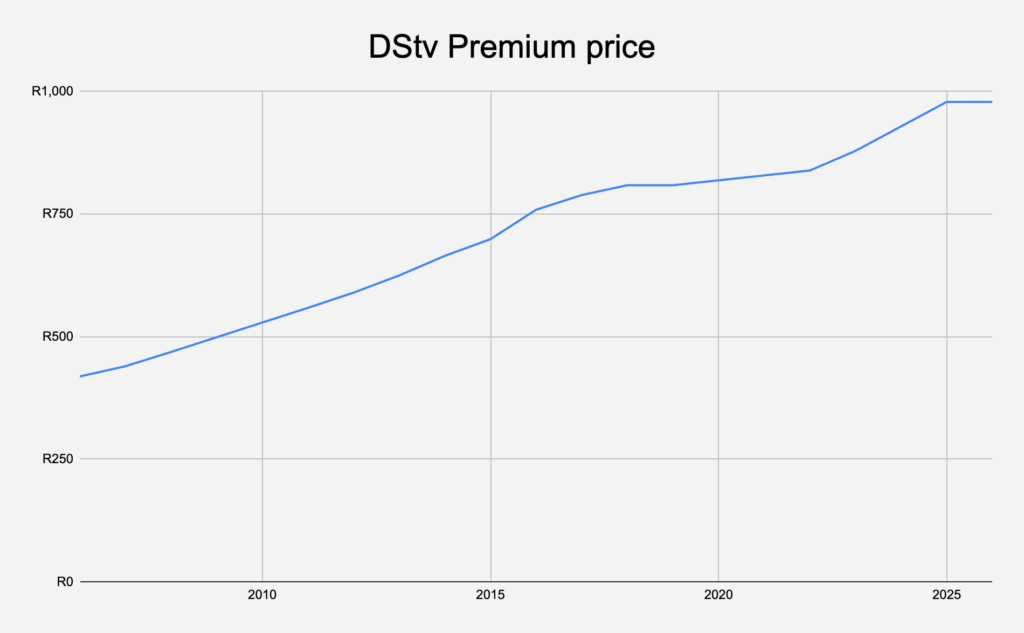
Over the past two decades, the price of MultiChoice’s DStv Premium package has increased from R419 to R979 per month.
This reflects a 133.65% increase in 20 years, far outpacing average headline inflation of 5.4% per year over the same period.
As MultiChoice’s prices rose, it became increasingly difficult to gain and keep DStv subscribers. Since 2023, MultiChoice has been losing subscribers.
This was despite DStv practically having operated as a monopoly for much of its history in South Africa, unquestionably dominating the local pay-TV market.
Today, many South Africans remain subscribed to DStv Premium solely for its extensive live sports offering and some local content.
MultiChoice, through its SuperSport division, holds many exclusive multi-year sports broadcasting rights, making it the only destination for South Africans who want to watch specific matches.
This sports offering is also available only on DStv’s premium package, which comes at a higher price.
In 2006, this pay-TV package would set South Africans back R419 a month. This was at a time when satellite pay-TV was in its early growth phase in Africa.
The year after, the service began to expand rapidly, with DStv gaining 300,000 subscribers between 2006 and 2007.
In 2008, it launched lower-tier bouquets in an attempt to draw more customers who may not have been able to afford the premium package price.
That same year, it increased the price of its premium package to R469 a month, a 6.62% increase from the prior year.
Over the decade to follow, MultiChoice continued to gain subscribers. At the same time, it was increasing the price of the premium offering by well over 5% each year.
It was only in 2017 and 2018 that DStv’s price increases slowed to below 4%, as currency devalutions in the Rest of Africa severely affected its subscriber growth.
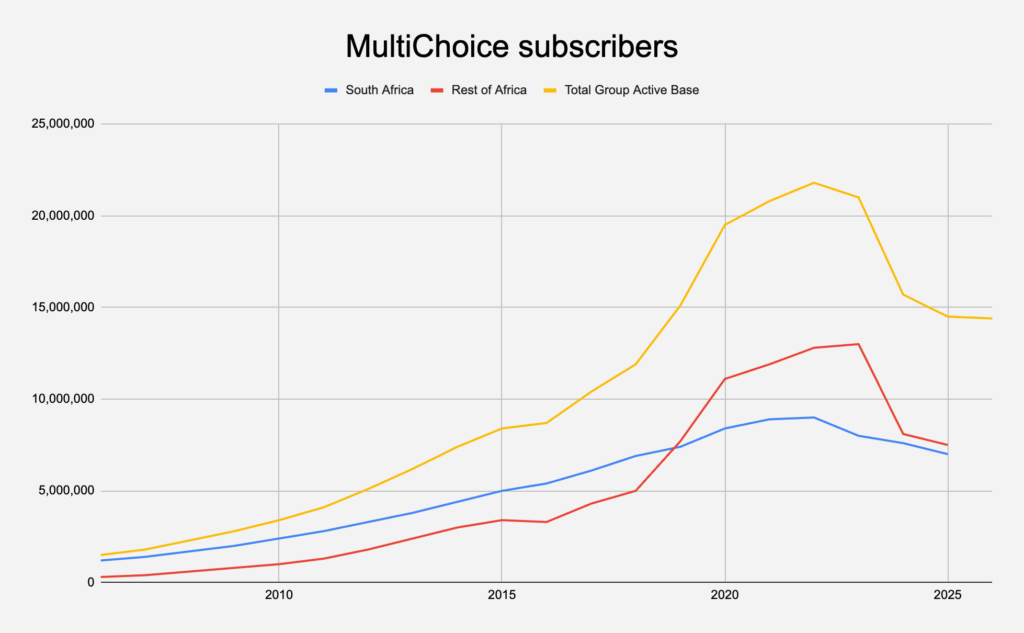
By 2018, MultiChoice was charging R809 per month for its premium DStv package, and it boasted 11.9 million subscribers, including 6.9 million in South Africa.
However, while its total subscriber count was growing, the service was rapidly losing premium customers, who either left or switched to lower-tier offerings.
The pain that followed
Between 2017 and 2022, MultiChoice kept its annual premium price increases well below 4%, and even froze prices in 2019.
The reason for this freeze was to combat a sharp decline in high-end subscribers. It also came at a time when streaming services were starting to gain ground in South Africa.
To stave off competition from international giants like Netflix, DStv had to reconsider its premium package pricing.
However, when the Covid-19 pandemic hit in 2020, and its ensuing lockdowns kept many South Africans at home, DStv saw an influx of subscribers.
Its total subscribers rose by 29% between 2019 and 2020, reaching 19.5 million active subscribers, including 8.4 million in South Africa.
Despite this surge in subscribers during the Covid-19 pandemic, MultiChoice’s finances were struggling. While its total subscribers rose significantly, this was not due to subscribers going for the premium package.
In fact, MultiChoice’s average revenue per user in South Africa declined by 4% in its 2020 and 2021 financial years. The company attributed this to pricing strategies and subscribers shifting toward lower-tier packages.
The premium package was less attractive during the pandemic because sports and local content production were disrupted by lockdown restrictions.
Post-lockdown, MultiChoice’s subscriber growth was significantly lower, gaining only 4.81% between 2021 and 2022.
Total subscribers hit a milestone of 21.8 million in 2022. That year, DStv’s premium package cost South Africans R839 per month.
Despite hitting a record number of subscribers, MultiChoice’s bottom line had begun to struggle.
The company’s trading profit fell by R10 billion in the financial year ended March 2023, largely due to escalating load-shedding in South Africa and its heavy investment in Showmax.
In 2023, for the first time in decades, MultiChoice’s total subscriber base declined. It went from a record 21.8 million in 2022 to 21 million subscribers.
That same year, MultiChoice had hiked the price of its premium offering by 4.77%, bringing it to R879 per month.
The effect of this showed in the company’s results for the year ended March 2024. Its revenue dropped by 5%, and its trading profit fell by 21%.
That year, MultiChoice also became technically insolvent, meaning its liabilities outweighed its assets.
At this point, MultiChoice was desperate to hold on to subscribers, yet its struggling bottom line forced the company to hike prices further, cut decoder subsidies, and contain costs.
MultiChoice today
In 2024 and 2025, MultiChoice hiked the price of DStv Premium by 5.69% and 5.38%, respectively. This brought the price up to R979.
Over the same period, MultiChoice was bleeding subscribers. Its total active base had declined to 14.5 million in 2025, less than half of which were in South Africa.
MultiChoice’s finances also continued to worsen, with the group recording a headline loss of R700 million for the year ended March 2025.
However, a major change came in 2025, when MultiChoice was acquired by the French media giant Canal+, which bought the company in a R55 billion takeover.
While this acquisition means investors will no longer be able to see detailed financial data for MultiChoice and DStv, Canal+’s latest results gave an idea of how the pay-TV giant is performing.
In Canal+’s 2025 financial year, during which MultiChoice was included for the final 3 months and 22 days, it contributed R12.87 billion in revenue.
The inclusion of MultiChoice also expanded Canal+’s global reach to 42.3 million subscribers across 70 countries.
However, as a standalone entity, MultiChoice was still struggling. Its unaudited figures for the full 12 months of 2025 revealed that its subscribers had fallen to 14.4 million.
For the first half of 2026, Canal+ reported that MultiChoice’s consolidation drove a 40% increase in its total revenue. MultiChoice’s contribution to the group’s Adjusted EBITDA surged by 34.4%.
Despite this, MultiChoice itself experienced a 2.9% decrease in revenue. Canal+ said it has plans to turn the company around and restore its financial position.
One of these plans included freezing the DStv Premium price increase for a year. This means the premium package remained at R979 per month for 2026.
It also lowered entry-level decoder equipment prices and expanded MultiChoice’s sales network by 15% since March 2026.
The company said this led to June 2026 being the best subscriber acquisition month in South Africa in a decade.
Canal+ has also heavily reinforced MultiChoice’s premium content offering, securing long-term rights to the Premier Soccer League and the Men’s 2027 and Women’s 2029 Rugby World Cups.
It remains to be seen whether these initiatives will see subscribers return to DStv, and specifically its premium offering.
DStv Premium prices from 2006 to 2026
| Year | Price |
| 2006 | R419 |
| 2007 | R440 |
| 2008 | R469 |
| 2009 | R499 |
| 2010 | R529 |
| 2011 | R559 |
| 2012 | R590 |
| 2013 | R625 |
| 2014 | R665 |
| 2015 | R699 |
| 2016 | R759 |
| 2017 | R789 |
| 2018 | R809 |
| 2019 | R809 |
| 2020 | R819 |
| 2021 | R829 |
| 2022 | R839 |
| 2023 | R879 |
| 2024 | R929 |
| 2025 | R979 |
| 2026 | R979 |
 Loading ...





Comments