Godongwana’s new rules to avoid another lost decade in South Africa


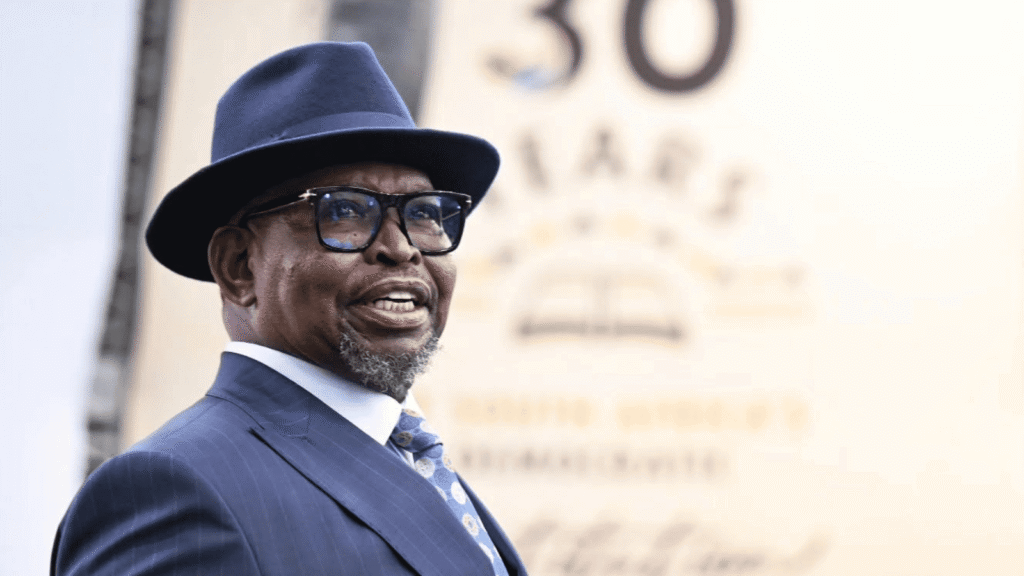
Finance Minister Enoch Godongwana unveiled new rules to ensure fiscal sustainability as debt reached a peak.
Godongwana confirmed that debt as a percentage of gross domestic product topped out at 78.4% in 2025-26, slightly lower than anticipated in February’s budget, and is seen declining in the years ahead.
“South Africa has emerged from the fiscal wilderness,” he said in the introduction to the medium-term budget policy statement that he presented in Cape Town on Wednesday.
“Government is meeting its fiscal targets and restoring the public finances to good health.”
The consolidated budget deficit is seen narrowing to 3.9% in the year through March, down from the previously forecast 4%.
Treasury also projected the primary budget surplus, or revenue minus non-interest spending, to grow for a fourth consecutive year to 1.7% of GDP, up from 1% in 2025-26.
To safeguard these gains, the government released draft fiscal anchor legislation for public comment, expected to be tabled in parliament next year, Godongwana said in his speech to lawmakers.
It foresees a principles-based fiscal rule focused on sustainability, with each new administration required to outline targets that are subject to oversight by parliament.
“The fiscal anchor forms part of the most extensive reconfiguration of the public finance system since 1999, in line with broader efforts to strengthen state capability,” the National Treasury said in budget documents.
The revamp could boost market sentiment.
South Africa’s bonds have outperformed peers in recent months, with the benchmark 10-year bond yield remaining steady around 9%.
Treasury expects to collect R17.1 billion more in taxes than anticipated in its February budget, helped by stronger mining receipts.
Godongwana’s budget marks significant progress since he took over as finance minister in 2021.
Then, the country’s finances were in a parlous state following the pandemic and years of mismanagement during former President Jacob Zuma’s scandal-marred leadership.
The minister was quick to point out that the improved outlook was achieved despite economic headwinds, including surging energy prices due to the Iran war.
The Treasury revised its 2026 growth forecast to 1.2%, down from a projected 1.6% estimate in February.
Godongwana announced temporary relief for motorists and commuters, reducing the fuel levy by R3 per litre for diesel and by R1.50 per litre for gasoline from 4 November to 1 December.
Future interventions would have to remain fiscally neutral, to prioritise fiscal targets over relief, said Duncan Pieterse, director-general at the Treasury.
The government previously allocated more than R17 billion for similar relief.
South Africa increased its borrowing requirement in the current fiscal year by 54.3 billion rand compared with the February projection, mainly to finance a domestic buyback program designed to smooth out redemptions.
The National Treasury expects total borrowing to reach R443.2 billion in 2026-27, compared to R380 billion projected in February.



Conversation
3 commentsOur finance minster has merely demonstrated he can nearly balance budget, without repaying interest. So he’s still gonna have to borrow money, (roughly R400bn) to repay interest!??
Now these are merely numbers on a spreadsheet. They do not take into account the following:
Our GFCR is hovering at 14%. in order to merely keep the productive assets of SA in equilibrium (by compensating their depreciation), we need GFCR at 15-17%. Finmin is clapping hands, whilst SA wears out assets.
Look where stands on several crucial assets now:
-SA Roads system: SA roads has maintenance backlog around R200bn. Much of our road system is in poor to very poor condition. We should be spending around R120 billion a year just to keep our roads in their current condition. We are effectively spending one-tenth the required amount.
-SA rail system: Transnet/Metro Rail was effectively stripped during COVID and incurred damage of roughly R120 billion. Large sections of our rail system remain unusable. That asset value has yet to be recovered.
-Sewage: More than 70% of our waste water treatment plants are in poor to very poor condition. Raw sewage is escaping from these plants to poison our rivers dams, where they threaten supply of quality potable water arriving in homes. Water from most river catchments in SA is now polluted…. Unfit to drink. Yet animals and people are drawing the water from these sources.
-Potable water: Between 42% and 47 of piped water in South Africa leaks away between dam and customer. The quality of potable water depends on filtration and sanitization where it is tapped from polluted dams. These systems are maintained the same way our sewage is maintained so if/they fail, contaminated water causes outbreak of dysentery-like symptoms that overload local hospitals (whose normal state is often a human rights concern).
-Electricity delivery: R320 billion was stolen from Eskom during the construction of two power stations, which led to 70% of Eskom debt before government started assisting. We have a grid network backlog of R400-R700bn required, to reinforce the grid so green energy can deliver power under open energy markets….but electricity prices are already structurally so high, electricity use is in decline….bad market signs.
-Municipalities: Most state services arrive via municipalities, so they’re crucial to service delivery. SA has about 257 municipalities. 80% (n=205) is not financially sustainable, meaning their planned spending is not covered by expected income. 42% (n=108) are or should be under administration. Municipal Irregular unauthorized, W&F expense was recorded as R286bn. Overall, they only collecting 63% of revenue, and their costs of sales is soaring… way faster than inflation.
The Finmin is rejoicing a clean dot, on his massive iceberg of serious problems.