South African electricity prices increased 900% in 19 years and it is set to continue



Electricity prices have risen five times faster than inflation since 2007, and the government’s new Electricity Pricing Policy lacks a path to lowering these tariffs.
While the policy references affordability and cost-reflectivity, it provides no concrete implementation framework or roadmap to achieve them.
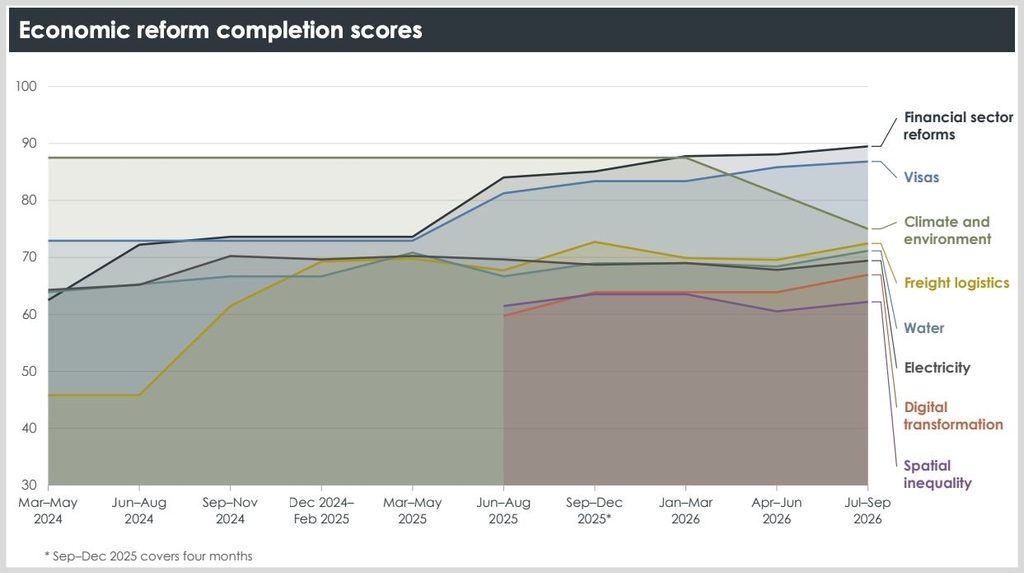
This is according to Business Leadership South Africa’s (BLSA) Reform Tracker for the third quarter of 2026.
This tracker monitors the government’s progress in implementing reforms across different areas of South Africa’s economy.
One critical area that BLSA tracks is South Africa’s energy and electricity sector, which falls under the economic reforms category.
In the third quarter of 2026, BLSA’s electricity reform index rose 2.4%, from 67.8 to 69.4 index points, due to progress made in three areas.
The three areas were: consensus on an independent Transmission System Operator (TSO), the revised Electricity Pricing Policy, and the electricity market transformation position paper.
“The TSO independence confirms a policy decision that now shifts to implementation, while the other two are still in the early stages of defining policy,” BLSA said.
“Across them all, collaboration between government, industry, and civil society remains important to achieve delivery.”
The gazetting of South Africa’s Revised Electricity Pricing Policy (EPP) in August 2026 was seen as a step in the right direction towards opening up the local electricity market to more players.
“It modernises the 2008 policy with a shift in focus to a multi-market model with competition in the electricity sector,” BLSA said.
However, BLSA said there remain glaring shortcomings in the new policy, which make it fall short of many objectives.
Crucially, BLSA pointed out that the EPP aims to ensure cost-reflectivity, affordability, and transparency.
Yet the policy provides no implementation framework to reach that point. “In fact, much of this work is deferred to Nersa to develop appropriate regulations,” BLSA said.
“The policy will need to be enhanced, and the public consultation requires meaningful engagement to shape the policy into one that is fit for purpose.”
Electricity prices have skyrocketed in South Africa
BLSA explained that the revised EPP is essential to guiding tariff reform as South Africa’s electricity sector transitions to an unbundled, competitive, multi-market structure.
However, while the policy upholds the principle of affordability, BLSA said it is silent on how to achieve a credible pathway to lower tariffs.
This lack of a clear roadmap to lower tariffs comes as electricity prices in South Africa have risen by 900% since 2007, as much as five times above inflation over that period.
EE Business Intelligence managing director Chris Yelland said in a Newsday interview that, for millions of South African households and businesses, electricity has become unaffordable.
“There are businesses that have had to forgo growth and even close down because the price of electricity has made these businesses uncompetitive,” Yelland said.
To remain competitive and reduce costs, some local businesses have invested in alternative energy sources, such as rooftop solar.
This has led to Eskom losing some of its biggest customers, further pressuring the utility’s revenue and pushing prices even higher.
Aside from this, Yelland attributed South Africa’s high electricity costs to inefficiencies and poor management at Eskom.
“A lot of these costs – the costs of inefficiently incurred costs, the cost of electricity losses through theft and non-payment – are considered to be costs that are not normal in a business,” he said.
“They are the result of a poorly managed business and the job of the regulator is only to pass through efficiently and prudently incurred costs.”
“The regulator has to start putting its foot down and not allowing these costs to be passed through to the customer.”