Prices have risen 158% since 2008. Eskom’s electricity prices skyrocketed by 1,044% over the same period.


Eskom’s electricity prices have increased more than ten times since 2008, far outpacing both consumer inflation and increases in electricity generation costs.
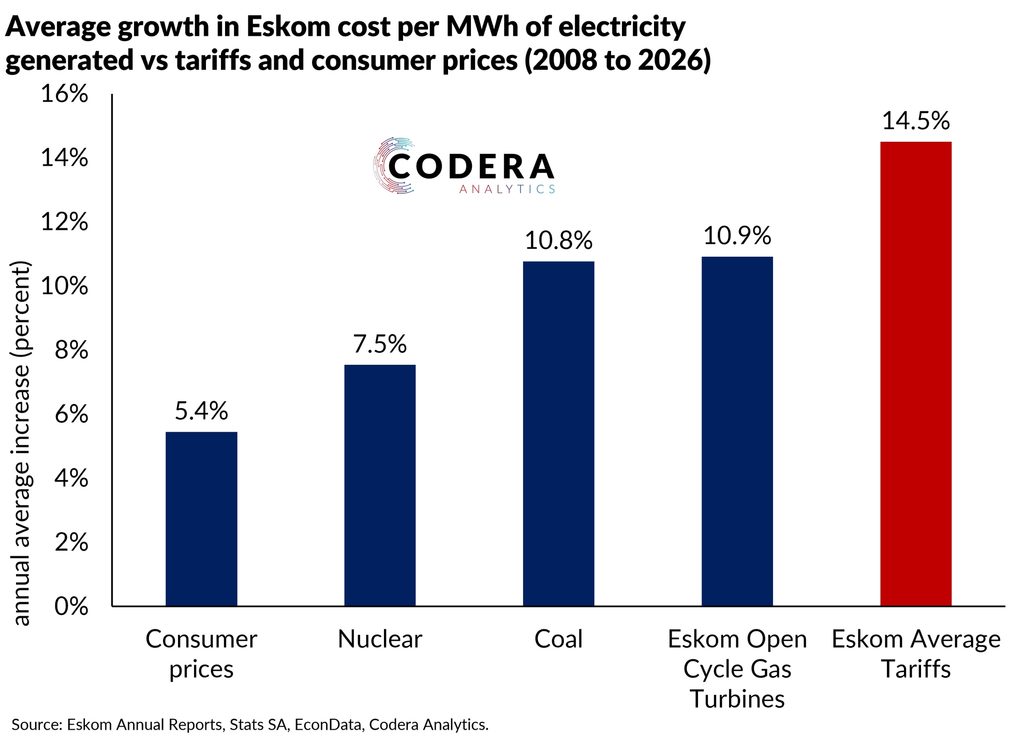
A recent blog post from Codera Analytics revealed that consumer prices in South Africa had grown at an average annual rate of 5.4% between 2008 and 2026.
Over that same timeframe, Eskom’s average electricity tariffs had risen at an annual rate of around 14.5%, almost three times the average annual rate of consumer inflation.
This translates to an absolute growth in electricity prices of 1,044% over the past 18 years, compared to a 158% growth rate in consumer prices during the same period.
While Eskom’s tariffs at the beginning of 2008 averaged around 19.59 c/kWh, the power utility reported its average tariffs at 206.34 c/kWh by the end of March 2026.
Eskom’s annual tariff adjustments are determined by the National Energy Regulator of South Africa (Nersa), based on a Multi-Year Price Determination (MYPD) submitted by the utility.
Over the past two decades, Eskom has consistently maintained that the tariff adjustments approved by Nersa have historically not been cost-reflective.
This has led the power utility to frequently challenge these approved adjustments by filing review applications with Nersa through the South African court system.
“The inadequate tariff path has been an ongoing challenge since 2006,” Eskom said in its latest performance report. “It is one of the main reasons for historic financial constraints.”
“This is together with operational challenges and the reliance on debt to fund our new build programme, which in itself was a result of the inadequate tariff.”
Eskom’s Capital Expansion Programme saw the utility increasingly borrow state funding to construct new power stations and expand the national transmission grid.
By the end of the last financial year, Eskom’s state-guaranteed debt totalled R328 billion. The utility aims to borrow independently without state guarantees by 2028.
Eskom’s rising input costs
One of the main reasons commonly cited by Eskom as driving its high tariff increases is the rising input costs associated with its electricity generation.
Overall primary energy expenditure across the utility escalated from R18.3 billion in FY2008 to R151.9 billion as of the end of FY2026.
According to Codera, costs at Eskom’s Open Cycle Gas Turbines (OCGTs) have increased at an average annual rate of 10.9% since 2008, equating to an absolute growth of 544%.
These OCGTs use diesel as their main resource for generating electricity, which has proven to be Eskom’s most expensive and volatile input cost over the years due to fluctuating global oil prices.
Eskom has said it plans to reduce its usage of OCGTs over the next few years, budgeting for a reduced load factor of 3% on both Eskom and IPP-owned OCGTs in FY2027.
“As OCGTs burn diesel fuel, they are significantly more expensive than other generation sources,” Eskom said.
“The use of OCGTs will be progressively curtailed to ensure long-term financial sustainability and alignment with our decarbonisation objectives.”
The utility has said that these OCGTs were vital in the past in reducing the need to implement loadshedding when coal plant reliability had dropped.
As Eskom’s primary resource for energy generation, coal-related input costs rose by an annual average of 10.8% after 2008, slightly less than diesel.
This was driven largely by a shift away from legacy long-term coal mine contracts towards more expensive short- and medium-term contracts to fill coal supply gaps.
In addition, a heavy reliance on road freight for transporting coal, as rail capacity became increasingly constrained, added significant logistics costs.
Nuclear, which has consistently remained Eskom’s lowest-cost generating resource, increased by 7.5% annually between 2008 and 2026, or 268% over the whole period.
“The cost of nuclear is competitive compared to other base-load technologies,” Eskom said in 2017. “The levelised cost of nuclear power is less sensitive to fuel costs than coal and gas.”
“The greatest hurdles to overcome are the significant capital outlay, coupled with continuous investments required to keep pace with international safety standards.”
 Loading ...


Comments