South Africa’s R10.68 trillion debt headache



South Africa’s preliminary total consolidated gross public sector debt increased to R10.68 trillion, or 137.2% of GDP, as of 31 March 2026.
This is up significantly from R9.47 trillion, or 28% of GDP, as of the end of March 2025.
These figures were revealed in the Reserve Bank’s Quarterly Bulletin published in September 2026.
The bulletin showed that the state’s total consolidated public sector debt, which includes domestic and foreign debt, increased by 12.78% over the past year.
Gross public sector debt comprises financial instruments such as special drawing rights, currency and deposits, debt securities, loans, insurance, pension schemes, and standardised guarantee schemes.
It is the figure reached before netting the individual debt instrument against its corresponding financial assets.
This figure is not to be confused with national government gross loan debt, which stood at R6.17 trillion, or 78.2% of GDP, as of 31 March 2026.
The gross loan debt figure is what the National Treasury was celebrated for stabilising in the 2026 Budget, a goal it had been targeting for over a decade.
Stabilising this figure is considered critical to improving South Africa’s fiscal outlook, as it will allow the state to reduce the interest it pays on its debt over time.
In addition, stabilising and eventually lowering South Africa’s debt-to-GDP ratio sends a positive message to rating agencies about the state’s reliability and fiscal management capability.
However, while the Treasury has made progress in stabilising its headline debt figure, the state’s total consolidated public sector debt continues to rise.
This figure exceeds the size of South Africa’s economy, accounting for 137.2% of the country’s GDP.
This is because, unlike the state’s headline debt figure, total consolidated public sector debt includes government guarantees.
Government guarantees are most commonly seen through bailouts from the National Treasury to state-owned enterprises (SOEs), such as Eskom and Transnet.
According to the Reserve Bank’s Quarterly Bulletin, insurance, pension, and standardised guarantee schemes are the second-largest debt instruments of gross public sector debt.
These schemes increased to R3.18 trillion, or 29.8% of total consolidated gross public sector debt, as at 31 March 2026.
South Africa’s debt problem
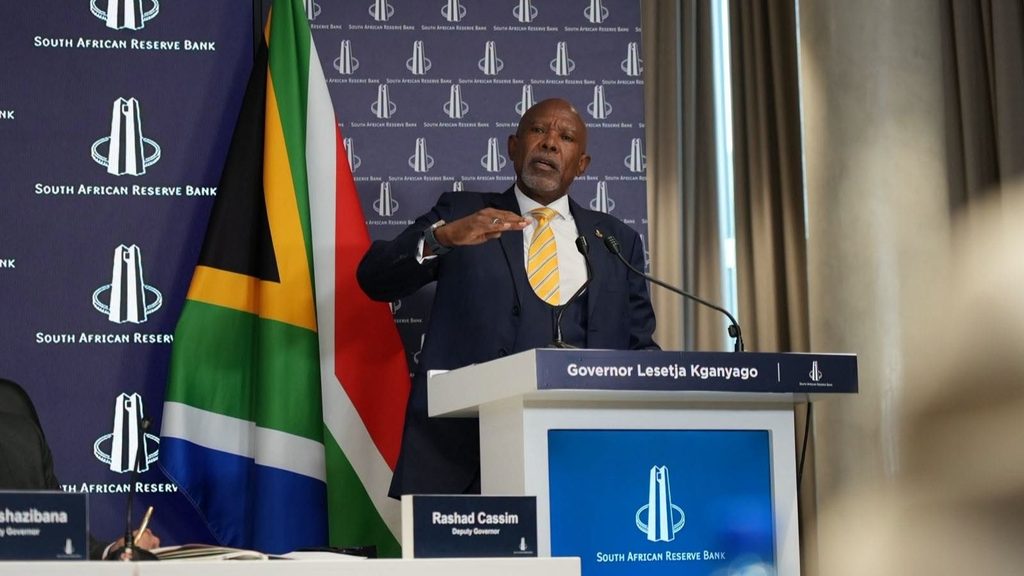
Reserve Bank Governor Lesetja Kganyago recently explained why controlling state debt is a difficult, yet very important, endeavour.
In an address at the Mapungubwe Institute for Strategic Reflection Forum on Africa and Geopolitics, he said that both rich and poor countries struggle with high debt.
“Major economies are now facing a toxic mix of high debt, high interest rates, and large new spending demands for things like defence,” the governor said.
For South Africa in particular, he pointed out that state debt has “more-or-less tripled” since the Global Financial Crisis.
“Interest costs rose severely, now consuming around 5.3% of GDP. To put that in context, the US is paying 4% of GDP in interest expenses, Britain is at 2.8%, and France is at 2.1%,” he said.
“The real problem is that controlling debt is also hard. Cutting spending is unpopular, raising taxes is unpopular, and these decisions are easy to protest.”
However, he also noted that South Africa’s macroeconomic prospects are healthier now than they have been in years.
“After many years of underperformance, with high and rising debt plus relatively high inflation, we are starting to look better, especially in comparative perspective,” he said.
For example, he said that local inflation was at target before it was derailed by the energy shock from the war in Iran.
“For fiscal policy, we finally seem to be recovering from the ‘outer year’ syndrome,” Kganyago said.
“Sufferers of this disease promise that things will get better at the end of the forecast period, but with each forecast, the promise shifts later.”
“Now there is increasing conviction that South Africa’s debt has peaked already and the debt-to-GDP ratio will improve over the next few years.”






Comments