No one knows how much fuel South Africa has in reserve


South Africa has no reliable data on its fuel stock levels, with only a rough estimate of its strategic fuel reserves.
To make matters worse, based on the data that is available, South Africa’s strategic oil reserves fall dangerously short of both the country’s policies and international standards.
These issues were highlighted in a recent article published by Wits professors Rod Crompton and Bruce Douglas Young.
Escalating tensions in the Middle East, after the US-Iran truce essentially collapsed, are once again highlighting South Africa’s preparedness for global oil and fuel shortages.
When the war first broke out, the effective closure of the Strait of Hormuz left many concerned that South Africa would run out of fuel.
Many of these concerns were proven justified when, roughly a month after the war started, many fuel stations in South Africa put out notices that they had run out of diesel and, in some cases, petrol.
This led to calls for the government to provide clarity on South Africa’s petrol, diesel, and jet fuel storage levels.
For example, Sygnia CEO Magda Wierzycka said the “time has come” for an update on South Africa’s petrol, diesel, and jet fuel. “We have no strategic reserves. What is next and by when?” she asked.
“Food chain disruption, load-shedding, water supply issues? How soon? How many weeks?”
The government was quick to reassure South Africans that the country had sufficient reserves and that a supply shortfall was not imminent.
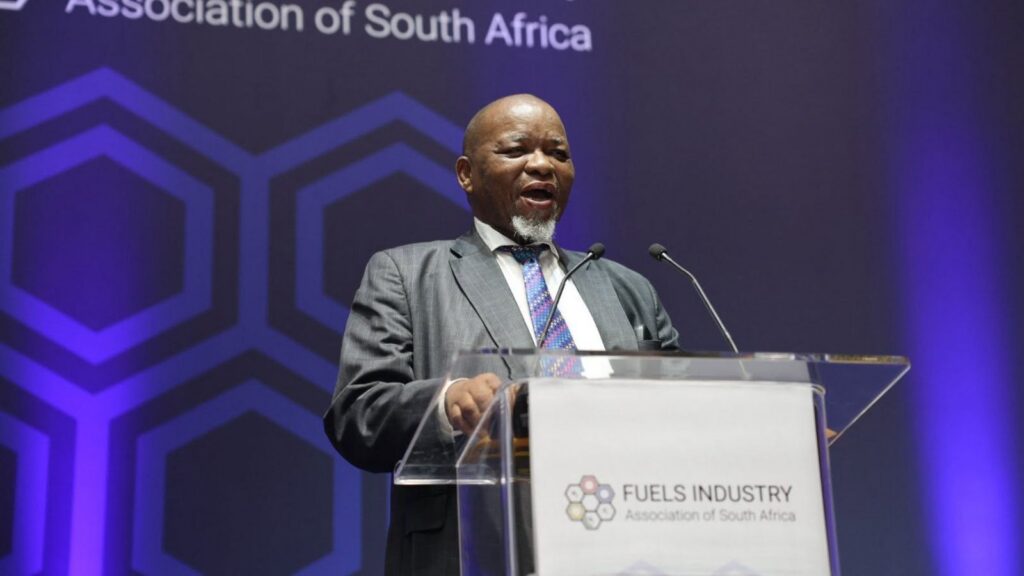
“There is no shortage of petrol, oil, or diesel in the country. It is just expensive. That is the function of the price,” Petroleum Resources Minister Gwede Mantashe said.
The Central Energy Fund said South Africa has about 8 million barrels of strategic crude oil stocks, but virtually no dedicated fuel reserves.
Those roughly 8 million barrels equate to around two weeks’ worth of demand, falling far short of South Africa’s 45-million-barrel capacity, and well below international standards.
After Middle East tensions escalated again this week, Russia suspended its petroleum product exports until further notice amid domestic fuel shortages.
The Bureau for Economic Research’s Tracey-Lee Solomon said that, while Russia’s move will tighten global supply, the impact will likely be limited given that exports had already fallen sharply in June.
No idea how much trouble we’re in
Crompton and Young explained that South Africa faces “huge challenges” in the data about its fuel stocks and needs.
They described the overall quality of fuel data as “very poor”, pointing to government blind spots, highly unreliable figures, and increased illicit activity as rendering the data largely unreliable.
“For example, the Fuels Industry Association of South Africa 2024 annual report data shows that net imports of petrol, diesel and kerosene were 81% of consumption, based on data claiming that diesel imports were 118% of consumption,” they said.
“According to this data set, LPG imports were a staggering 1,685% of consumption. These are obviously highly improbable numbers.”
The National Treasury has previously raised concerns about discrepancies between South Africa’s actual and reported imports, noting that much of the data is skewed by illicit activities such as the adulteration of fuel.
Another issue that Crompton and Young highlighted concerns South Africa’s strategic oil stocks, which are dangerously below the levels required.
South Africa’s energy policy requires at least three months’ worth of total consumption, while the International Energy Agency mandates member countries to hold 90 days’ worth.
Based on reports, South Africa has between 7.7 million and 8 million barrels, equating to two weeks’ worth of consumption.
“The 8 million barrels would last only about 13 days against total liquid-fuels demand of about 600,000 barrels a day, or about 18 days if output from Sasol’s coal-based output of 150,000 barrels a day was taken into account,” Crompton and Young said.
This means South Africa’s oil reserves fall well below its own and international standards.
To make matters worse, the 8-million-barrel number is not necessarily confirmed. Crompton and Young explained that South Africa’s strategic stock is kept secret.
“The country’s Strategic Fuel Fund accounts to Parliament through the portfolio committee on mineral and petroleum resources,” they said.
“Although the quantity of stocks was not disclosed, in its March 2025 report, the committee raised concern about ‘insufficient’ strategic fuel reserves.”
This uncertainty, they said, presents a notable problem that South Africa needs to address.
“Our analysis of the current situation is that South Africans should be concerned about the fact that the quality of fuel data is very poor and the country only has a rough idea of where it stands in relation to fuel stocks,” they said.
“Based on our reading of the situation, it appears that the government doesn’t have much idea of how much trouble it’s in.”
 Loading ...





Comments