DStv death by a thousand cuts



DStv is dying a slow death in South Africa, and not even the 2026 FIFA World Cup could help to meaningfully lift subscriber numbers.
This was revealed in Canal+’s 2026 half-year financial results, which included details about MultiChoice’s integration into the company.
Canal+ said that within MultiChoice Group countries, the subscriber portfolio remained broadly flat compared to the first half of 2025.
In comparison, French-speaking African territories, which exclude MultiChoice countries, saw strong growth.
These countries added more than 1 million additional subscribers over the 12 months leading up to June 2026.
This showed that while MultiChoice’s DStv growth has declined in recent years, there has still been growth in Canal+’s offerings.
What is particularly concerning for MultiChoice is that the 2026 FIFA World Cup served as a tailwind, significantly boosting subscriber growth in the first half of the year.
“The event and the commercial growth boost plan led to a 40% increase in subscriber acquisition in MultiChoice countries compared to the first half of 2025,” it said.
June 2026, when the 2026 FIFA World Cup began, was the best month for subscriber acquisition in South Africa in a decade.
However, despite this strong subscriber growth driver, the DStv subscriber base remained flat. This does not bode well for the service.
DStv’s poor growth filtered down to MultiChoice’s finances. Its revenue for H1 2026 was €1,184 million, a 2.9% decline from €1,220 million in H1 2025.
This decline was attributed to equipment subsidies that reduced the barrier to entry for new subscribers and to a 1% decrease in subscription revenues.
The poor DStv subscriber numbers forced Canal+ to implement cost-cutting measures, which started to filter through to the financial results.
Adjusted earnings before interest and taxes rose by 160% to €143 million, up from €55 million in H1 2025. The Adjusted EBIT margin reached 12.1%, up from 8.7%.
DStv death by a thousand cuts

Canal+ has stopped reporting individual DStv numbers in its financial reporting, which makes it difficult to track local subscriber changes.
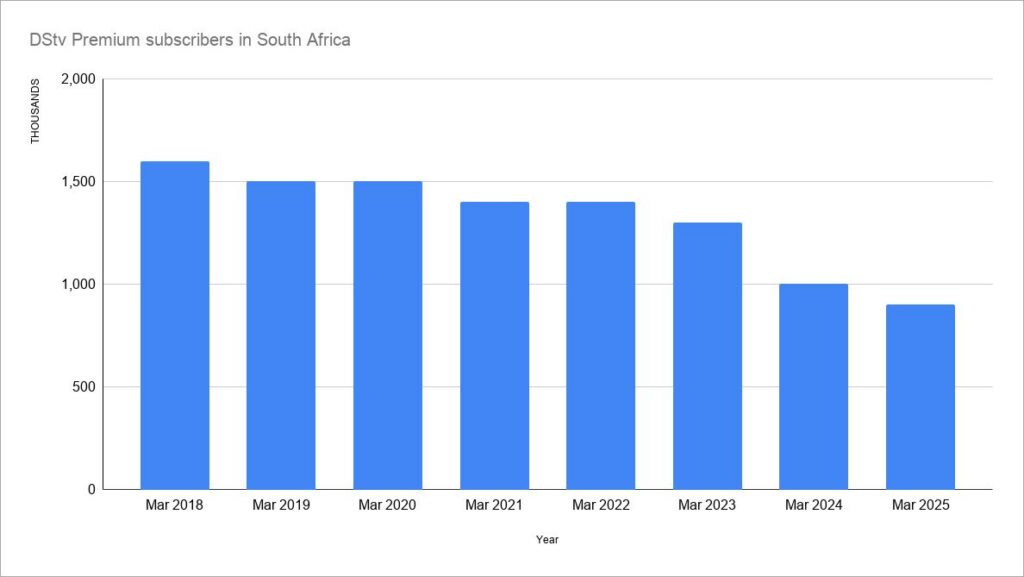
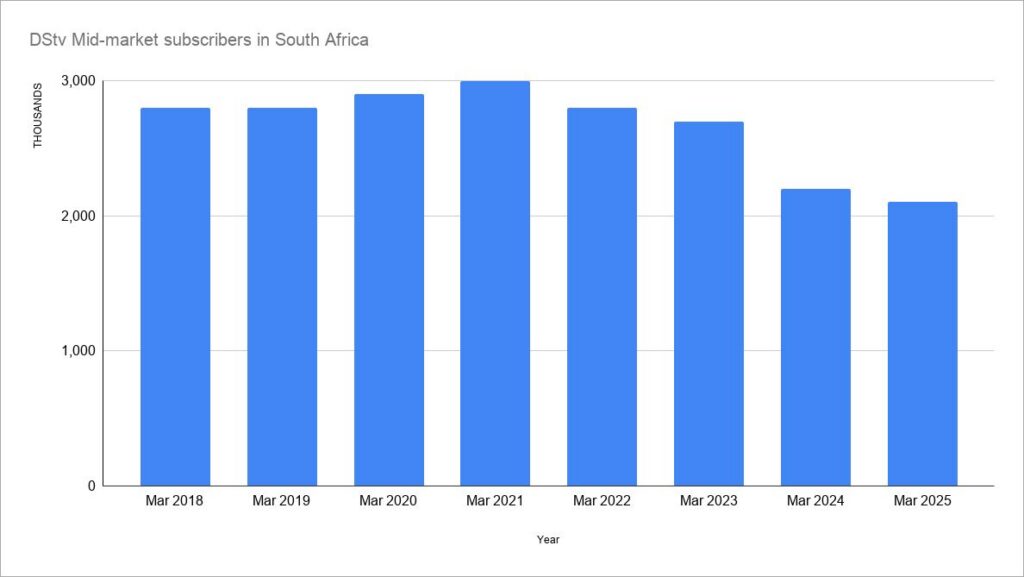
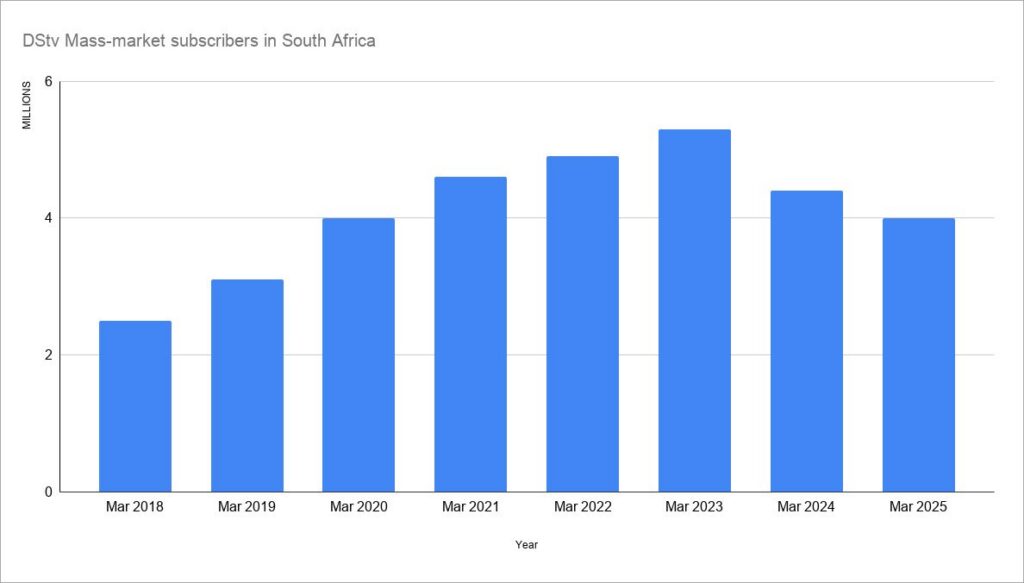
However, previous financial results give a good indication of the trend which MultiChoice is grappling with when it comes to DStv subscribers.
MultiChoice’s integrated annual report for the year ended 31 March 2025 showed that DStv lost 589,000 subscribers in South Africa.
The premium base, including Compact Plus and DStv Premium, declined by 96,000 subscribers, representing a 9% year-on-year decline.
Middle-market subscribers, including DStv Compact and Commercial package users, fell by 99,000, representing a 5% year-on-year decline.
The mass-market tier, including DStv Access and DStv Family, lost 394,000 subscribers, representing a 9% year-on-year decline.
Canal+, which acquired DStv owner MultiChoice last year, cancelled Showmax in April 2026 after it failed to live up to expectations.
That means DStv will rely on its streaming offering, DStv Stream, to compete with Amazon Prime Video.
However, DStv Stream’s most affordable package costs R99 per month, significantly more than Amazon Prime or Netflix’s R59 per month.
Other DStv Stream packages, which offer better content, including Showmax Originals, are priced at R299 and R699 per month.
Price is the biggest reason people cut the DStv cord, but it is unclear how MultiChoice can respond to the threat from Amazon Prime.
MultiChoice is under severe financial pressure, and cutting prices to R59 per month is highly unlikely.
This means DStv could lose more customers as households shift to more affordable streaming options, such as Prime Video or Netflix.
Sports and piracy are other challenges
Another challenge is that DStv’s biggest drawcard, sport, is getting cannibalised by customised online sports streaming services.
Many top sports, like F1, have their own streaming platforms, which offer better quality content than DStv. YouTube also has many high-quality sporting content.
South Africans can therefore subscribe to an entertainment service like Netflix or Amazon Prime and still get their sports fix through a custom subscription.
Many people who want to save money have also turned to piracy, which offers unlimited access to movies, TV series, and live sports streaming for free.
Another reason for piracy is the fragmented content system, where many shows are not available to DStv subscribers.
TV expert Thinus Ferreira said that the loss of premium content, including many major HBO and first-run Warner Bros. Discovery shows, drove people to piracy.
“Canal+, MultiChoice, and M-Net are now driving DStv subscribers to piracy because content that used to be on DStv is no longer there,” Ferreira said.
The problem for MultiChoice and DStv is that once people engage in piracy, they can access all the content they need for free.
It is then very easy for them to cancel their DStv subscription and obtain whatever they need from pirate services.
DStv subscriber numbers in South Africa
 Loading ...





Comments