South Africa is the second-worst place in the world to be an entrepreneur


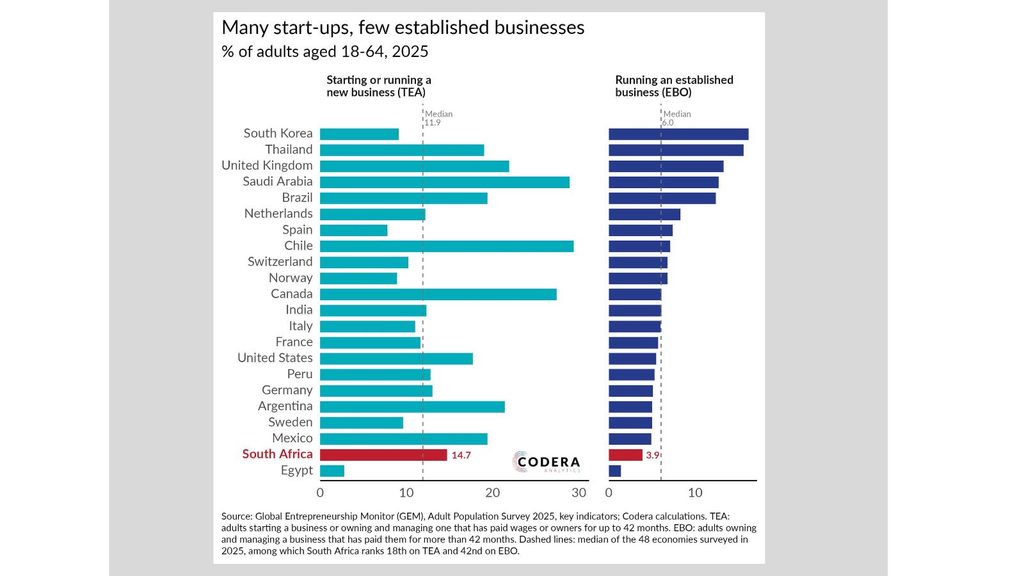
South Africa has been ranked as the second-worst place in the world to be an entrepreneur with regard to building an established business.
While the country ranked relatively well in terms of starting or running a new business, very few of these translate into established companies that employ many people.
This was revealed by the Global Entrepreneurship Monitor in its 2025/26 report, which tracks the level of self-employment in key global economies.
The report revealed that very few businesses survive to maturity in South Africa, with many shutting down within a few years of opening.
Furthermore, many South African businesses stay small as they are informal and are largely started to supplement formal incomes or substitute for formal employment.
Calculations from Codera Analytics show that this results in South Africans earning R13 from self-employment for every R100 of income, three times less than in Brazil or Turkey.
The Monitor’s analysis also points to South Africa’s stagnant economy as a key driver behind a lack of entrepreneurial activity and the creation of established businesses.
It also pointed to trade tensions with the United States as creating significant uncertainty for entrepreneurs who want to access the world’s largest consumer market.
Ultimately, South Africa’s stagnant economy and rising unemployment have led to a surge in early-stage activity, with 14.7% of adults starting or running a new business.
This is an increase from 11% in the previous year’s report and indicates a need for many adults to start their own business to supplement their income or generate income.
While this is good news, the report pointed out that established business ownership fell to 3.9%, meaning that fewer than four businesses out of 100 survive to maturity in South Africa.
This indicates a high level of dynamism, but low survivorship, as businesses fail to get the support they need or are unable to be sustainable in a no-growth environment.
Pointing to the rise in unemployment that results in self-employment, the report showed that half of all early-stage entrepreneurs are aged 18 to 34.
This is the age range with the highest rate of unemployment in South Africa, with 87.3% of respondents saying they started their business to ean a living.
Things are also not getting easier, with respondents saying that they believe starting a business is harder now than it was a year ago.
Small businesses won’t solve unemployment
South Africa’s government and many business leaders have touted the role of small businesses in resolving the country’s unemployment crisis.
However, as the data shows, this is unlikely to happen in a no-growth economy, as businesses fail to survive to maturity and create jobs.
Entrepreneurship in South Africa is seen as a means of surviving as opposed to growing into a medium-sized or large business that employs hundreds of people.
More recently, economists have pushed back on the idea of small businesses as being the way to solve South Africa’s unemployment crisis.
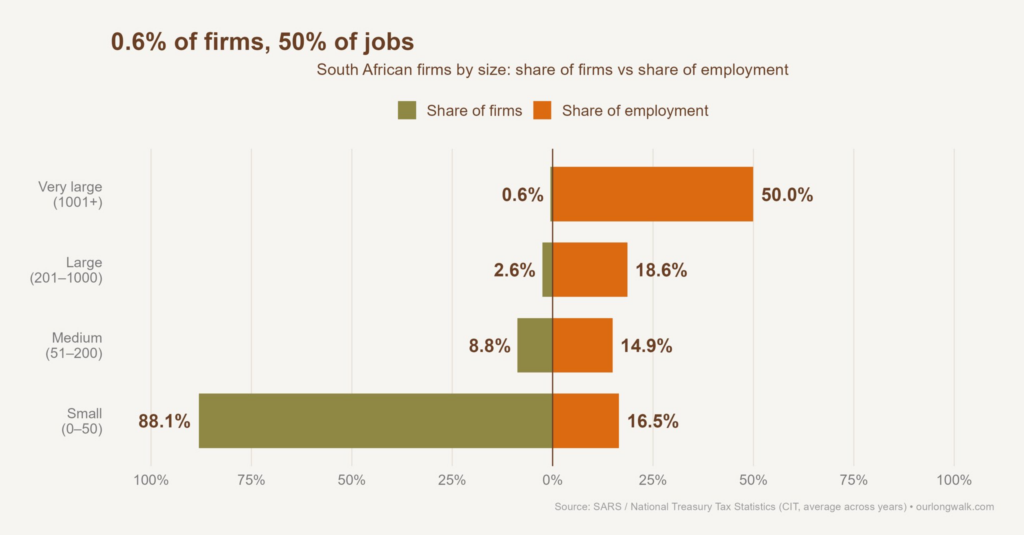
Data show that the majority of formal workers in South Africa are employed by just 0.5% of companies, indicating the importance of big business in tackling unemployment.
While small businesses make up the majority of companies in the country, they do not create the majority of jobs.
Stellenbosch University economic historian Johan Fourie analysed where South Africans are employed and argued that the country does not have an issue in creating businesses.
Where the issue lies is in getting those businesses to grow into medium-sized and large companies that can meaningfully address unemployment.
“If South Africa wants jobs, stop romanticising smallness. Make sure the big firms can compete with the best in the world,” Fourie said.
South Africa does not have national champions on the scale necessary to move the needle in terms of economic output and job creation.
“That is because the uncomfortable truth is that small firms – however admirable their hustle – are not the ones that will move the needle. Large firms will,” Fourie said.
Efficient Group chief economist Dawie Roodt has argued this point for some time, saying that small businesses fundamentally do not move the needle regarding employment in South Africa.
“Small businesses tend not to survive for very long and tend not to employ many people over a long period of time. As such, they do not pay much tax either,” Roodt said.
“That is why the government is wrong to try to create small businesses that cannot compete with big businesses. They may be important for niche products and services, but not much else.”
“Small businesses, in the grand scheme of things, are only important because they can become medium-sized businesses and big businesses in time. That is what has to be done. We have to create corporates. That is where the emphasis must be.”
Fourie’s analysis shows that big businesses employ the vast majority of South Africans, with 0.6% of companies employing 50% of all workers.
Log in or register for free access to all articles.






Conversation
4 commentsEntrepreneurship in SA is largely a “side hustle” , and for most not able to be grown – or simply not worth the compliance hassle of the ANC machinery.
Exactly how the ANC wants it.
They do not care about producing jobs for people. .. not even “owa people” – as that risks making them less dependent on the ANC