South African food giant went from zero to hero



Rainbow Chicken staged a complete turnaround of its business without retrenching any employees.
Following its successful turnaround, the company converted 1,000 temporary roles into permanent positions, bringing its share of permanent employees to 72% of headcount.
This was revealed in Rainbow Chicken’s results for the year ended 28 June 2026, which showed how far the company has come since it launched a turnaround in 2021.
The turnaround strategy was launched when Rainbow Chicken was still a part of RCL Foods, before it was unbundled and separately listed in 2024.
The first phase of the turnaround followed Rainbow Chicken’s “Brilliant Basics” strategy, targeting improvements across breeding, feed formulations, farming husbandry, processing efficiency, and logistics.
Rather than chasing raw volumes, Rainbow systematically refined its feed quality and simplified low-cost feed formulas.
This reduced Rainbow’s input costs significantly, protecting its margins at a difficult time when the local chicken industry contended with load-shedding and a widespread bird flu outbreak.
At the same time, Rainbow’s parent, RCL Foods, converted R2.9 billion in shareholder and treasury loans into equity in February 2024.
This significantly reduced Rainbow’s gearing and interest costs while resolving the company’s unsustainable debt burden.
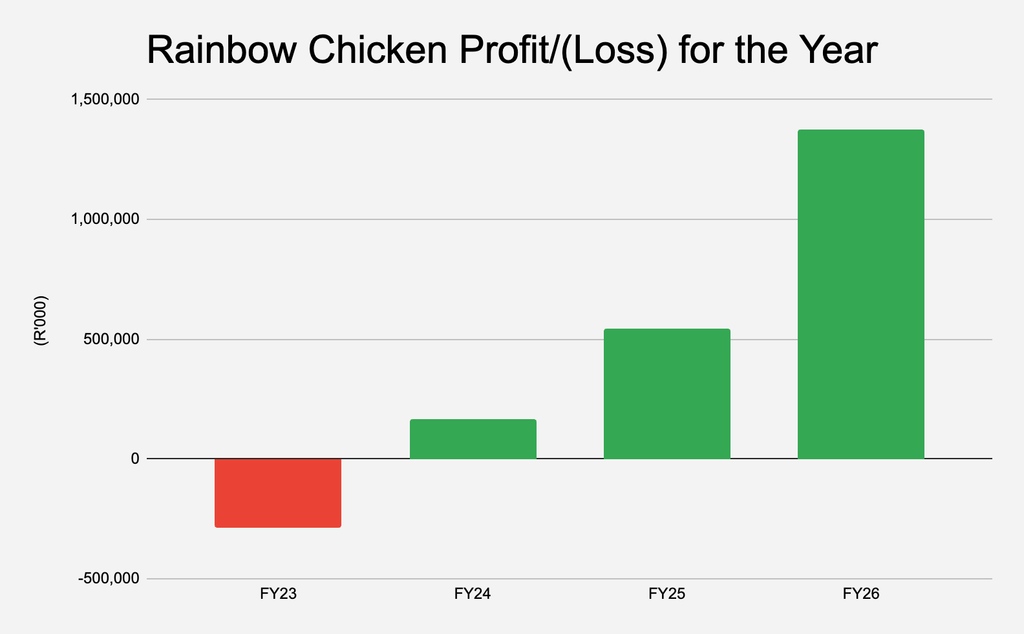
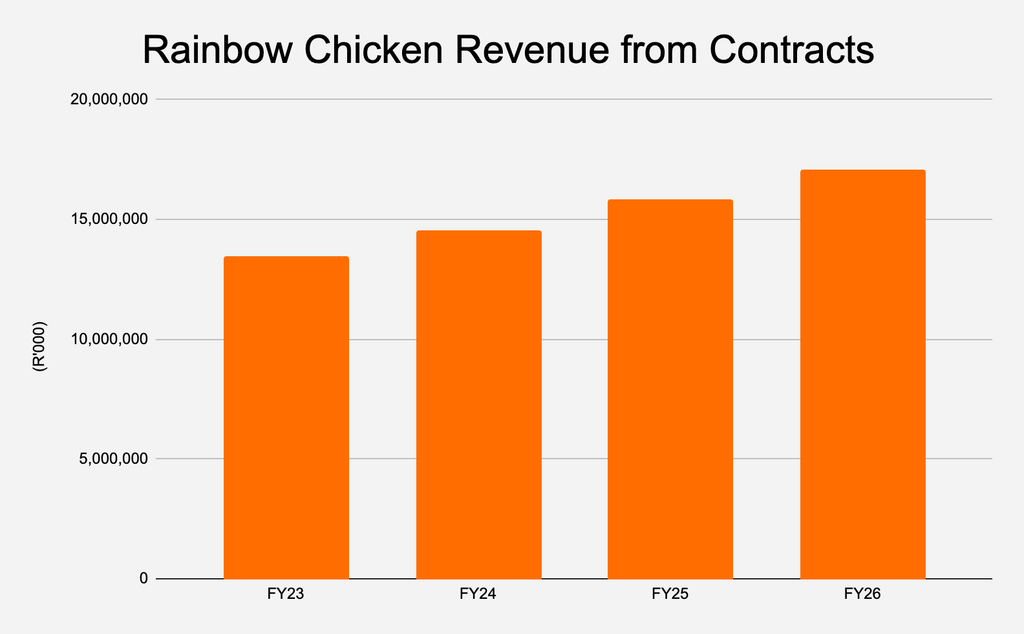
These efforts paid off handsomely for Rainbow. It went from a loss of R285.26 million in the 2023 financial year to a profit of R1.37 billion in 2026.
This turnaround was achieved without launching a Section 189 process, which has become a last resort measure for many South African companies staging a restructuring.
The last time Rainbow Chicken underwent retrenchments was in 2016, when RCL Foods initiated a Section 189 process that affected 1,000 jobs at the chicken producer.
At a media roundtable following the company’s 2026 results, Rainbow Chicken CEO Marthinus Stander said job creation is one of the company’s main priorities.
He said the company hired back many of the employees affected by the 2016 retrenchments, and opted not to resort to job cuts for its latest turnaround.
“When we started a turnaround, it was never a tool to retrench people. We kept the jobs going,” Stander said.
Rainbow’s chief people officer, Barney Khumalo, said the company has always been focused on creating more jobs.
This is why, he said, the company converted 1,000 temporary roles into permanent positions in the 2026 financial year, bringing the share of permanent employees to 72% of headcount.
Retrenchments in South Africa
Section 189 processes have been a staple of many turnaround strategies in South Africa for years.
In 2026 alone, many major JSE-listed companies, including Dis-Chem, Pick n Pay, Premier, and The Foschini Group, have launched retrenchment processes.
This is not unique to private companies, with the South African Post Office also having reduced its staff count by 4,342 employees during its business rescue process.
Staff salaries and wages are often among the highest input costs for businesses, making them an easy target when a company seeks to improve its bottom line.
However, recent changes to South Africa’s labour laws may make retrenchments a more costly process for local businesses.
In February 2026, the Department of Employment and Labour (DEL) gazetted proposed amendments to the Labour Relations Act and the Basic Conditions of Employment Act,
These proposals included doubling retrenchment pay, extending protections to gig workers, and introducing a more equitable maternity leave system.
UASA Trade Union advocate Vusi Masinga told SABC News that the proposal to double retrenchment pay is a welcome effort from Parliament to strengthen workers’ rights.
He explained that, under existing labour laws, severance pay for retrenched employees is limited to a minimum of one week of pay per completed year of continuous service.
The DEL proposed changing this to a minimum of two weeks’ remuneration per completed year of continuous service.
In practice, this could mean that an employee with 10 years of service who is earning R20,000 per month would go from receiving R46,150 in severance pay to R92,300.
Should these proposed amendments be implemented, it will become far more expensive for companies to retrench employees while implementing a turnaround.






Comments