From R10,000 and one pharmacy to R22 billion and 343 stores


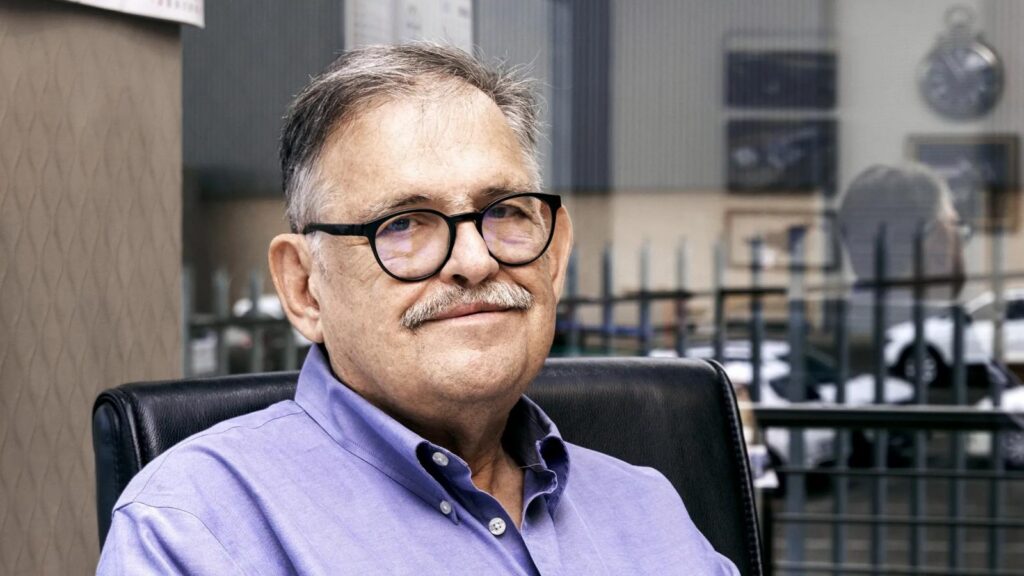
Ivan and Lynette Saltzman started Dis-Chem with R10,000 in 1978, with its first pharmacy being a tiny 75 m² corner shop.
This pharmacy would revolutionise retail in South Africa as the Saltzmans were interested in taking on retail giants across the country.
Their idea of having a front-of-shop retail section would create the concept of a discount pharmacy that dominates South Africa today.
Ivan recently explained how the couple came to this revolutionary idea in a discussion with Broll Auctions after his retirement from Dis-Chem’s board.
Both Ivan and Lynette trained as pharmacists at the University of the Witwatersrand, which put them on track for lucrative careers.
However, it was Ivan’s experience in his home town of Port Elizabeth (now Gqeberha) that informed the creation of Dis-Chem and his love for retail.
After Saltzman’s father passed away when Ivan was 12, his mother ran a general dealer store near a township in Port Elizabeth.
“I was there every Friday afternoon and in the school holidays, particularly before Christmas. I wanted to do things in the store,” Saltzman said.
“You learn a lot from your parents, and they were business people in my case. They were traders, and my mom worked hard in retail.”
The Saltzmans met at Wits and formed a lifelong bond, which began with both working as locums for two years.
During this period, Ivan spotted a run-down shop in the southern Johannesburg suburb of Mondeor, which made him think about his love for retail.
“I realised that I was standing outside a business. It had huge potential, but it was a neglected business,” Saltzman explained.
“I kept coming home from work and telling my wife, ‘If I had this, I would do this, and I would do that.’ I soon realised, instead of going to work, why not own the business?”
Saltzman snapped up the store, its old stock, and some of its furniture fixtures. It was tiny, just 75 m² and situated on a side street.
“Everyone advised me not to buy this shop. They saw what I saw, but they did not see the potential. I knew the potential because I saw what I could do,” Saltzman said.
This little store became the first Dis-Chem, and it did not go as Saltzman imagined. Instead, it turned into something far larger than he could dream of.
Revolutionising retail

The Saltzmans had their store and began making cosmetic improvements. However, there was a major problem – medicine prices were highly regulated at the time.
This left them with little room to compete as they could not lower prices, and it was too expensive to offer superior service.
Saltzman said the pharmacy business at the time was relatively sleepy, with people visiting only when they were sick.
This is where the obsession with retail kicked in. The Satlzmans realised they could sell normal retail products in front of the shop and the medicine at the back.
They wanted to turn Dis-Chem into a corner shop with a pharmacy, ensuring people would visit it more often and enabling the Saltzmans to compete on price and product diversity.
Ivan and Lynette would drive to Jumbo Cash & Carr every two weeks to buy glassware, giftware, and other products they could sell in the front half of the store.
This was hugely popular, and the Saltzmans began opening more Dis-Chem stores in Johannesburg’s suburbs.
Ivan’s obsession with detail made these stores highly efficient and ensured a quality of service that could not be found elsewhere.
“We turned the pharmacy into mini-supermarkets. People in the industry were waiting for me to go bust. But people liked the choice we offered that no one else had,” Saltzman said.
His obsession would drive him to compare their retail prices to Pick n Pay, which was the gold standard at the time under Raymond Ackerman.
“I used Pick n Pay as a benchmark. They were the gold standard of pricing. Every time an invoice came in, I sent someone into Pick n Pay to check the price,” Saltzman recalled.
“I took their price, and I made my price. Whatever we had was cheaper. We used the front shop to build out the back-shop pharmacy.”
The Saltzmans also disrupted pharmacies by investing heavily in ensuring availability and diversity.
“Anything that you wanted to find in a pharmacy, we should have. Competitors did not have thermometers for many years. We had them in pink and blue and at different prices,” Saltzman said.
However, this obsession came with a problem. Dis-Chem could not expand rapidly because of the Saltzmans’ desire for personal oversight of every store.
Letting go

For Dis-Chem to grow, the Saltzmans would have to let go and trust partners to run stores across Johannesburg and around the country.
Ivan knew this, but wanted to expand in a way that would not dilute the Saltzman ownership stake or compromise quality.
To do this, they brought on young, newly qualified pharmacists as minor equity partners to run individual stores.
“I gave them shares at no cost to themselves. They paid it off not from their salary but from the stores’ profits,” Saltzman said.
“They paid it back quickly, but they became ‘owners’ of those stores and took personal responsibility for their performance.”
Saltzman came to trust a handful of these partners deeply and let them run parts of the business.
For example, Brian Bonn took responsibility for legal work, lease negotiations, and licensing. Stan Goetsch famously led Dis-Chem’s charge into sports supplements.
All the while, Saltzman was running the company from a shopping basket that he kept in his car. He would travel to stores and work from there to monitor their performance.
Real growth kicked off in the early 2000s when the pharmacy ownership in South Africa was deregulated, sparking fierce competition between Dis-Chem and Clicks.
To keep up with this growth, Dis-Chem invested heavily in logistics hubs and controls 100,000 m² of distribution centre space in Gauteng alone.
In 2016, Dis-Chem listed on the JSE to give it capital to fund its growth and enable the founders to make their shares liquid.
This also kick-started the transition away from the founding family to professional management, which was completed in July 2026 when Ivan stepped down from the board.
Saltzman said the key to making Dis-Chem a success was personal sacrifice, which required “absolute total focus” on the business.
He would even stop while driving his wife to give birth to peer into a closed pharmacy near the hospital to see what they were doing differently from Dis-Chem.
“We always had supper together as a family, and the conversation was always about Dis-Chem. The boys had to eat their food, and it was not in their interest,” Saltzman said.
“But that is the sacrifice for being successful, and I regret it sometimes.”




Comments