United States sanctions could cause serious financial distress for South African banks


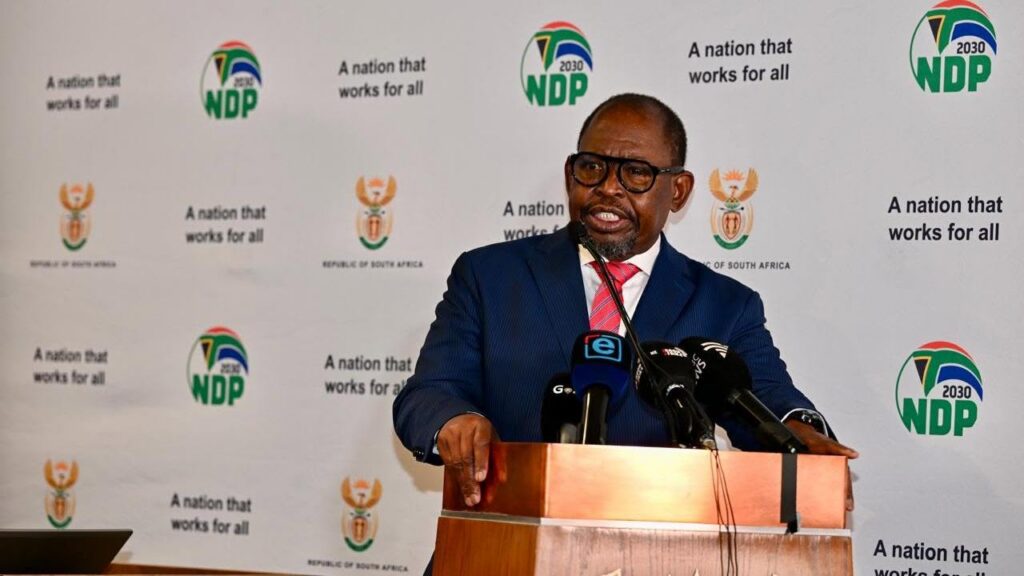
Should United States President Donald Trump instruct foreign pension funds to stop holding South African bonds, it will cause serious problems for local banks.
This is the warning from Efficient Group chief economist Dawie Roodt, who shares his views during an interview on the State of the Nation podcast.
Roodt explained that the official government statistics put debt-to-GDP (gross domestic product) at under 80%. However, there is more than meets the eye.
The off-balance-sheet municipal debt of R450 billion, and the debt of Eskom and state-owned enterprises of R350 billion, push the actual debt closer to R7 trillion.
These items ultimately fall on the shoulders of the National Treasury, which means South Africa’s true debt-to-GDP is 90%.
This ratio, Roodt explained, is far too high for South Africa’s economy, especially when considering the slow economic growth.
The country’s debt servicing costs are R432.4 billion per year, which is more than what South Africa spends on healthcare, basic education, or policing.
To reduce this debt burden, the government must either cut spending or grow the economy. However, both are challenging due to political problems.
Roodt explained that the National Treasury cannot cut spending because 30 million South Africans rely on state support every month.
Another challenge, he explained, is that ‘tenderpreneurs need their money’. These entrepreneurs are linked to the government and politicians.
The other option, economic growth, is only possible if South Africa changes its economic policies.
The current policies, like black economic empowerment (BEE), expropriation without compensation (EWC), and National Health Insurance (NHI), are destructive.
However, these are ideologically driven policies which are unlikely to change under the current government structures.
A big risk to South Africa’s banks and financial system

Roodt explained that South Africa’s financial system and banks are at risk of United States sanctions.
He said that 25% of South Africa’s rand-denominated debt is held by foreign investors, primarily Europeans and Americans.
“That represents a significant lever for someone like the United States President, Donald Trump,” he said.
“If he were to instruct those foreign pension funds that they are no longer allowed to hold South African bonds, they would start dumping them.”
A bond sell-off of that scale drives yields up and bond prices down. That means that South Africa’s debt servicing costs will escalate.
Another problem is that the pool of local buyers, such as domestic pension funds and insurers, is limited.
“South African banks would be forced to step in as buyers of last resort. However, their balance sheets are already heavily exposed to government debt,” he said.
“If they are forced to absorb even more falling, high-yield bonds, local banks will eventually face serious financial distress.”
He noted that South African banks are well-capitalised and financially sound. There is currently no reason to be concerned.
“I am sketching out a scenario. If the US were to impose financial sanctions, severe collateral damage would ripple throughout the South African financial system,” he said.
He said the bottom line is that the country’s debt level is unsustainable and that the government must address it.




Comments