How rich people spend their money versus ordinary people in South Africa


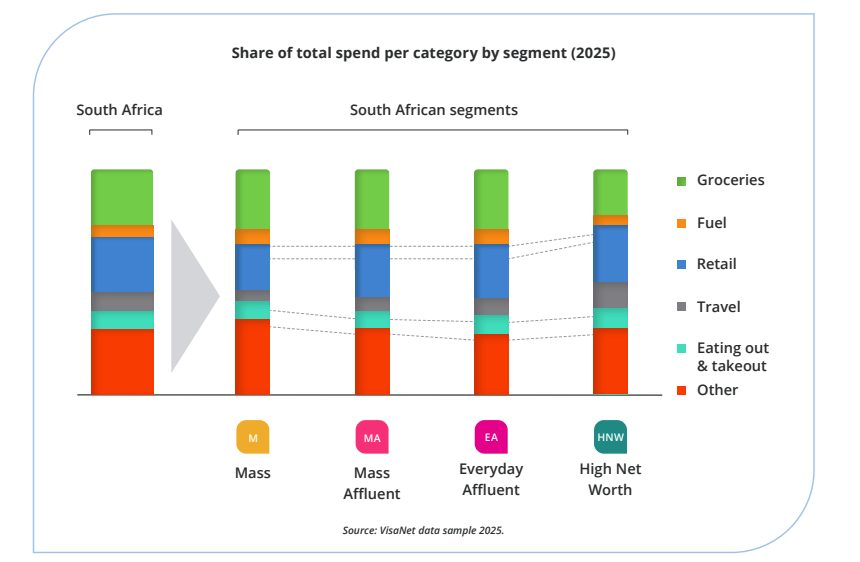
Rich South Africans spend a disproportionate amount of money on travel and retail spending, excluding groceries, in comparison to the national average.
These differences are made more stark when comparing the spending behaviour of rich South Africans to that of lower-income individuals.
Lower-income South Africans, termed the ‘mass market’, spend a relatively higher proportion of their income on groceries and fuel in comparison to wealthier individuals.
The South Africans in between these two, the middle-class, spend a higher proportion of their income on fuel and groceries relative to the national average.
This points to a familiar trend in South Africa, where wealthier individuals can live a relatively comfortable life as spending on basic necessities eats up less of their disposable income.
Discovery Bank and Visa revealed this data in the latest SpendTrend26 report in April, with it providing a comprehensive overview of spending behaviour in South Africa.
The report is built on data from 2.6 billion transactions across 20 million Visa credit cards, as well as exclusive Discovery Bank client data.
Same as the SpendTrend25, this year’s report was supplemented by a survey of 1,000 South Africans earning more than R100,000 a year to get a broader view of spending patterns in the country.
Discovery Bank noted that the main trend in the data is that cost pressure continues to shape spending behaviour, despite lower inflation and falling interest rates.
Consumers continue to focus on everyday essentials while seeking better value from discretionary spending.
Groceries, retail, travel, eating out and takeaways, and fuel together account for the bulk of spend, underscoring how strongly everyday living costs continue to anchor household budgets.
Rather than cutting spending, South Africans adjust where and how often they spend to maximise value from promotions and sales.
The vast majority of respondents reported being concerned about rising prices for everyday essentials, despite the lower inflation and declining interest rates seen in 2025.
Where South Africans spend their money can be seen in the graph below.
High-income vs low-income
In a continuation of historical trends, wealthier South Africans continue to spend a disproportionate share of their income on travel and retail.
Retail in this regard excludes groceries, which make up a markedly smaller proportion of wealthier South Africans’ spending compared to the average.
“As expected, spending across income segments remains concentrated in a handful of major everyday categories,” Discovery Bank CEO Hylton Kallner said.
“Groceries, retail, travel, eating out and takeaways, and fuel together account for more than 70% of total spend.”
What is vastly different is the mix of spending, with groceries being the largest category for the mass market and the middle class. This is not the case for high-income earners.
These patterns suggest that while everyday costs continue to anchor household budgets, higher-income consumers retain greater flexibility in how they allocate discretionary spending.
One area in which all South Africans are increasing their spending is travel, with it recovering to surpass pre-pandemic expenditure levels.
“Travel spending increased across all income groups in 2025, signalling continued recovery in mobility and leisure activity,” Kallner said.
“Growth was strongest among higher-income segments, with High Net Worth consumers recording annual growth of 11%, while Mass Affluent and Everyday Affluent consumers both grew by 9%.”
The SpendTrend26 report also looked at spending data in South African cities to compare how individuals in different parts of the country spend their money.
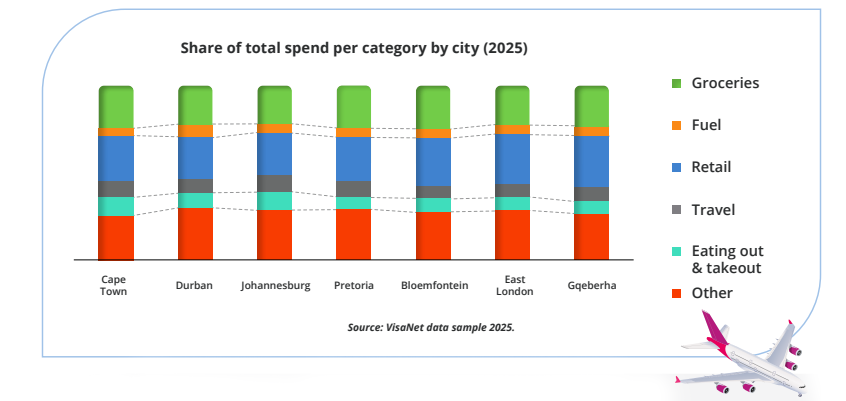
Discovery Bank compared spending across South Africa’s major metros – Johannesburg, Durban, Cape Town, and Pretoria – and selected secondary cities, such as Bloemfontein, Gqeberha, and East London.
In South African cities, food, including groceries, eating out, and takeout, accounts for the largest portion of spending.
However, Johannesburg residents spend a lower share on groceries and more on shopping, eating out and takeout compared to those in Durban and Cape Town.
Residents of coastal primary cities like Durban and Cape Town have a wider variety of social activities outside of dining out.
People in Bloemfontein, East London, and Gqeberha spend a more significant share on food and fuel but less on travel, eating out, and takeout compared to those in Johannesburg, Durban, and Cape Town.





Comments