Eskom is getting replaced by its own customers


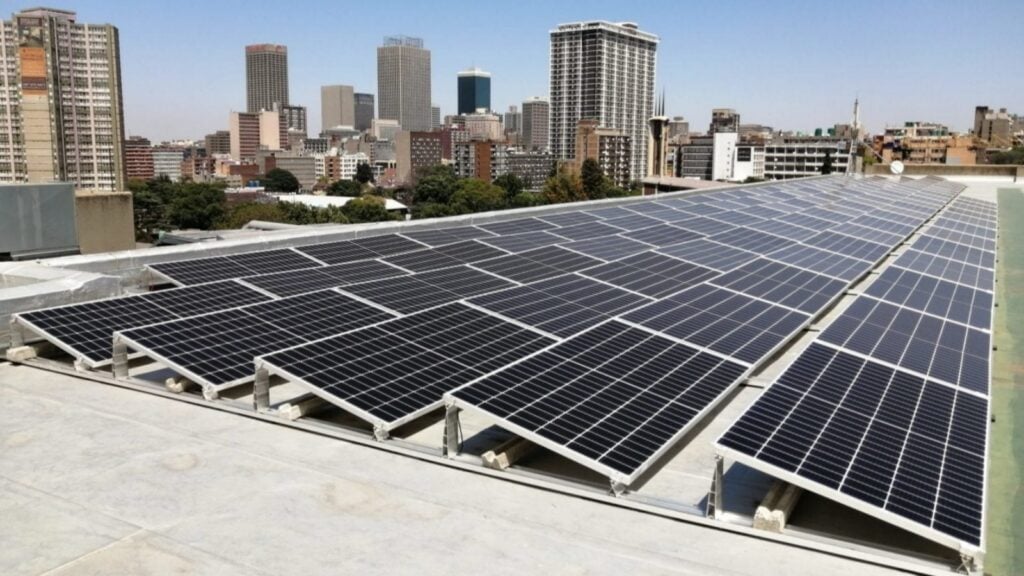
Eskom’s electricity sales continue to decline year-on-year as more businesses and households across South Africa move towards self-generation.
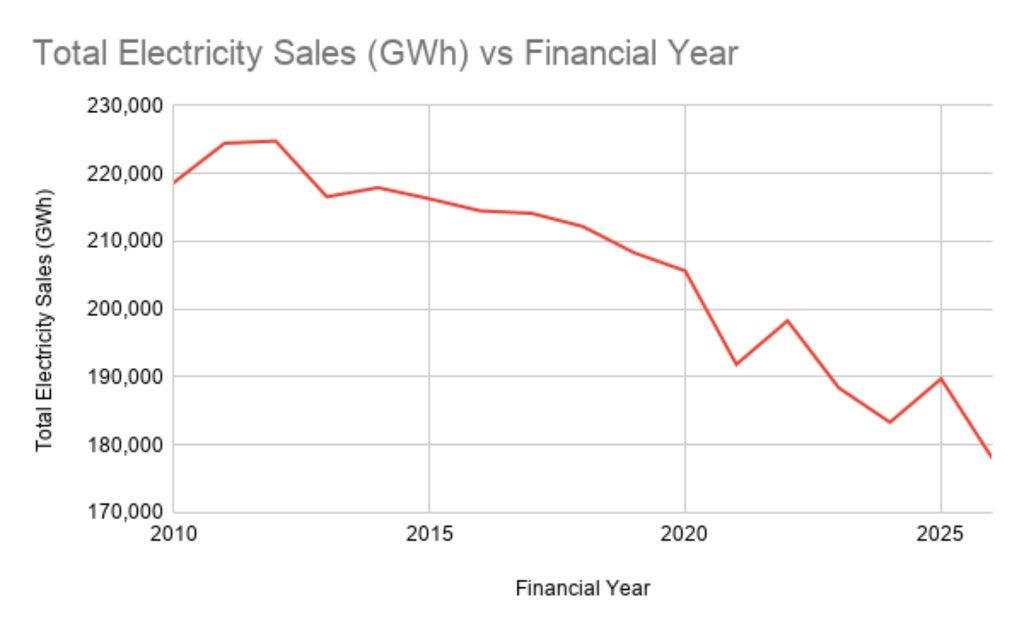
In the power utility’s results for its 2026 financial year, it recorded total sales volumes of 178 TWh, a 6.2% decline from the year prior.
This is the lowest annual sales volume recorded by Eskom since 2000, when its total sales that year were also 178 TWh.
This decline was most pronounced in the industrial sector, which saw a 22.5% year-on-year reduction of 9.7 TWh in the 2026 financial year.
Eskom chief financial officer Calib Cassim described this drop as a “serious signal” in the context of a longer-term sales decline of 2% per annum.
“Demand from energy-intensive industrial smelter customers weakened materially under economic pressure,” Cassim said.
“Meanwhile, embedded self-generation continues to reshape how and when our customers draw power. We recognise that tariff increases alone cannot secure Eskom’s future.”
With the publication of its latest results, Eskom estimated that the total installed rooftop solar capacity behind the meter in South Africa had reached 9.1 GW.
As more households and businesses across the country moved away from Eskom’s electricity towards generating their own, this has reduced demand on the national grid.
For the first time in a decade, the power utility reported an electricity surplus of 2-3 GW over the next few years.
Eskom has attempted to regulate the shift towards solar, requiring all solar users in South Africa to register their small-scale embedded generation (SSEG) systems with the utility.
However, groups such as the Organisation Undoing Tax Abuse have cautioned that South Africans are not legally required to register these systems.
Energy expert Chris Yelland, meanwhile, has called out the solar registrations as a means for Eskom to generate more revenue as its sales continue to decline.
This is done through converting registered solar users to a more expensive electricity tariff, which has a substantially higher fixed monthly charge.
The reason behind the solar shift
Despite Eskom’s electricity sales declining consistently over the past 15 years, the company’s revenue has continued to climb.
Total electricity revenue at Eskom rose from R69.9 billion in 2010 to R353 billion in 2026, an increase of over 400%.
This has been mainly attributed to an unsustainable upward trajectory in electricity tariffs, which have risen sixfold over the last 16 years.
The central driver behind these increases has been Eskom’s ongoing attempt to achieve cost-reflectivity, where its tariffs generate enough revenue to cover operating costs.
Historically, electricity tariffs approved by the National Energy Regulator of South Africa (Nersa) have lagged behind Eskom’s actual cost of supply.
“The lack of cost-reflective tariffs has been an ongoing challenge since 2006 and one of the main reasons for our financial challenges,” Eskom said in 2022.
“This has required increased reliance on debt to fund the annual shortfall, which, together with our new build programme, has led to our gross debt securities and borrowings balance escalating.”
Between 2005 and 2022, Eskom’s state-guaranteed debt rose from R29 billion to R396.3 billion, with much of this going towards its Medupi and Kusile stations.
The steep rise in electricity tariffs, coupled with persistent load-shedding over the past two decades, has driven even more South Africans to seek alternative energy solutions.
Yelland previously described this as a “classic utility death spiral”, with a decline in demand for Eskom’s electricity leading to higher energy prices.
While lower demand would usually lead to lower prices, Nersa’s pricing policy allows Eskom to raise prices to recover revenue lost due to lower demand.
As prices rise, demand continues to drop as more people and businesses look for alternative energy sources, causing prices to keep rising even higher.
“We all can see the prices of electricity are going up as Eskom struggles to cover the loss of revenue as a result of demand destruction,” Yelland said.
“This is driving Eskom to the brink, and it doesn’t help putting your prices up anymore because it causes demand to go down, and they put up prices even more.”






Comments