The private sector is the only thing creating value in South Africa



The government is a net destroyer of value in South Africa due to its historic mismanagement and reliance on borrowing.
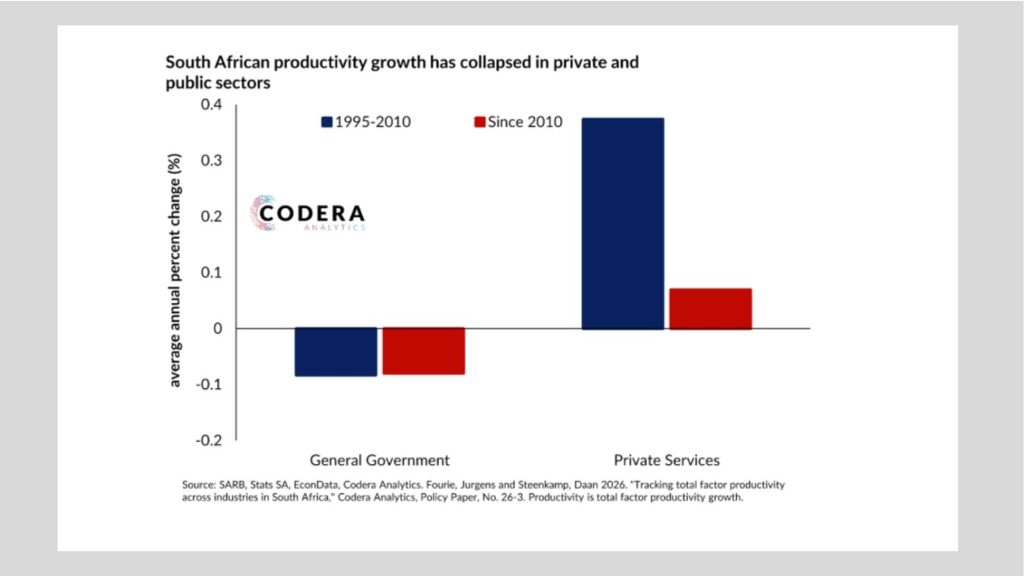
In contrast, data from Codera Analytics shows the private sector has been a net creator of value in South Africa since 1995 and is the main driver of employment and GDP growth.
However, since 2010, the private sector’s productivity has collapsed as businesses have held off on investment in infrastructure, equipment, and machinery.
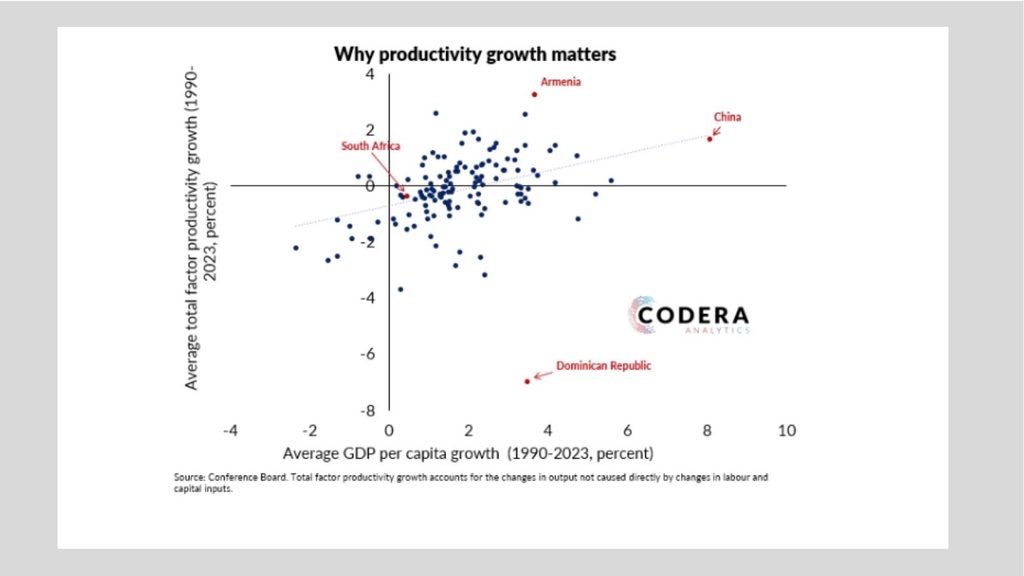
This spells significant trouble for South Africa over the long run, as productivity is the main determinant of a country’s economic growth rate and per capita income.
Codera’s data show that the government has been a net negative creator of value since 1995, with its productivity improving only marginally since 2010.
The impact of the state’s productivity decline is not limited to the government. It has negative spillover effects on the broader economy.
For example, the collapse of Eskom and intense load-shedding did not only affect the state-owned company and the government. It crushed the entire economy’s output.
The same can be said for the logistics bottlenecks at Transnet, the failure of the Post Office, and the collapse of South African Airways.
Codera’s report on productivity, published in February, places the blame on a strange paradox in government since 1994.
Under ANC rule, South Africa has seen a rise in state interventionism, occurring simultaneously with a decrease in actual state capacity.
In effect, a less capable state has played a larger role in South Africa’s economy, overwhelming it and resulting in economy-wide declines in productivity.
This has been coupled with rising regulatory compliance costs and municipal mismanagement that Codera says amounts to a tax on private business.
By far the largest driver of negative government productivity has been the collapse of several state-owned enterprises (SOEs) since 1994.
Despite huge investments in these companies, rising salaries, and widening authority, the output of SOEs has steadily declined.
While there have been some improvements, the decline in output remains. Eskom produces less electricity than it did a decade ago, and Transnet handles less cargo.
Ultimately, Codera argues that the root cause has been the state’s interventionist policy, which has prioritised redistribution over efficiency.
Private sector collapse spells trouble
For the first 15 years of democratic South Africa, the private sector’s surging productivity offset the steady decline in state output.
Private sector productivity grew at an average annual rate of 0.4% from 1995 to 2010, pushing economic growth to an average of above 4% in the 2000s.
However, since 2010, private productivity growth has averaged less than 0.1% per annum, plunging amid extreme government mismanagement.
Codera explained that it is almost a natural law of private enterprise to grow, with companies investing in expansion and absorbing rising inflation-driven prices.
For the private sector not to grow and expand, something severe has to happen in the environment in which it operates.
Since 2010, the private sector has not invested in the country’s capital stock, which includes machinery and equipment.
Over the past 16 years, there has been zero growth in the inflation-adjusted value of South Africa’s capital stock as investment has been too low to outpace inflation.
Codera explained that much of the ‘new’ capital invested by the private sector has gone to replacing ‘old’ capital, rather than adding to the overall stock.
Economists refer to this as maintenance investment, describing businesses that invest in keeping their doors open and operating rather than growing their operations.
Ultimately, this is a function of declining business confidence, with the private sector being unwilling to invest in South Africa amid elevated uncertainty and stagnant growth.
Codera also noted that the collapse of SOEs, given their important role in the local economy, has made it increasingly difficult for businesses to operate in South Africa.
Worryingly, as SOEs have collapsed and state capacity has declined, the government has tried to expand its role in the economy.
The rise in state intervention, typically through regulation, has occurred alongside a notable collapse in state capacity. This generates high compliance costs for businesses.
The collapse of SOEs has also left local businesses energy-constrained and unable to get products to international markets, limiting growth and investment.





Comments