Behind-the-scenes revolution at Standard Bank



Standard Bank is quietly revolutionising how it serves clients across Africa, creating what it calls “One Standard Bank”.
This is the term the bank uses to refer to its strategy of ensuring that the services a client accesses in one country are replicated in another, and the client feels as though they are engaging with one institution.
On the surface, this may seem simple and obvious for banks, but it requires a lot of heavy lifting behind the scenes, given the diverse jurisdictions and regulatory environments across Africa.
Standard Bank has built itself as a pan-African institution since the 1980s, when it separated from Standard Chartered and lost its African presence.
CEO Sim Tshabalala is fond of telling the story of how the bank, under Dr Conrad Strauss and Eddie Theron, built the continent’s biggest financial services business.
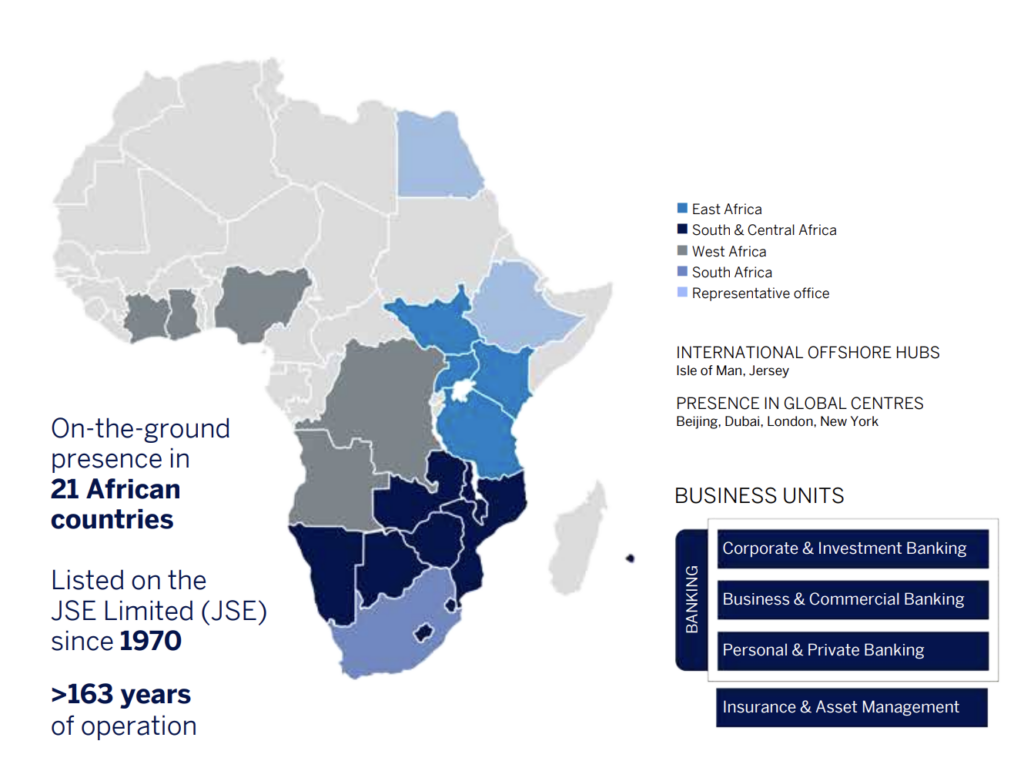
The bank has grown from the 1988 acquisition of Union Bank in Eswatini to operating in 21 markets across the continent and 4 global hubs.
In its latest interim results, the bank revealed that its Africa Regions business contributed 40% of headline earnings, which is up from 25% a decade ago.
Crucially, this business is immensely profitable, with a return on equity of 27.2% compared to the bank’s group-wide ratio of 19.8%.
The bank is not resting on its laurels, having invested heavily in creating platforms through which it can offer unified services across the continent.
The buyout of Liberty’s minority shareholders in 2022 also enables the bank to provide integrated financial services, fulfilling a client’s needs from lending through to life insurance.
“What is now emerging is that customers rely heavily on trust to make decisions about where to keep their full set of payments, deposits, insurance, and wealth products, among others,” Tshabalala told Daily Investor.
“Trust in that is fundamental. For this to be done well and at a cost acceptable to clients, you need scale. That is in the nature of our business.”
Tshabalala explained that while Standard Bank operates and competes through its four business units, the underlying products are the same – payments, deposits, lending, and insurance, et cetera.
This organisational design gives the bank a tremendous edge, if it gets it right, in integrating its offering across Africa to deliver the same experience to clients across the continent.
What ‘One Standard Bank’ means
For the customer, the outcome is relatively simple. There is less friction, and all financial services are available in one place.
This is the ‘Holy Grail’ for any financial institution, as it can sell multiple products to a single customer, hook them into its ecosystem, and diversify its income streams.
For banks, central to this is bundling insurance and asset management services, as this provides annuity-type income outside of banking activities that are typically capital-intensive.
This improves profitability and reduces the bank’s overall exposure to interest rate fluctuations, which strongly influence lending growth and income.
“If you can work seamlessly across the organisation, then we get economies of scale and scope, which is why you want to compete on the basis of an integrated financial services organisation,” Tshabalala said.
“When you buy your home, it’s simpler, better, and faster for you to get the insurance, loan, and protection all in one place. There is less friction for the client.”
Another example the CEO pointed to is Standard Bank’s prestigious Corporate and Investment Banking (CIB) division, which can create long-term relationships with companies and grow.
“It is important to operate closely because this is a continuous process of raising funds, lending, and investing on a long-term basis,” Tshabalala said.
“This is one of our differentiators: We are able to meet any business where they are and offer a full range of services.”
To explain the difficulty of this, Tshabalala used the example of Heineken, a major multinational operating across Standard Bank’s portfolio.
“You have got to find a way of delivering products seamlessly across that network so that when somebody gets a credit facility in Nigeria, it has the same feel as if they were in Johannesburg,” he said.
“Heineken wants to be serviced the same wherever they are on the continent, regardless of the regulatory difference or legal framework.”
“It is the same from the individual through to the corporate. The tricky thing is you have to have an independent board and management team on the ground that can work with headquarters.”
“It is a very difficult thing to get right. It requires extraordinary amounts of energy and time to get right. But if you do, it is very valuable.”






Comments