Telkom is coming after Vodacom and MTN in South Africa’s small towns and cities


Telkom said it is gaining market share in non-metro regions of South Africa, as part of the company’s country-wide regional strategy.
The strategy aims to increase Telkom’s share of acquisitions and gain market share, as the telecoms giant has fallen behind its larger competitors in recent years, especially outside major urban areas.
On Monday, 3 August, Telkom released a trading update detailing its performance in the first quarter of its 2027 financial year.
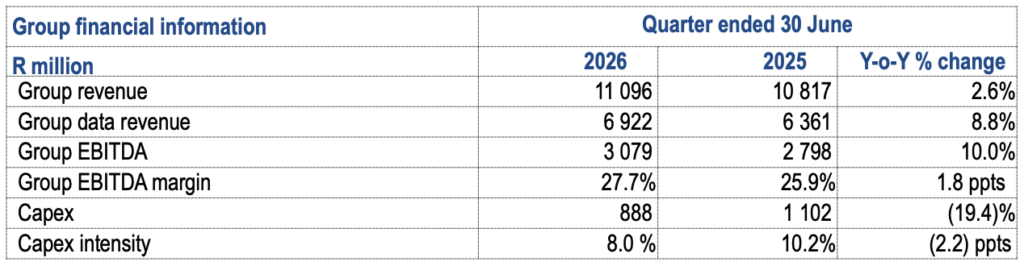
This covers the three months through 30 June 2026, which saw Telkom record a 2.6% increase in revenue to R11.1 billion.
The growth was primarily driven by strong data revenue, up 8.8% to R6.92 billion. Data revenue now accounts for 62.4% of Telkom’s total revenue.
This strong growth was bolstered by an 11.4% rise in mobile data revenue and a 4% increase in fibre-related data revenue.
Telkom’s prepaid service revenue grew by 9.1%, and was the main driver behind its 6.4% increase in mobile service revenue.
The company reported that its EBITDA rose by 10% over the three-month period, reaching R3.08 billion, with its margin now at 27.7%.
This strong earnings growth was largely driven by the increased revenue, though Telkom CEO Serame Taukobong also attributed it to the company’s cost-cutting measures.
One weak point in Telkom’s first quarter results was the same issue that has plagued its past few financial years: BCX.
Taukobong said BCX continued to experience revenue pressure, attributing it to a revenue decrease in Converged Communications, as well as IT hardware and software sales
“As expected, subdued performance in BCX remains, while the new management continues the reshaping of the business,” he said.
“BCX turnaround requires time, and the new leadership has commenced with repositioning and reassessing the IT product portfolio.”
Telkom’s regional strategy
In its outlook for the rest of its 2027 financial year, Telkom said its data-led strategy is expected to continue driving expansion, while cost optimisation initiatives remain a key focus.
“Our OneTelkom approach is delivering on its promise, reinforcing our leadership in digital infrastructure and strengthening our role as the backbone of South Africa’s digital future,” it said.
Telkom is particularly optimistic about the growth prospects for prepaid in its Mobile business, given the execution of its countrywide regional strategy.
This strategy served Telkom well in its 2026 financial year, when the company attributed its double-digit prepaid revenue growth to this regional approach.
Now, Telkom wants to keep this momentum going into its 2027 financial year, aiming to gain market share in under-indexed and underserved regions.
Historically, Telkom’s mobile network has been concentrated in major urban areas like Gauteng, Cape Town, and Durban, but the company is now looking to expand its reach.
This will put the state-owned telecoms company in competition with Vodacom and MTN, which have already expanded beyond urban and metro areas.
So far, Telkom’s strategy is paying off well. The company said this plan increased its share of acquisitions and helped it gain market share in the first quarter.
This also led Telkom to achieve double-digit revenue growth in non-metro regions, with the company expecting this to continue as the year progresses.
“Accordingly, service revenue is expected to grow in the mid-single digits, potentially trending above the upper end of the range,” it said.
“Our focused strategy remains on driving deeper regional penetration, delivering differentiated data-led propositions and scaling margin-enhancing beyond connectivity solutions.”
Telkom said this is all underpinned by its continued investment in a strong mobile and fibre network.
The network, it said, is sustaining the company’s growth momentum and strengthening its competitive position in the market.
Telkom’s capex was 19.4% lower in the first quarter of its 2027 financial year compared to 2026, though the company said it would ramp up spending for the remainder of the year.
The capex in the first quarter was aimed largely at the Mobile business, where R421 million was invested to expand network capacity and upgrade base stations.
As a result, 84 sites were added during the quarter, increasing Telkom’s network footprint in its Mobile division to 8,504 base stations.






Comments