One industry where the government pays R300,000 to keep each worker employed


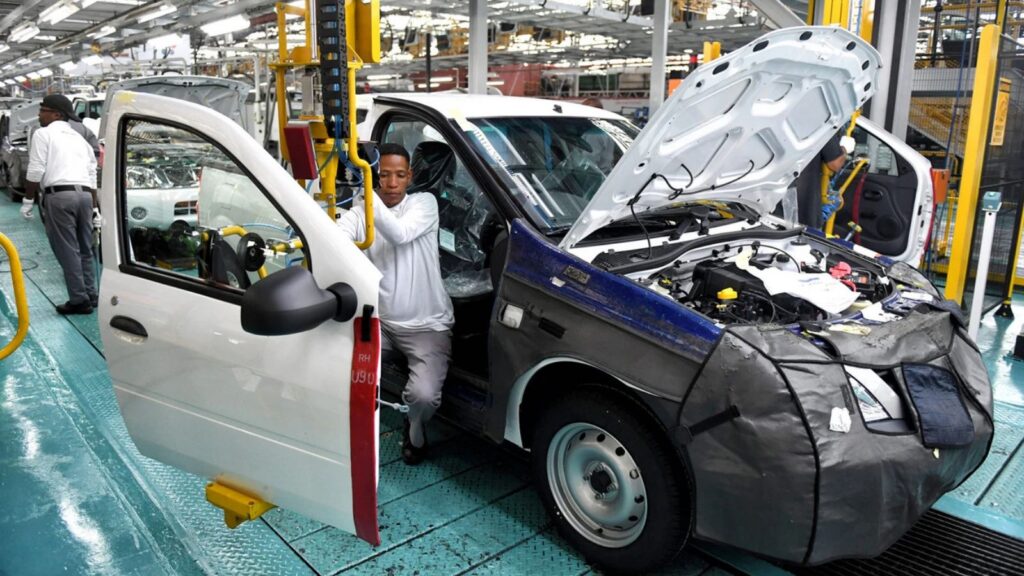
The South African government supports the automotive industry to the extent that each job in the sector effectively costs it R250,000 to R300,000.
This sector received generous preferential tax treatment to encourage local production and employment as part of the state’s industrial policy.
The support has largely been effective, with it being one of the few examples of successful industrial policy in South Africa.
Automotive manufacturing is not seen in South Africa as a normal industry, with it being considered a pillar of the economy.
This is because the sector is employment-intensive, with a significant job multiplier, and provides a key source of foreign exchange earnings from exports.
It is estimated that for every job created in the automotive assembly line in South Africa, another three to five indirect jobs are created across the broader economy.
These jobs come in the form of opportunities in the logistics sector, steel and aluminium supply, engineering, retail, and servicing.
The government has placed increasing emphasis on localisation efforts for manufacturers in South Africa to encourage them to source parts and supplies within the country’s borders.
This is seen as the next stage of its South African Automotive Masterplan 2035, with the country already having the likes of Toyota, Ford, BMW, and VW manufacturing vehicles locally.
Many of these vehicles are for export, generating valuable foreign exchange earnings to boost the rand through the balance of payments.
While the sector only generates around 1% of the country’s GDP, it is by far the largest manufacturing contributor, and accounts for 12% to 14% of total export earnings.
Despite this success, there are questions being raised about the extent of government support required to keep the sector operating.
While its economic contribution is small, it receives significant preferential tax treatment to encourage local production.
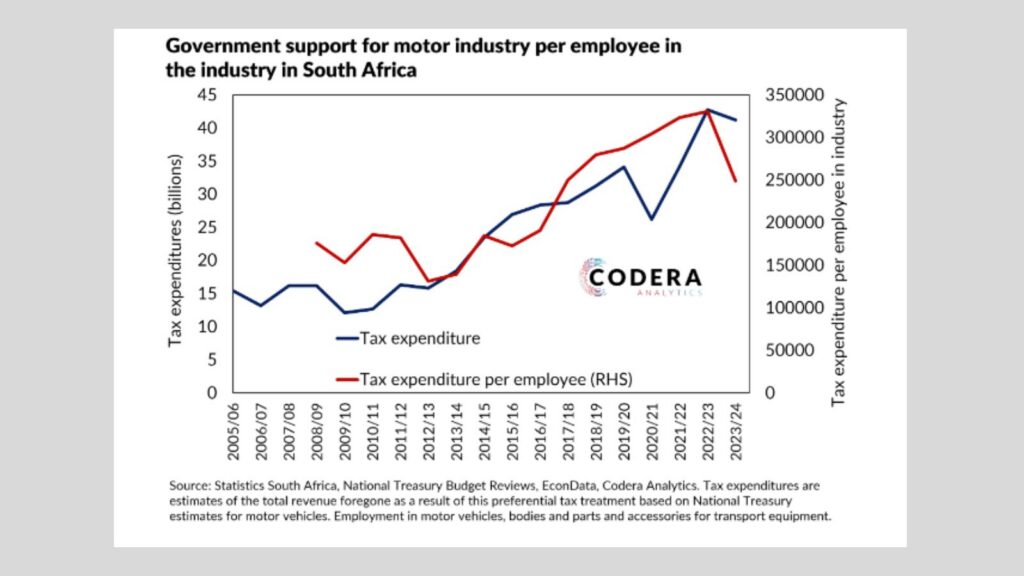
This tax treatment equates to over R40 billion in lost tax revenue, Codera Analytics revealed. This equates to 0.6% of GDP.
To emphasise this cost, Codera compared the lost tax revenue to the number of jobs the sector supports, with it employing around 100,000 South Africans directly and in the manufacturing of parts and accessories.
This results in the state effectively losing R250,000 to R300,000 in tax revenue per job created in the automotive sector. This can be seen in the graph below, courtesy of Codera Analytics.
Under siege
The automotive industry in South Africa is under significant pressure, with the rise of Chinese brands and electric vehicles (EVs) threatening to put it out of business.
These trends have been coupled with tariffs on exports to the United States, which is a major market for some local manufacturers.
In particular, the majority of Mercedes-Benz production from Port Elizabeth (now Gqeberha) is sent to the United States. This factory has been effectively closed since tariffs were first announced on South African products.
Coupled with this has been the past decade of declining service delivery in South Africa, with energy insecurity, rising electricity prices, and water shortages impacting manufacturers.
BD South Africa automotive sector leader Siyabonga Mthembu explained that the sector is at a crossroads with survival on one side and shutdown on the other.
“Of concern is that, as a country, we’ve not yet effectively addressed the basics that are critical to ensuring a conducive investment climate for the automotive manufacturing sector,” Mthembu said.
“As if this wasn’t enough, the sector now faces an onslaught from imports of Chinese and Indian vehicle models.”
Mthembu said that the emergence of these imports has resulted in South Africa’s completely knocked down (CKD) mix deteriorating dramatically.
CKD refers to vehicles that are completely assembled in South Africa, which is the most beneficial form of automotive manufacturing for the local economy.
This mix has plunged to below 50% inr ecent years, with local manufacturing proving uncompetitive against Chinese and Indian counterparts.
Chinese companies enjoy significant subsidisation from their government, coupled with South Africa’s free trade of rebates and CKD options, which encourages de-industrialisation, Mthembu said.
Localisation levels have reduced by 10% since 2021, from 42% to 38% in 2023, with Tier 2 and lower suppliers significantly underdeveloped.
On the policy front, the government should impose measures to protect the automotive sector from imports, while making it easier for existing and new investors to operate profitably.
These are critical interventions needed if South Africa is to compete with countries such as Morocco, which is taking advantage of its geographical proximity to European markets.



Comments