Uber and Bolt resurgence in South Africa


South African spending on ride-hailing services, such as Uber and Bolt, is outpacing growth in fuel spend, indicating that these offerings are experiencing a resurgence in popularity.
This is part of a wider rise in alternatives to driving traditional combustion-engined vehicles, with South Africans exploring a broader mix of mobility options.
These options include electric vehicles and hybrids, as South Africans look to reduce their exposure to volatile fuel prices at the pump.
This is feedback from Discovery Bank and Visa, who teamed up to produce the annual SpendTrend26 report.
Based on 2.6 billion transactions across 20 million credit and debit cards in South Africa, the report is one of the most comprehensive analyses of consumer spending in the country.
Combined with Discovery Bank client data, the report is able to offer detailed insights into where South Africans spend their money and how they spend it.
This informs the creation of products and services that suit client needs across the Discovery Bank ecosystem and Visa’s systems.
Spending on fuel remains one of the largest categories of overall spend in South Africa, accounting for a large share of household budgets.
In particular, South Africa’s middle class spends a high proportion of their income on fuel, as they are the most likely to drive themselves to work and back on a daily basis.
Discovery Bank noted that fuel spending continued to grow in South Africa in 2025, albeit at a slower pace. Total spending volumes remain stable across card users.
This was somewhat distorted by the stability in fuel prices in South Africa over the past 12 months, due to a stronger rand and lower oil prices. This has changed in 2026.
Despite subtle shifts, fuel spending remains habitual and time-based rather than discretionary in South Africa. This reflects the essential nature of transport in the country for work and everyday commuting.
Uber resurgence and electric vehicles rise

Apart from the regularity of fuel spending in South Africa, Discovery Bank noted the emergence of other trends in this space.
In particular, the bank highlighted strong growth in ride-hailing expenditure, which is steadily eating into fuel spending.
Fuel still accounts for the majority of mobility spend, representing 82% of total combined spend. However, ride-hailing spending is growing faster month-on-month.
The bank noted that this trend was accelerating, with ride-hailing spending rising particularly strongly during the second half of 2025.
This is also borne out by the responses from those surveyed, with ride-hailing usage surging in 2025 across all users.
58% of respondents said they use ride-hailing more than they did 12 months ago, while 70% of 18- to 30-year-olds reported increased usage in 2025.
This trend is particularly strong in Johannesburg, with 67% of residents in the richest city in South Africa saying they used ride-hailing more than in the previous year.
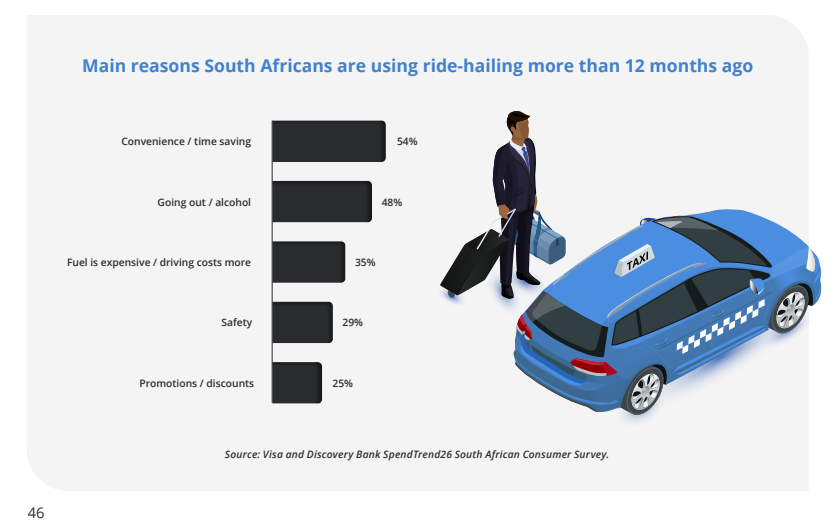
Discovery Bank said the growth in ride-hailing is predominantly driven by increased demand for convenience and time-saving. This is followed by going out or alcohol-related travel, and the rising cost of fuel.
This suggests that ride-hailing is not simply replacing private driving on price alone, but is becoming a practical solution for urban routines, social occasions, and lifestyles.
The rise in ride-hailing has been combined with increased interest in electric vehicles, with Discovery Bank flagging increased spending on charging networks.
While petrol and diesel vehicles continue to dominate South Africa’s overall fleet, electric vehicle sales are growing rapidly off a small base.
The bank noted that high fuel price volatility will accelerate interest in electric vehicles over time, while infrastructure expansion will make them more viable options.
However, the base is still extremely small, with spending data showing that electric vehicle charging accounted for only 0.5% of total fuel payment volumes.





Comments