Eskom and Transnet fighting their own privatisation


South Africa’s reform framework positions state-owned entities like Eskom and Transnet as both players and referees.
This incentivises Eskom and Transnet to put their own interests first, potentially jeopardising the pace and effectiveness of reforms, which rely heavily on private-sector participation.
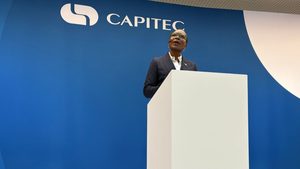
This is according to Business Leadership South Africa (BLSA) CEO Busi Mavuso, who outlined the country’s reforms progress in the BLSA’s latest Quarterly Review of its Reform Tracker.
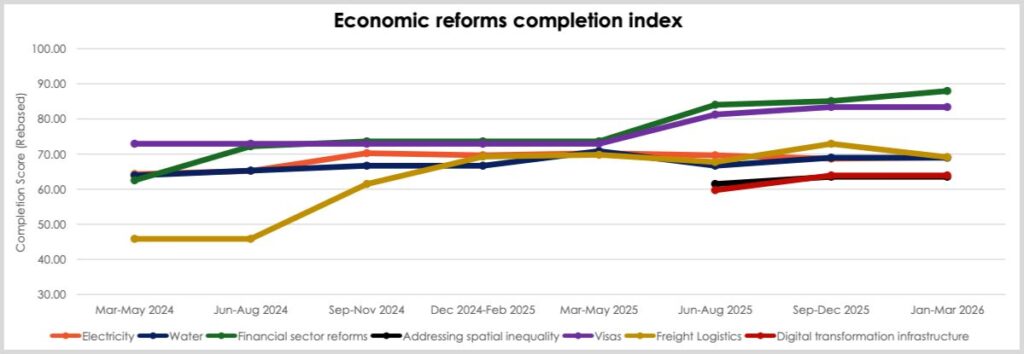
The latest Quarterly Review, covering January to March 2026, found that progress made in economic reforms slowed, largely due to a sharp fall in freight logistics.
Notably, the electricity sector saw its reform index climb over the quarter, though this was largely due to presidential intervention.
In the last quarter of 2025, reforms in this sector took a retrogressive step after Eskom and the Department of Electricity and Energy approved an unbundling strategy for the state-owned utility.
This strategy diverged from the initially agreed-upon process, which originally intended for Eskom’s transmission assets to be housed in a separate, independent company, the Transmission System Operator (TSO).
Mavuso previously warned that the new plan, which would have retained the transmission assets within Eskom, would weaken the TSO’s credibility with investors, thereby limiting its ability to attract private investment.
This investment is considered critical to ensuring South Africa’s long-term electricity security, as it will allow the country to expand its transmission grid and introduce private players to the market.
Luckily, in his 2026 State of the Nation Address, President Cyril Ramaphosa made it clear that Eskom’s unbundling would proceed as originally envisioned, with the TSO set to operate independently and own the transmission assets.
This presidential intervention allowed reforms in the electricity sector to progress in BLSA’s tracker in the first quarter of 2026.
However, Mavuso said it highlighted a bigger problem within South Africa’s reform framework, which can also be seen with Transnet’s reforms in the logistics sector.
Player and referee
The underlying reason for the setback in logistics reforms in the first quarter of 2026 is that Transnet continues to design and run private sector participation processes internally.
Mavuso said this has seen transaction terms emerge that push disproportionate risk onto private partners.
“With the infrastructure framework as it is for now, Transnet is incentivised to ensure favourable commercial terms for itself,” she explained.
Similar to Eskom, Transnet is increasingly looking to attract private sector partners to manage some of its operations, though progress in this regard is moving very slowly.
Mavuso explained that this comes down to the architecture of both sets of reforms, which is hampering progress significantly.
“The architecture of both sets of reforms, at this stage of their unbundling processes, leaves them both referee and player at the very time their industries and business units are being opened up to private sector participation,” she said.
Mavuso said this framework explicitly incentivises Eskom and Transnet to put their interests first.
“As such, we have a situation where a state entity might push back, quite rationally from their perspective, against certain reforms,” she said.
Mavuso explained that there is an “awkward point” in this transition where both Eskom and Transnet are relied on to implement reforms.
At the same time, implementing these reforms will expose both state-owned entities to future competition. “It is not a surprise that they are resisting,” she said.
Despite this, she said the most important thing is to keep the momentum going with these reforms, as the competitive markets they will create are set to lay the foundation for a stronger economy.
A stronger economy relies upon network industries that are able to provide sufficient energy to drive industrial expansion, and a transport-logistics system that can import and export products.
Crucially, Mavuso said this must all be done at competitive rates, which is where private sector participation becomes key.
“Both Eskom and Transnet will remain huge businesses right through and beyond this reform process, but if private sector participants are unable to compete on equal terms, the industry’s entire reform process will collapse,” she said.




Comments