Goodbye DStv: South Africans cut the cord



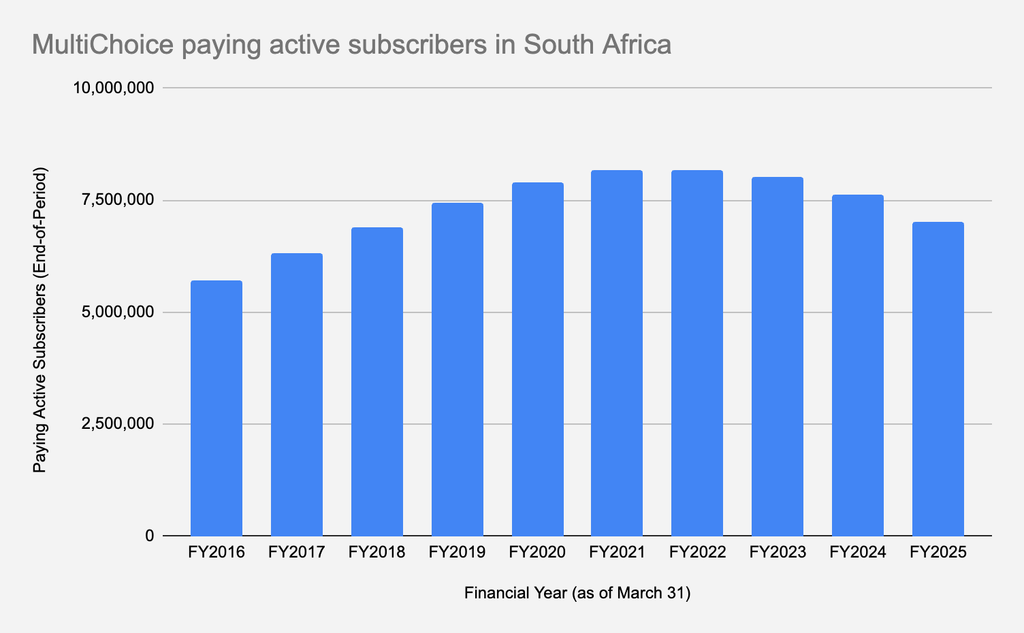
South Africans continue to dump DStv, with its subscriber numbers steadily declining over the past few years as consumers switch to streaming platforms.
These platforms are highly competitive, offering vast catalogues of content at a fraction of a DStv subscription.
While they lack live sport, they have steadily eaten into DStv’s subscriber base and its owner, MultiChoice, has been unable to respond.
Canal+, after completing the purchase of MultiChoice in 2025, has tried to revive DStv’s offering by changing its look and overhauling its product offering.
Its latest trading update for the first nine months of the 2026 financial year shows that these changes are yet to yield results in South Africa.
Canal+ reported declining subscription revenue in South Africa, continuing a trend that began in 2021. The decline in the first nine months offset revenue growth in other parts of Africa for MultiChoice.
This is a far cry from the MultiChoice of old, which enjoyed a steadily growing subscriber base thanks to its effective monopoly on live sport and high-quality TV shows in South Africa.
MultiChoice was formed out of M-Net, which was founded in 1986 by Koos Bekker. MultiChoice was established to manage subscriber services for the pay-TV operator.
In 1995, DStv was launched and revolutionised broadcasting in South Africa, giving MultiChoice an effective monopoly in the country.
Subscriber growth has grown steadily since then, generating predictable income for the business and enabling it to invest in acquiring sports rights and licensing global TV shows and movies, cementing its dominance.
In the 2010s, to maintain growth, MultiChoice began expanding into the mass market through lower-tier decoder packages.
The company also aggressively subsidised its decoders and their installation costs to lower the entry barrier for lower-income households.
This kept its subscriber base growing and was coupled with investment in exclusive sporting rights for the Premier League, Rugby World Cups, and the Olympics.
It also halted the churn of its Premium customers by freezing subscription prices, bundling Showmax, and launching mobile streaming apps.
The fall
DStv’s days of growth were not to last, with pandemic-era lockdowns proving to be the last boost for its subscriber numbers.
The company’s paying subscribers peaked in the 2021 financial year and have been steadily declining since then.
MultiChoice has attributed this to the rising cost of living in South Africa as inflation surged in 2022 and 2023, which eroded household disposable income.
It also became clear that the company’s growth in the mass market was unsustainable and was based on its Premium subscribers continuing to cover decoder subsidies for lower-income consumers.
As its Premium base came under pressure, these subsidies were removed, thereby halting MultiChoice’s mass-market growth.
This was coupled with a shift towards streaming services such as Netflix and Amazon Prime, which launched in South Africa in 2016.
The pandemic accelerated this shift, and MultiChoice’s Showmax offering has been unable to compete with the catalogue offered by global giants.
Protea Capital Management founder Jean Pierre Verster said a large chunk of DStv’s decline in South Africa should be attributed to the rise of streaming.
Verster said services such as YouTube, Netflix, and Amazon Prime Video have all drawn eyeballs away from DStv, leaving it in a downward spiral.
Its last hope is its exclusive sports rights, which give it an edge over these platforms, but with a dwindling subscriber base, these risk becoming unaffordable.
The purchase of MultiChoice by French pay-TV giant Canal+ appeared to offer a solution to these problems.
Canal+ brings scale with regard to finances to cover sports rights and scale in terms of content that can be offered through a standalone streaming service.
Canal+ tries to revive DStv

Canal+ is trying to leverage these advantages to revive DStv, with it investing in an overhaul of its product offering in South Africa.
It launched new DStv packages on 17 September, with price tiers ranging from R99 to R799 per month and including a standalone DStv Sports package at R399 per month.
This is the biggest change to DStv’s offering in 15 years, with a sports-only package going against what the company had refused to do for decades.
However, these changes are yet to reverse the decline in MultiChoice’s South African subscriber base, as revealed in Canal+’s nine-month trading update on 22 October.
This update revealed that, despite the 2026 FIFA World Cup, DStv subscriptions in South Africa continue to fall.
Africa and Asia revenue for the three months ended 30 September was up 6.9% year-on-year. On a like-for-like basis, revenue was down 0.1%.
Canal+ admitted that MultiChoice remains a laggard, with the company’s revenue declining slightly year-on-year.
MultiChoice Group revenue increased 0.4% on a restated basis, notably benefiting from a material positive currency effect.
On a like-for-like basis, revenue decreased 3%, driven by lower subscription revenue in South Africa, partially offset by higher revenue in most other English-speaking countries.
Canal+ CEO Maxime Saada remains upbeat about MultiChoice’s prospects, saying its new value proposition will halt subscriber decline.
However, Verster is not convinced. “The rebrand and repacking of DStv in South Africa has not moved the needle much. Sport is not really sport if it does not include the Springboks,” he said.
“MultiChoice will struggle to grow revenue in South Africa through DStv. It may do slightly better in the rest of Africa.”






Conversation
6 commentsTheir obsession with keeping National sports like rugby and cricket away from South Africans was a death blow. They should have opened all channels and platforms to everyone at a flat rate of R450.pm and show National sports. I dumped them at the last ridiculous price increase.