South Africans kiss DStv goodbye


Canal+, which is set to list on the Johannesburg Stock Exchange (JSE) next month, faces a serious challenge as South Africans cut the DStv cord.
On Tuesday, 12 May 2026, Canal+ announced that it will complete a secondary inward listing of its ordinary shares on the JSE on Wednesday, 3 June 2026.
“The JSE has granted approval to Canal+ for a secondary listing, by way of introduction, using the fast-track listing process,” it said.
“Canal+ shareholders are advised that their ordinary shares will be traded in South African rand on the JSE, in dematerialised form only.”
On 5 December 2025, Canal+ completed a full takeover of MultiChoice, which was followed by the delisting of MultiChoice from the JSE on 10 December 2025.
The new Canal+ secondary listing on the JSE was part of the deal’s regulatory conditions, giving local investors access to MultiChoice.
“This commitment was proposed voluntarily by the company in the context of its acquisition of MultiChoice,” Canal+ said.
As part of its pre-listening announcement, Canal+ said that the acquisition gave it unmatched scale in Africa.
“The combination of Canal+ and MultiChoice has created a market leader by revenue in around 40 countries,” it said.
“The merged entity’s greater global scale and additional resources and expertise have created significant opportunities to enhance future returns through cost reductions.”
It expects to deliver over €400 billion in adjusted earnings before interest and taxes (EBIT) and €300 million free cash flow run-rate cost synergies from 2030.
The combined entity had 42.3 million customers on 31 December 2025, which included 14.4 million DStv subscribers.
It generated 8,665 euros in annual revenue, which included a contribution of 2,400 euros from Multichoice.
South Africans are cutting the DStv cord

Canal+ is talking up the merger with MultiChoice ahead of its secondary listing on the JSE. However, it faces a serious challenge.
Many DStv subscribers in South Africa and the Rest of Africa are cutting the DStv cord and migrating to more affordable streaming services.
The impact of the migration away from DStv was clearly seen in Canal+’s trading update on 28 April 2026.
MultiChoice’s revenue declined from 657 million euros (R12.7 billion) in Q1 2025 to 617 million euros (R11.9 billion) in Q1 2026.
The lower revenue drivers include higher subsidies on equipment to new subscribers, content sales, and commissions on insurance business.
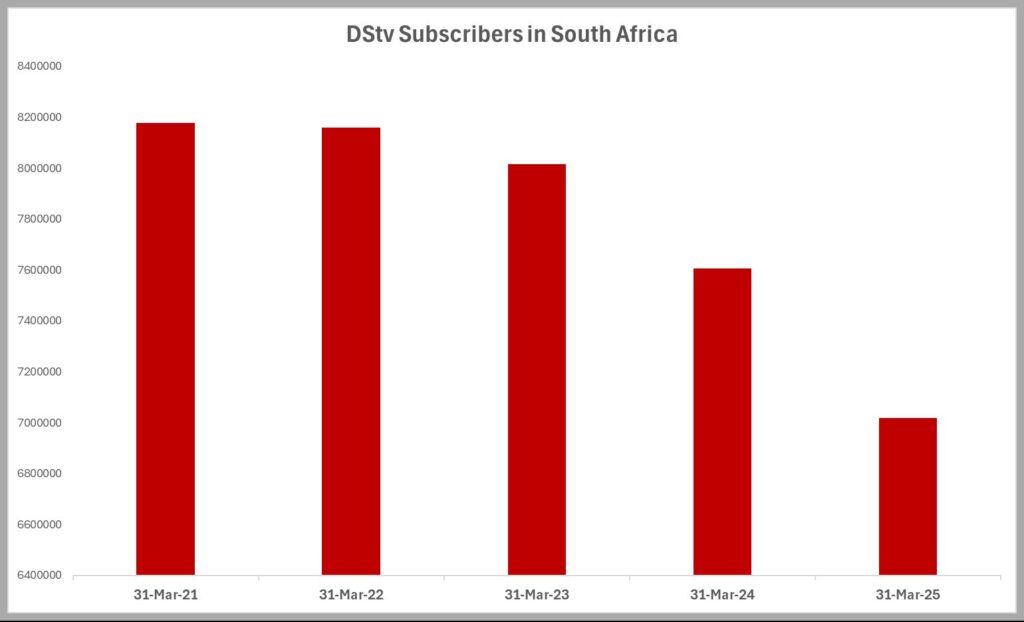
This trend is not new. Over the last financial year, MultiChoice’s DStv subscriber base declined from 14.9 million to 14.4 million.
MultiChoice’s integrated annual report for the year that ended 31 March 2025 revealed that the number of DStv subscribers in South Africa declined by 589,000.
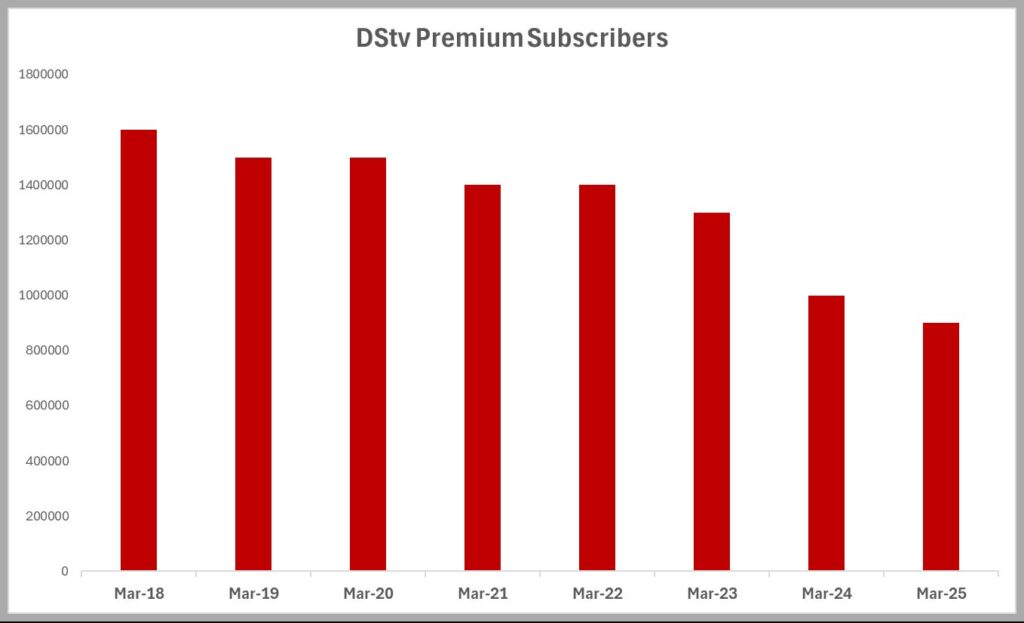
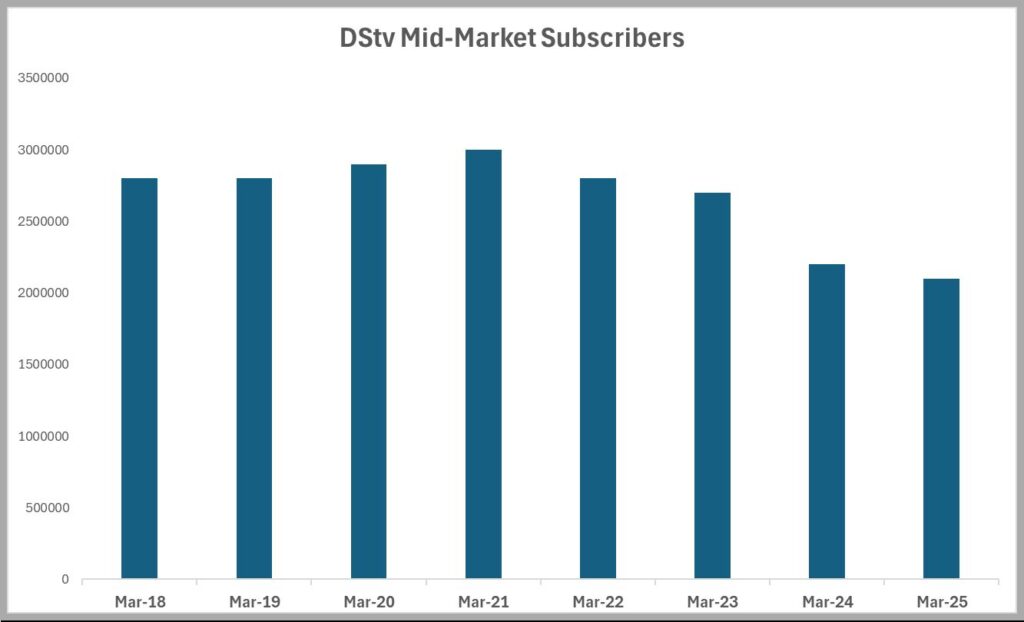
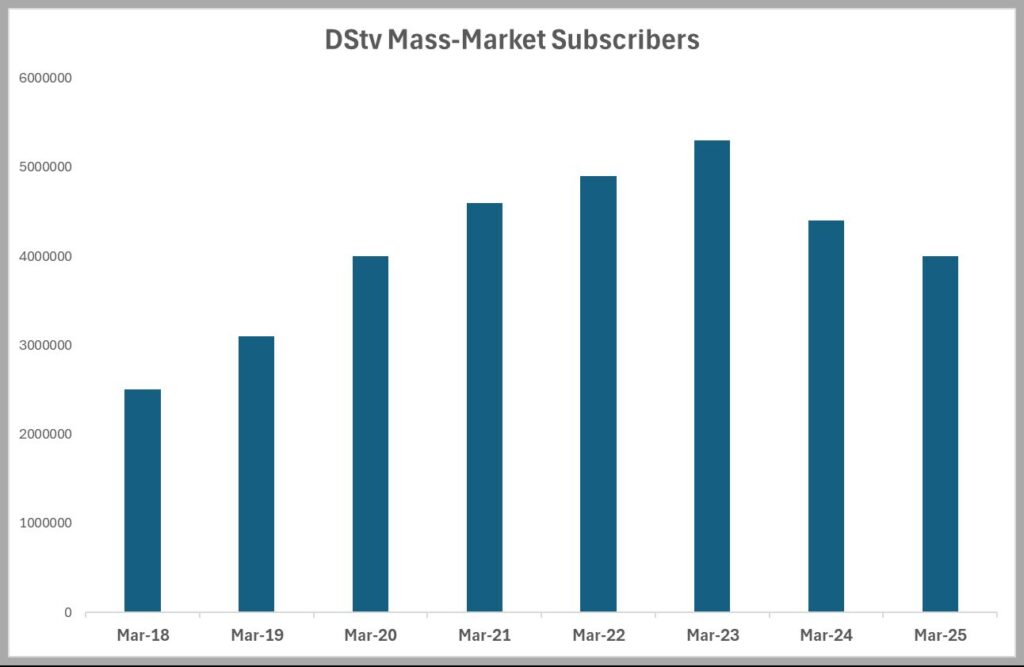
What was striking was that all segments of the DStv subscriber base declined, indicating an accelerating trend.
- The DStv Premium base, which included Compact Plus, declined by 96,000 subscribers. This represents a year-on-year decline of 9%.
- MultiChoice’s middle-market subscribers declined by 99,000, representing a year-on-year reduction of 5%.
- The mass-market tier was down by 394,000, a year-on-year decline of 9%. This is the second year it has experienced a decline.
MultiChoice reported subscriber declines in South Africa each year from 2021 to 2025, and it was likely that this trend continued into 2026.
Equally concerning was that MultiChoice’s earnings before interest and taxes (EBIT) margin of 6.6% was much lower than Canal+’s 8.7%.
With Canal+’s promotions and subsidies to attract new DStv customers, this margin is set to come under increasing pressure.
DStv subscribers in South Africa
DStv Premium subscribers in South Africa
DStv Mid-Market subscribers in South Africa
DStv Mass-Market subscribers in South Africa






Comments