South Africa’s forgotten R164 billion tax


The government’s Sector Education and Training Authority (SETA) system has received billions in taxpayer funds over the past decade, but some researchers say these funds could be far better spent elsewhere.
This is because the SETA system has proven to be inefficient and ineffective, with severe financial mismanagement.
This is according to researchers from the Bureau for Economic Research (BER), Robert Botha, Roy Havemann, and Claire Bisseker.
In a recent research note, titled ‘Time for a skills rethink – A review of the SETA system’, these researchers outlined challenges facing this programme.
Launched in 1998 as a way to address the country’s growing skills crisis and remedy the structural skills deficit inherited from the pre-1994 era, the SETA system was expected to usher in a “skills revolution”.
However, more than two decades later, this system is plagued by systemic underperformance and serious financial mismanagement.
Operationally, the researchers found that the SETA system suffers from significant “leakages”, with many learners exiting the programmes without certifications.
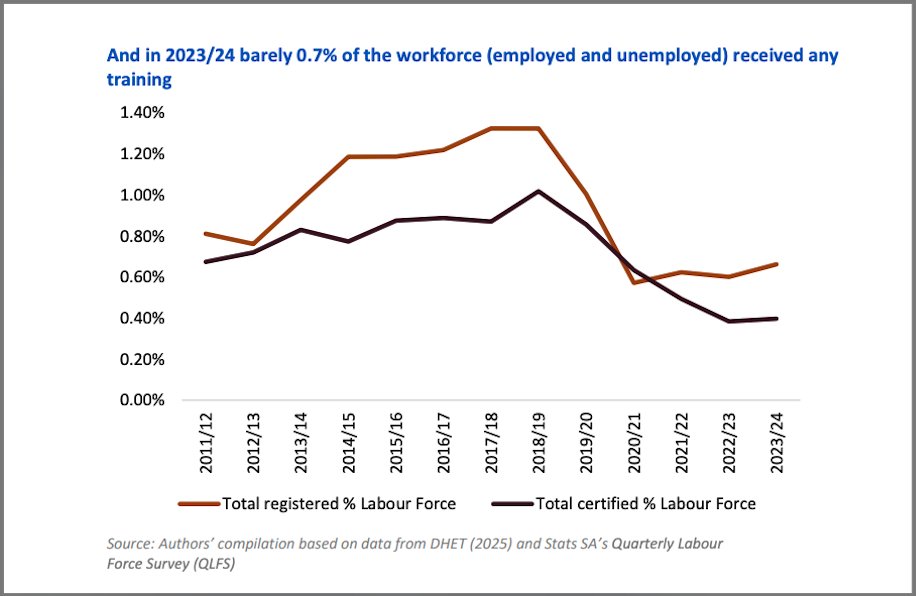
Between 2011/12 and 2023/24, the system registered 2.6 million individuals across its various programmes, with 2 million completions, meaning over 630,000 registrations did not lead to a successful certification.
The researchers said this leakage is most severe in the programmes designed to address deep skills and facilitate workforce entry.
In addition, the total number of SETA skills programme registrations in 2023/24 was only 1% of the employed and 0.7% of the labour force.
These operational issues are common among some state-led initiatives and would be less concerning were it not directly funded by South African employers.
SETA programmes are funded by the Skills Development Levy (SDL), a levy imposed to encourage learning and development in South Africa.
It is determined by an employer’s salary bill and is due by employers who have been registered. These SDLs are then distributed via SETA.
Over the BER researchers’ 13-year review period, R164 billion was disbursed from the SDL fund to SETAs.
Despite this significant annual cash injection, the SETA system continues to struggle both financially and operationally.
Underspent, overemployed, and wasted
The BER researchers found that the SETA system commands significant financial resources but is defined by inefficiency and a failure to spend its budget on its core mandate.
The system’s total revenue has consistently exceeded expenditure, leading to large net surpluses, which stood at R6.7 billion at the end of 2023/24.
In addition, cash and cash equivalents held by SETAs grew from R8.9 billion in 2011/12 to R27.1 billion in 2023/24 in nominal terms. After adjusting for inflation, they grew by 78%.
“This represents a massive opportunity cost, with billions of rands intended for skills development sitting idle in bank accounts,” the researchers said.
Despite the system’s poor performance, the researchers found that SETA administrators have significantly increased their employee headcount, from 1,716 employees in 2011/12 to 2,748 in 2023/24, up 60%.
The wage bill also grew by 12% on average annually between 2014/15 and 2023/24, significantly outpacing both average consumer price inflation (5%) and the growth of the broader public service wage bill.
The system has also received multiple audit findings, with the operational and financial
inefficiencies underpinned by systemic governance failures.
The researchers said this is reflected in an audit history that reveals a system in distress. From 2011/12 to 2023/24, across 273 individual audits, 54% were termed “unqualified with findings”, 15% were “qualified”, and 1% were issued with disclaimers or adverse audit opinions.
They said the most common outcome, “unqualified with findings”, masks significant governance problems as it indicates that, while the entities’ financial statements are reliable, they persistently fail to comply with key legislation.
According to the Auditor-General, there is also evidence of a cumulative R9.15 billion in irregular expenditure over the 13-year period under review.
This represents 5.5% of the total revenue SETAs received from the SDL over the 13-year period.
An additional R274.9 million of fruitless and wasteful expenditure was incurred over the same period, which represents money spent in vain due to negligence and is a severe indictment of operational competence.
“The SETAs are currently not spending their entire allocations with excess funds accumulating in growing surpluses and cash reserves,” the researchers said.
“This is the worst of both worlds – the cost of employment has increased, and the money is simply going into a SETA bank account. This increases unemployment without the offsetting benefit of an increase in skills.”