Eskom reaping the benefits of one man’s work


Eskom’s performance has dramatically improved over the past two years, with the utility’s intense focus on maintaining its power plants bearing fruit.
This has been led by Eskom’s Group Executive for Generation, Bheki Nxumalo, who was appointed to his current position in 2023.
Nxumalo took on responsibility for the utility’s Generation Recovery Plan, which has been widely identified as the plan behind Eskom’s improved operational performance.
The utility’s CEO, Dan Marokane, and chairman, Mteto Nyati, have received the most praise for the load-shedding reprieve. However, they have both said Nxumalo deserves credit.
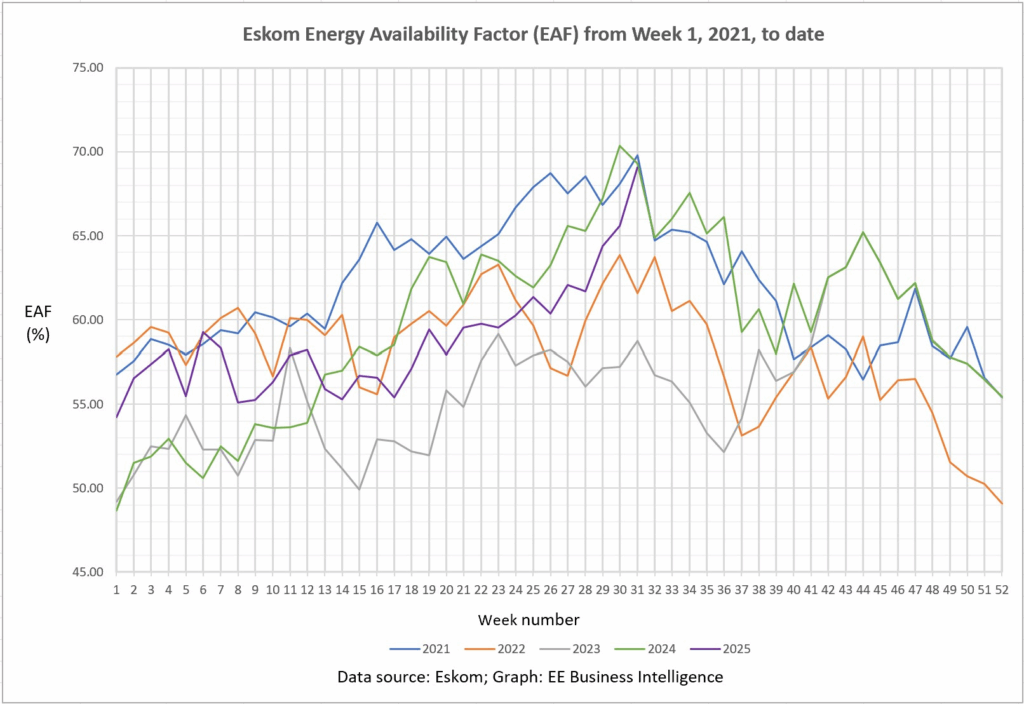
Eskom’s turnaround since March 2023 has been impressive. In early 2023, the utility recorded an energy availability factor (EAF) of 48%.
Just over two years later, Eskom’s EAF has reached 69% across its fleet, with the majority of its power stations exceeding the utility’s target of 70%.
This improvement is one of the major reasons why load-shedding has become significantly less severe in South Africa and is considered a thing of the past by some.
Coupled with significant investment from private companies and households in alternative energy sources, load-shedding has been kept at bay for all of winter so far in 2025.
Electricity Minister Kgosientsho Ramokgopa recently explained what has changed at Eskom’s power stations under Nxumalo’s leadership to drive this turnaround.
Ramogkopa told Newzroom Afrika that it was vital to ensure that the role of Group Executive for Generation was filled by a competent individual with vast experience in the electricity sector.
He explained that Nxumalo has an appreciation for what was technically required to improve the performance of Eskom’s power stations, including an understanding that you have to invest in them.
“There was an appreciation that you needed money to get these machines going. You needed to have the space available to invest in their maintenance and technical requirements,” Ramokgopa said.
“You also needed to make sure that you coordinate the rate at which you schedule taking units offline and how long they remain offline to ensure the maintenance is adequate.”
Eskom has had a historical problem with poor maintenance and an inability to efficiently bring units back online. Many of the units would also trip relatively quickly after being repaired.
Nxumalo and Eskom were willing to take units offline for extended periods of time to ensure proper maintenance was done to improve their performance sustainably.
“Previously, I have made this point that it was short-term pain for long-term gain. We went through periods of elevated load-shedding to drive improved long-term performance.”
“I said, ‘We are working on these machines and the Eskom team is working on them’. We are now reaping the rewards 18 months later. It is because of the investments that were made previously.”
The graph below shows Eskom’s improved performance, with its EAF for 2024 and 2025 trending higher than in previous years. The graph is courtesy of EE Business Intelligence managing director Chris Yelland.
How Nxumalo took Eskom from zero to hero
Ramokgopa said that Eskom’s turnaroudn has created a template for how to rescue a failing state-owned enterprise (SOE).
The central part of this template is the employment of competent leadership from the board level down to power station managers.
Nxumalo has proven to be an important cog in this machine, as he is the head of the implementation of Eskom’s Generation Recovery Plan.
Before entering his current role, Nxumalo was CEO of Eskom Enterprise and Eskom Rotek Industries. He had also previously served as a station manager at two power plants.
Nexumalo has been at Eskom for over 15 years, with more than two decades of experience in South Africa’s electricity sector.
Ramokgopa explained that to bring Eskom out of its crisis, it needed leadership from individuals who had a deep understanding of South Africa’s electricity sector.
Nxumalo’s time as Group Executive for Generation has been characterised by the implementation of three principles.
The first pillar centres around Eskom’s people, with Nxumalo placing emphasis on engaging directly with employees on the ground to understand what has gone wrong at the utility’s power stations in recent years.
Staff were also encouraged to recognise and celebrate successes — no matter how small — as a way to boost morale and reinforce the importance of following standard procedures.
The second pillar, labelled ‘strategy’, is closely linked to the first. A key component involved making power station managers fully accountable for the performance of their respective plants.
As part of this strategic shift, Nxumalo spearheaded a major reshuffle of power station leadership, replacing more than 40% of managers who were not suited to their roles.
The third pillar, accountability, also ties into the first two. This also includes creating the right incentives to drive better employee performance.
Nxumalo and his leadership team introduced clear performance metrics for staff and rolled out regular performance reviews to ensure progress could be tracked and measured.
Crucially, employee performance was linked to short-term incentives to drive a rapid improvement in both maintenance and overall operational output.
Lastly, clear communication was vital — both internally and externally — to assure employees and the public that Eskom had a recovery plan in place and that improvements would be sustainable.
To support this, Eskom also prioritised people-focused storytelling to uplift employee morale and reinforce the message that the future of the utility rests in their hands.




Comments